
Quick Wins: Before You Dive In
- Stop the Dashboard Obsession: Analytics stats don't pay the bills early on; content output does.
- Embrace the 6-Month Rule: Accept that income is a lagging indicator of consistent work.
- Kill the Fluff: Focus on one niche and one traffic source—ignore the "shiny objects" that promise shortcuts.
- Build Systems, Not Hopes: Use micro-habits to ensure you show up even when you don't feel like it.
The Silent Mental Battle of Earning While You Sleep
Building an online income isn't about finding a magic "money printer" button; it’s about managing your own expectations while you wait for the math to catch up. Most people quit because they treat their side project like a sprint, not a business. If you’re tired of seeing zero in your dashboard, let’s stop guessing and look at why your brain is currently fighting your success.
This unseen pressure often ruins our daily mental peace. We become physically present but mentally absent during family dinners, our minds constantly wandering back to traffic stats and click-through rates. The constant mental exhaustion steals the joy from our everyday lives.
The truth is, this struggle has very little to do with your actual skills or your chosen niche. It has everything to do with how the human brain processes effort and reward. We are biologically wired to expect immediate returns for our physical and mental labor.
When you work a normal day job, you get a paycheck at the end of the month, creating a safe and predictable loop. Building an online revenue stream shatters this loop completely, forcing your brain into a state of panic and confusion.

The Dopamine Disconnect: Why Your Brain Hates the Early Stages
To genuinely understand why so many smart people quit their online journeys too early, we have to look closely at our brain chemistry. Every time we complete a task in our regular lives, our brain releases a tiny hit of a feel-good chemical called dopamine. This chemical is responsible for keeping us motivated and moving forward.
However, the world of online asset building operates on a deeply frustrating timeline. You might write highly helpful articles or design beautiful digital products today, but the financial reward might not arrive for several months. Your brain does not know how to handle this massive delay between putting in the effort and receiving the prize.
Because the dopamine hit is missing, your mind automatically assumes you are doing something wrong. It sends out stress signals, telling you to abandon the project and seek out a more immediate reward. This biological response is why so many beginners experience a sudden, overwhelming urge to quit after just three weeks of consistent effort.
We are actively fighting thousands of years of human evolution.
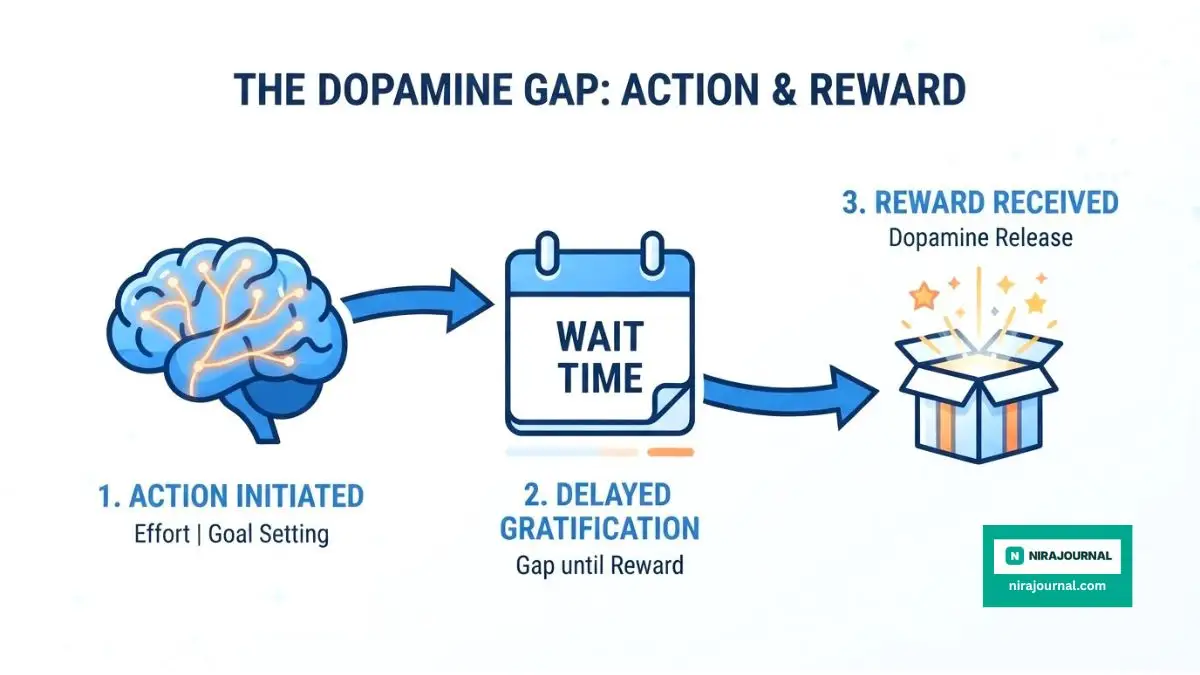
You have to realize that feeling discouraged is not a sign of weakness or a lack of business sense. It is simply a psychological mismatch between how our bodies evolved and how modern digital businesses actually grow.
To combat this natural programming, you must learn the science of delayed gratification and actively trick your brain into enjoying the daily process.
Reframing the "Set It and Forget It" Myth
One of the most dangerous concepts sold to beginners is the idea that digital revenue requires zero ongoing effort. Gurus love to paint a picture of sitting on a beach while money magically flows into a bank account. This heavily edited version of reality sets a psychological trap that almost guarantees early failure.
When you enter the process expecting easy money, every tiny technical hurdle feels like a massive roadblock. Setting up a basic website or fixing a minor formatting issue suddenly feels incredibly exhausting. Your expectations are so detached from reality that normal business tasks feel like unfair punishments.
The reality is that creating an automated income stream requires a highly intense period of front-loaded work. You are essentially building a machine from scratch. You have to gather the parts, assemble the engine, and oil the gears long before you can ever turn the key.
Instead of expecting passive results from day one, you must adopt a builder's mindset.
Treat your early months as a heavy construction phase. By simply changing what you expect from the process, you remove the emotional shock of having to work hard without immediate pay.
Watch exactly how your brain processes delayed rewards and how to hack this natural limitation.
The Danger of the Comparison Trap
In today's highly connected world, we are constantly bombarded with highlight reels of other people hitting massive financial milestones. You open a social media app and instantly see a twenty-year-old claiming to make thousands of dollars a day from a simple blog. This constant exposure completely warps our sense of a normal timeline.
We start comparing our messy, difficult "day one" to someone else's highly polished "day one thousand". This unfair comparison creates a deep sense of inadequacy and panic. You start changing your strategy every two days, hoping to find the magical shortcut that the young millionaire seems to know.
This behavior is universally known as "Shiny Object Syndrome," and it is an absolute killer of digital progress. Every time you switch to a new strategy or a new platform, you reset your progress entirely back to zero. You never give any single project enough time to mature and actually generate a return.
To protect your mental health, you have to strictly curate your digital environment. Stop following accounts that make you feel terribly anxious about your current progress. Focus entirely on your own daily actions and measure your success against who you were yesterday.
I used to check my analytics dashboard seven times a day, hoping for a miracle spike in traffic that would validate my hard work. My biggest realization came when I blocked the analytics site on my browser for a full month, which forced me to focus entirely on creating helpful resources instead of obsessing over empty numbers.
Overcoming Decision Fatigue in Your Daily Routine
When you first start building an online asset, you are suddenly forced to make hundreds of new choices every single day. You have to pick a domain name, choose hosting, select brand colors, and decide on a content schedule. Each of these small choices drains a little bit of your mental energy.
Psychologists refer to this draining process as understanding cognitive load theory, which explains why we feel physically exhausted after a long day of learning. By the time you actually sit down to do the meaningful work, your brain is entirely out of fuel. You end up staring blankly at the screen, unable to type a single helpful sentence.
To survive the early days, you must aggressively limit your daily decisions. Create a highly rigid structure for your working hours so you never have to guess what to do next. If you plan to write, decide the exact topic and outline the night before.
Here is a quick "Decision Audit" for your morning:
- Did I clear my desk last night? (Yes/No)
- Is my main topic already outlined? (Yes/No)
- Am I avoiding the "dashboard check" until work is done? (Yes/No)
- If you answered "No" to any of these, fix that before you write a single word.
Common Mistakes That Kill Your Digital Income Potential Before It Starts
Remove the friction from your work environment entirely. If your desk is messy and your computer takes ten minutes to load the right software, you are burning precious willpower just getting started. Streamline your entire setup so you can jump straight into the productive tasks within thirty seconds of sitting down.
Building Micro-Habits for Long-Term Survival
Relying on raw motivation is a terrible strategy for building anything on the internet. Motivation is an extremely unreliable emotion that disappears the moment you feel tired or hungry. If you only work on your digital assets when you feel inspired, you will never build enough momentum to see real results.
Instead of hunting for motivation, you need to focus heavily on building unbreakable micro-habits. A micro-habit is a task so incredibly small that it feels ridiculous not to do it. For example, instead of committing to writing a massive guide every day, commit to writing just fifty words.
Most of the time, once you sit down and write those fifty words, you will naturally keep going. The hardest part of the entire process is simply crossing the starting line. By lowering the barrier to entry, you trick your brain into starting without triggering any performance anxiety.
Consistency always beats intensity when it comes to search engines and online platforms.

Working for twenty minutes every single day is vastly more powerful than working for ten hours once a month. Search algorithms strongly favor creators who show up reliably over a long period.
The Sunk Cost Fallacy in Content Creation
Sometimes, the psychological trap is not about quitting too early, but rather refusing to pivot when something is clearly broken. We often pour months of effort into a specific topic or format that simply does not resonate with any audience. Because we have invested so much time, we refuse to let it go.
This mental block makes us stubbornly stick to losing strategies. We wrongly believe that if we just push a little harder, the bad idea will suddenly turn into a profitable masterpiece. This refusal to adapt is why so many digital creators stay stuck at the exact same level for years.
You must learn to separate your personal ego from your digital experiments. If a specific type of article or digital product gets zero traction after a reasonable testing period, let it die peacefully. Look at the data objectively and use that failure as a highly valuable learning tool for your next project.
Managing the Illusion of Perfection
Perfectionism is rarely about high standards; it is usually a deeply hidden form of fear. We obsess endlessly over the exact shade of blue on our website or the perfect phrasing of an introduction. We convince ourselves that we are just being professional, but we are actually terrified of being judged by the public.
This fear of judgment paralyzes beginners and prevents them from ever hitting the publish button. You have to accept that your first attempts at creating digital assets will likely be quite bad. Every successful online entrepreneur looks back at their early work and cringes heavily.
Decoding Digital Assets: A Simple Guide to Understanding Online Revenue Streams
Give yourself absolute permission to be a beginner. The internet is highly forgiving, and your early mistakes will be buried under your future improvements. The only way to get better at producing valuable content is through the messy, imperfect process of actually publishing it for the world to see.
Designing a Reward System That Actually Works
Since the financial rewards are heavily delayed, you must artificially create your own short-term reward system. If you do not celebrate the small wins, your brain will eventually refuse to do the hard work. You need to link your daily efforts to immediate, positive feelings.
Set incredibly small, action-based goals instead of outcome-based goals. You cannot control how many people click on your link today. However, you can absolutely control whether or not you spend forty-five minutes optimizing your site architecture.
When you successfully complete your daily action goal, give yourself a small, tangible reward. It could be enjoying your favorite cup of coffee, taking a quiet walk, or watching a single episode of a show you love. This tiny hit of dopamine trains your brain to associate the boring setup work with immediate pleasure.
Over time, this artificial loop becomes entirely natural. You will start to genuinely enjoy the quiet process of building and organizing your digital systems. Once you learn to love the daily grind, the delayed financial results simply become a pleasant bonus rather than a desperate necessity.
Mastering the Long-Term Mental Game of Digital Growth
To survive the quiet months of building your digital revenue stream, you need more than just a good work ethic. You actually need to change how you view yourself and your daily routine. Most beginners rely purely on raw motivation, which completely disappears the moment they face a technical glitch.
Real professionals do not rely on motivation at all. Instead, they focus heavily on shifting their personal identity to match their new goals. If you constantly tell yourself, "I am just trying to make some extra money online," your brain will treat this project like a temporary hobby.
Hobbies are the first thing we drop when life gets stressful or busy. To create lasting results, you must tell yourself, "I am a digital publisher" or "I am a digital business owner." This tiny shift in language forces your brain to take the daily tasks much more seriously.
The Psychology of Environmental Design
Willpower is a limited resource that drains very quickly throughout the day. If you have to fight distractions every time you sit down to work, you will eventually lose that battle. The secret to long-term consistency is designing an environment that makes doing the right thing incredibly easy.
If you want to write helpful articles every morning, leave your laptop open on your desk with the writing software already running. Put your phone in a completely different room to eliminate the temptation of social media. By removing these tiny friction points, you stop relying on willpower entirely.
Your physical environment heavily dictates your mental focus and emotional state. A cluttered, chaotic workspace naturally produces a cluttered, anxious mind. Spend ten minutes every evening cleaning your workspace so you can wake up to a fresh, inviting environment the next day.
Managing the "Trough of Sorrow" Phase
Every single successful creator goes through a deeply frustrating phase known as the "trough of sorrow." This is the period where you are putting in maximum effort, but your traffic and revenue are completely flat. It feels like you are shouting into an empty canyon, hoping for an echo that never comes.
Beyond Freelancing: Building Sustainable Income Without Trading Time for Money
During this phase, your brain will try to convince you that your strategy is completely broken. It will beg you to quit and go back to a safe, predictable routine. You can actually use proven cognitive behavioral techniques to recognize these negative thoughts and logically challenge them.
Instead of looking at your flat traffic graph and feeling depressed, reframe the situation entirely. Tell yourself that this quiet period is actually a blessing in disguise. It allows you to practice your skills, make mistakes, and improve your content quality without the pressure of a massive audience watching you.
Implementing a "Creator Dopamine Detox"
When we consume highly entertaining videos on social media, our brain gets flooded with cheap, instant rewards. Over time, this makes the slow, quiet work of building an online asset feel incredibly boring. You essentially break your brain's ability to focus on hard tasks.
To fix this imbalance, you must intentionally limit how much content you consume as a user. Try going on a strict digital diet where you only consume information directly related to your current project. Stop scrolling through endless feeds of other people's highlight reels.
When you remove all the cheap entertainment from your day, writing an article or designing a digital product suddenly becomes much more engaging. You retrain your mind to find deep satisfaction in the act of creation rather than the act of consumption. This single habit separates the dreamers from the actual high earners.

The Hidden Psychological Traps That Destroy New Creators
When you step into the world of online revenue, you are walking through a minefield of emotional traps. These pitfalls rarely look dangerous from the outside. They often disguise themselves as perfectly normal business activities, which makes them incredibly difficult to spot.
If you do not recognize these subtle traps early, they will slowly drain your energy until you have nothing left to give. The failure rate in digital business is exceptionally high, not because the work is physically hard, but because the emotional toll is completely misunderstood.
Let us look closely at the specific mental mistakes that cause smart, talented people to abandon their projects just weeks before a massive breakthrough.
The Danger of Metric Obsession
It is completely natural to want to check your analytics dashboard to see if anyone visited your new website. However, checking your stats multiple times a day is a highly toxic habit. It places your entire emotional well-being in the hands of unpredictable search algorithms.
When the numbers go up slightly, you feel a brief rush of intense excitement. When the numbers stay flat or drop the next day, you crash into a deep state of depression. This daily emotional rollercoaster leaves you feeling completely exhausted and unable to focus on creating new content.
Your daily pageviews have absolutely nothing to do with your long-term potential. They simply reflect what the algorithm decided to do today. You must physically block yourself from checking your stats during the first few months of any new project.
The Truth About Making Money Online: Debunking Popular Myths
The "Lone Wolf" Isolation Trap
Building digital assets is naturally a very lonely process. You spend hours staring at a glowing screen, completely isolated from the outside world. Your friends and family probably do not understand what you are doing, which makes the journey feel even more lonely.
Many beginners adopt a "lone wolf" mentality, believing they have to figure everything out entirely on their own. They refuse to ask for help or connect with other creators because they view everyone else as strict competition. This isolation makes every small failure feel like a massive personal disaster.
You need a community to survive the mental challenges of this business. Find a small group of people who are at the exact same stage of the journey as you are. Sharing your frustrations with people who actually understand the struggle is incredibly healing for your mental health.
The Cycle of Constant Pivoting
Fear of missing out is a powerful emotion that ruins many promising digital projects. You might start out writing a helpful blog, but then you see a video about someone making huge money selling digital art. Suddenly, your blog feels stupid, and you decide to pivot to a completely new strategy.
Two weeks later, you abandon the digital art project because you heard about a new social media platform. You keep jumping from one strategy to another, hoping to find the magical path of least resistance. You end up spending a whole year working hard, but you never actually finish a single project.
Success online comes from doing one boring thing exceptionally well for a long period of time. You have to put blinders on and ignore everything else happening in the digital space. Pick one single traffic source, one single monetization method, and refuse to look at anything else until you see real results.
The Paralysis of Infinite Learning
There is a massive difference between doing actual work and simply consuming information about work. Many beginners fall into the trap of endless preparation. They buy dozens of courses, read hundreds of articles, and watch endless hours of tutorials.
They convince themselves that they are being productive because they are constantly learning new things. In reality, this is just a clever form of procrastination. They are terrified of actually starting the work because starting means they might fail publicly.
You do not need to know everything to take the first step. You only need to know enough to complete the very next task in front of you. Stop reading about how to optimize a website and simply start typing your very first rough draft today.
Your Blueprint for Unstoppable Daily Momentum
The journey of building a sustainable digital income stream is entirely a game of mental endurance. It is not reserved for the lucky few or the incredibly brilliant minds. It is a predictable path available to anyone willing to manage their expectations and control their daily habits.
You now understand that feeling frustrated or tired is not a sign that you should quit. It is simply your brain reacting normally to a challenging, long-term project. By changing your relationship with delayed rewards, you strip away the heavy emotional baggage that holds most beginners back.
To guarantee your long-term success, you must turn these psychological concepts into a concrete daily action plan. Inspiration is a wonderful feeling, but only strict, reliable systems will actually build your financial future.
An Action Plan for Tomorrow Morning
Before you go to sleep tonight, write down exactly one small task you will complete tomorrow regarding your digital asset. Do not write down a massive goal like "finish my website." Write down a highly specific micro-task like "write the first three paragraphs of the about page."
When you wake up, protect your morning energy fiercely. Do not open your email, and do not look at social media until that single micro-task is completely finished. The psychological boost of experiencing a small win early in the day will give you massive momentum for everything else you need to do.
Treat this small daily promise to yourself with the same respect you would give to a serious doctor's appointment. When you consistently keep promises to yourself, your self-confidence grows naturally. You stop worrying about failure because you know you have the discipline to figure things out.
I remember staring at my empty screen months ago, feeling totally hopeless and ready to delete my entire project. My life completely changed the exact moment I stopped looking for a quick payout and simply focused on becoming a better, more consistent creator every single day.
Common Questions About the Digital Business Mindset
How long does it really take to see online revenue?
Most reliable digital income streams require anywhere from six to twelve months of consistent effort before generating meaningful revenue. Search engines and social platforms need time to trust your content and show it to real human beings. Expecting results in thirty days is the fastest way to become deeply discouraged.
Why do I feel so burnt out creating digital assets?
Burnout usually happens because you are focusing entirely on the outcome instead of enjoying the daily process. You are draining your mental energy by constantly worrying about traffic numbers and financial metrics you cannot directly control. Shifting your focus to simply producing one helpful piece of content a day will relieve this heavy pressure instantly.
Can I build passive income with a full-time job?
Yes, absolutely. In fact, keeping your full-time job takes the immense financial pressure off your new digital project, allowing you to make better, long-term decisions. You only need to dedicate one highly focused hour a day to see steady, compounding growth over a year.
What should I do when my website gets zero traffic?
You should celebrate the fact that you have a completely safe environment to make terrible mistakes without anyone watching. Use this quiet period to test different formats, improve your writing skills, and build a solid backlog of helpful content. Zero traffic is not a punishment; it is the standard starting line for every single successful creator on the internet.
Disclaimer: The information provided in this article is for educational and informational purposes only. It does not constitute professional financial, business, or psychological advice. Building a digital income stream involves significant time, effort, and potential risk. Results vary widely based on individual effort and market conditions. Always consult with a certified financial advisor or professional before making major financial decisions or investments in any online business venture. Additionally, if you are experiencing severe stress or anxiety, please seek guidance from a licensed mental health professional.
About the Author
Munira Parveen is a dedicated Digital Content Strategist and Lead Researcher with a passion for simplifying complex topics. From navigating personal finance and emerging tech trends to uncovering the best practical lifestyle solutions, she spends her time analyzing data to bring readers highly accurate, actionable, and easy-to-understand guides. Her ultimate goal is to empower everyday people to make smarter, more informed decisions in this fast-paced digital world.
![5 Proven Myths About Online Wealth [The Step-by-Step Reality]](https://nirajournal.com/storage/uploads/blogs/1786849099_5-proven-myths-about-online-wealth-the-step-by-step-reality.webp)
![Tired of the Freelance Grind? 7 Ways to Build Wealth While You Sleep [Step-by-Step]](https://nirajournal.com/storage/uploads/blogs/1786842994_tired-of-the-freelance-grind-7-ways-to-build-wealth-while-you-sleep-step-by-step.webp)