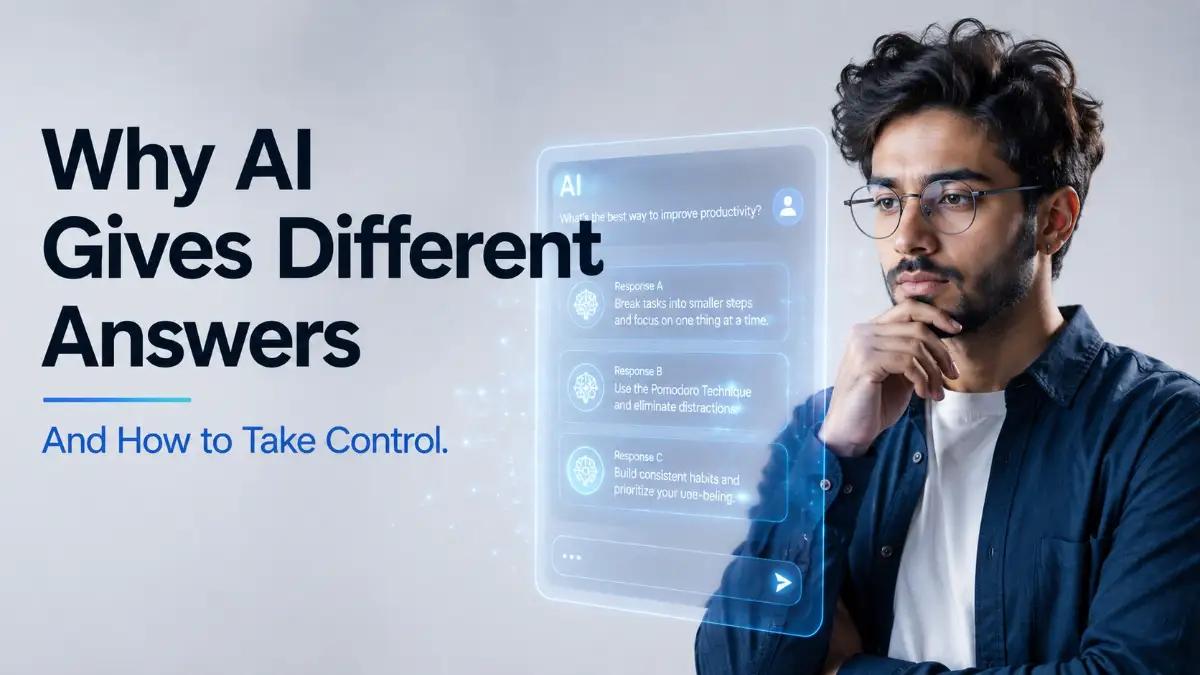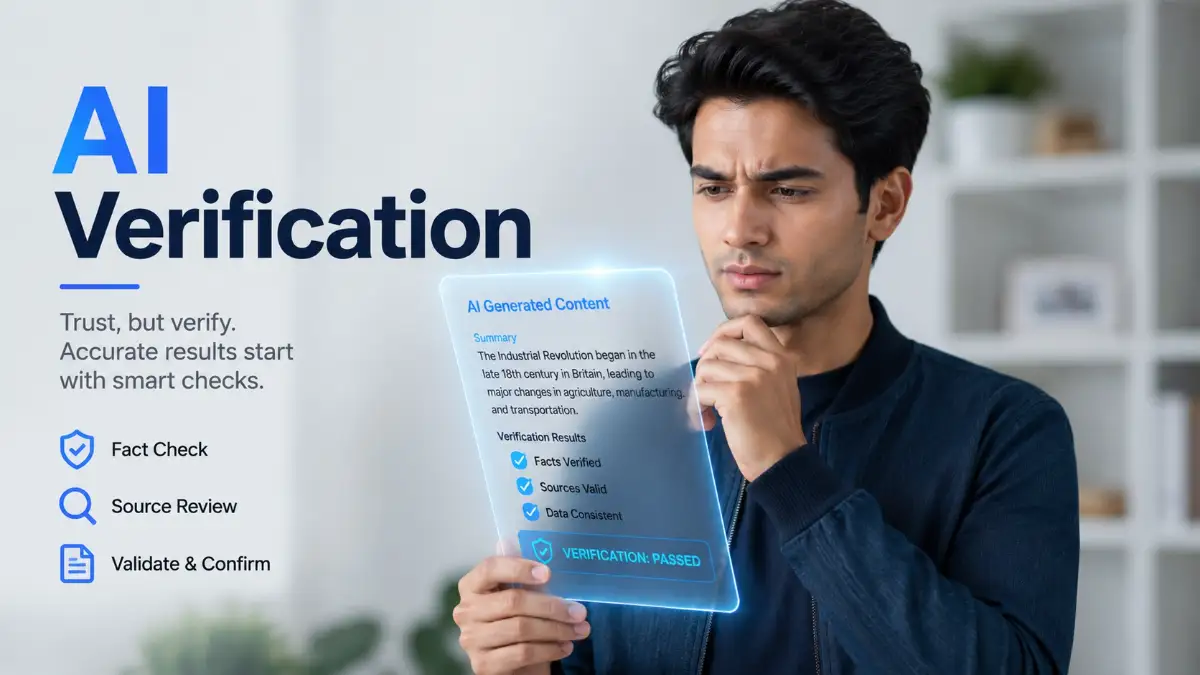
The Moment of Panic: When the Machine Fails You
I still remember the cold sweat I broke into when a client emailed me about a "fake" law I included in a major report. I had trusted an AI tool to grab a quick legal reference, and it confidently made up a rule that did not even exist. That embarrassing mistake nearly cost me my biggest contract, and it forced me to completely change how I trust technology.
Imagine sitting at your desk late at night, rushing to finish a highly important project. You ask your favorite artificial intelligence tool for a quick historical fact or a specific legal reference to tie your whole presentation together.
The machine answers instantly. The text looks incredibly professional, confidently written, and completely believable. You copy it, paste it, hit send, and go to sleep feeling accomplished.
The next morning, your world turns upside down. Your client or boss replies with a simple, terrifying question: "Where exactly did you get this information? This law does not exist."
Your heart sinks into your stomach. Your hands start to sweat. You just staked your personal reputation on a machine that confidently lied to your face.
This is not a rare nightmare. It happens to students, writers, developers, and seasoned professionals every single day. We have become deeply dependent on algorithms that generate text so smoothly that we forget they are not human.
The anxiety of not knowing what is real and what is completely fabricated is exhausting. You start to doubt every piece of research you do. It steals your peace of mind, making you double-guess your own expertise.
When a machine makes up a completely fake piece of information, it does not stutter or look nervous. It hands you a beautifully formatted lie. If you do not know how to spot these hidden errors, you risk your credibility, your career, and your mental well-being.
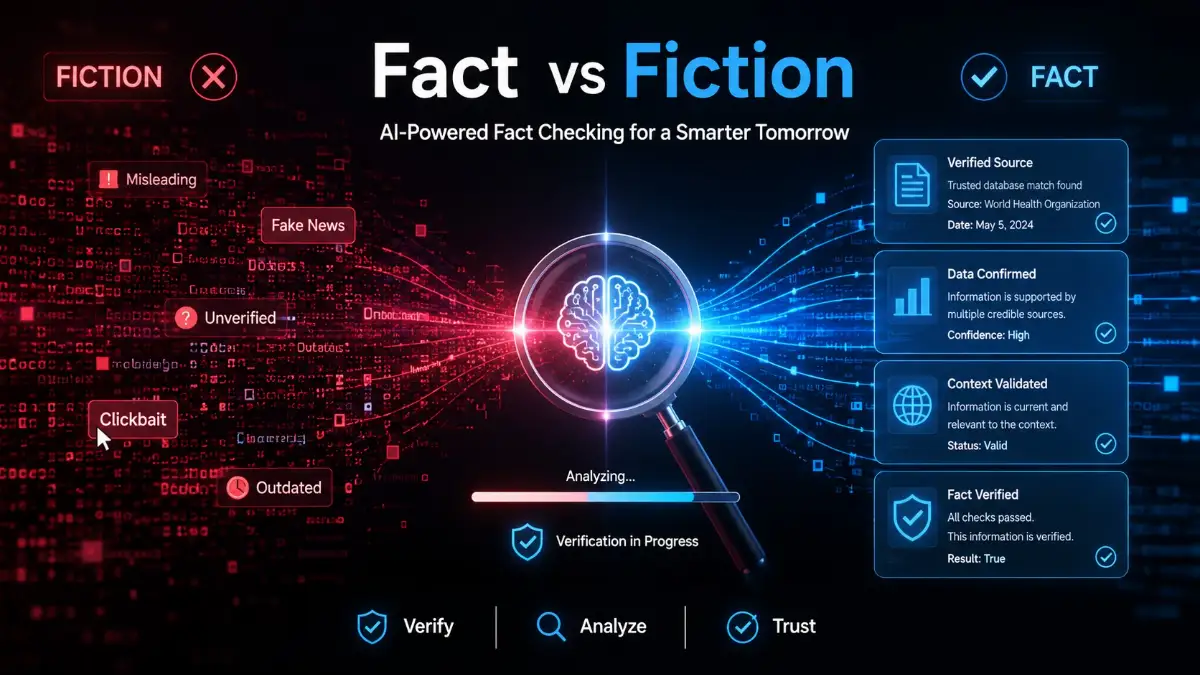
Unmasking the Confident Liar: Why Algorithms Make Things Up
To protect yourself from bad information, you first need to understand how these systems actually work behind the scenes. These programs are not giant digital libraries where a robot searches for a factual book and reads it to you.
Instead, they function like the world's most advanced autocorrect. When you type a question, the software simply predicts what the next most logical word should be. It strings words together based on patterns it learned during its training.
It predicts; it does not think. This means the system does not actually understand the concept of truth. It only understands what sounds mathematically probable.
If the most probable string of words happens to be a completely fake historical event, the system will generate it without a second thought. This phenomenon is commonly known as a "hallucination."
The machine wants to please you by giving an answer. If it does not know the real answer, it will stitch together a highly convincing fake one just to fulfill your request.
If you want to see exactly how these smart tools get confused and start making things up out of thin air, check out this quick video below. Once you understand their secret flaws, keep reading to discover my exact step-by-step system to catch these sneaky lies every single time!
Myth vs Reality
- The Myth: If an artificial intelligence provides a direct quote with quotation marks, it must be a real statement from a real person.
- The Reality: These systems frequently invent quotes, books, and even entire research papers out of thin air to make their answers look more authoritative.
Everyday Tactics to Bulletproof Your Research
Now that we know the machine can and will lie, how do we protect ourselves? You do not need a degree in computer science to separate fact from fiction. You just need a solid, repeatable system.
Let us look at a few highly practical strategies you can apply to your daily workflow right now. These steps are easy, fast, and will save you from embarrassing mistakes.
The "Trace the Claim" Technique
Whenever a machine gives you a specific fact, name, or statistic, treat it as a suspect in an investigation. Never accept it at face value.
Take the core claim and plug it directly into a standard search engine. If the machine claims a specific study says drinking green tea increases memory by forty percent, search for those exact keywords.
If the study actually exists, you will find articles from reputable medical journals or universities discussing it. If the only search results you see are spam websites or random forum posts asking about the same study, red flags should go up instantly.
Always look for the primary source. If the artificial intelligence mentions a book, find the author's official page or look for the book on major retail stores. If the book does not exist, the machine hallucinated it.
The Rule of Three Sources
A single piece of evidence is never enough when dealing with machine-generated text. You need to verify any major claim across at least three entirely separate, trustworthy sources.
For example, if the software tells you about a major change in tax laws, do not just check one random blog. Check a government website, a major financial news network, and an official accounting firm's publication.
If all three independent sources confirm the exact same detail, you can finally trust the information. If they contradict each other, or if you can only find one obscure source, you must discard the machine's answer completely.
Isolating Specific Names and Numbers
Algorithms struggle heavily with hard numbers, dates, and exact mathematical formulas. They love to mix up historical timelines or combine two different people with similar names into one fake person.
When you see a specific date or a complicated math equation in your generated text, stop reading immediately. Highlight that specific section.
Take that exact name, date, or number and cross-reference it independently. If the text says a famous inventor patented a device on a highly specific day, go to an official patent database and check.
Numbers are the easiest things to check, but they are also the most common things these systems get wrong. Paying close attention to digits will save you hours of frustration later.
My personal wake-up call happened when I realized I was spending more time fixing AI math mistakes than if I had just done the research myself. Now, my golden rule is simple: if a machine gives me a date, a percentage, or a specific name, I instantly assume it is wrong until I can prove it right with my own eyes.
Spotting the Subtle Red Flags in Machine Text
Sometimes, you cannot easily search for a fact because the information is too broad or conceptual. In these cases, you need to analyze the actual writing style of the response.
Machines have specific habits when they are unsure of an answer. They tend to use "weasel words" or highly repetitive sentence structures to hide the fact that they lack real data.
Vague Generalizations Are Your First Warning
If an answer feels incredibly long but somehow says absolutely nothing of value, be careful. When these systems lack concrete facts, they pad their responses with generic, fluffy language.
You might ask for a specific coding solution, and the machine spends three paragraphs explaining why coding is important before giving you a half-finished script. This padding is a major indicator that the system is stretching its knowledge to the absolute limit.
Pro Tip for Professional Writers
Read the text out loud to yourself. If it sounds like a smooth-talking politician who is avoiding a direct question, the machine is likely hallucinating. A truthful, factual answer is usually direct, sharp, and highly specific.
The Danger of the "Broken Link" Trick
Many modern tools will now provide clickable links to back up their claims. This seems like a perfect solution, but it actually introduces a new layer of danger.
These systems will often generate URLs that look completely legitimate. They will use real domain names like a popular news site, but the actual page path is entirely fabricated.
When you click the link, you get a "404 Page Not Found" error. Do not assume the page was simply deleted or moved. More often than not, that specific page never existed in the first place.
Never trust a provided link until you actually click it, load the page, and read the human-written text on that exact destination site.
Using Reverse Engineering to Protect Yourself
If you are dealing with a large amount of generated content, checking every single sentence manually is impossible. You need smarter ways to reverse engineer the output to find the weak spots quickly.
Quote Tracking Like a Detective
As mentioned earlier, machines love to invent quotes. But there is a very simple trick to catch them in the act.
Take the most unique, specific phrase from the quote they provided. Put that exact phrase inside quotation marks in your search engine. By using quotation marks, you force the search engine to look for an exact match.
If the quote is real and belongs to a famous person, you will instantly see hundreds of results from historical archives, news interviews, or published books. If the search engine returns zero results, you have successfully caught the machine in a lie.
When to Trust vs When to Verify
1. Brainstorming Ideas for a Project
- Level of Risk: Low Risk
- Required Action: Skim for general concepts. No deep fact-checking needed.
2. Drafting a Casual Email to a Friend
- Level of Risk: Low Risk
- Required Action: Read once to ensure the tone sounds natural.
3. Summarizing a Document You Already Wrote
- Level of Risk: Medium Risk
- Required Action: Compare the summary against your original text for missed details.
4. Quoting Medical, Legal, or Financial Data
- Level of Risk: High Risk
- Required Action: Verify every single word, number, and source manually.
Build Your Personal Truth Filter
The ultimate goal here is to change your mindset. You should never view these tools as omniscient experts. You must view them as highly eager, but slightly clumsy, interns.
An intern might work incredibly fast and bring you a giant pile of research in five minutes. But because they want to impress you, they might cut corners, misunderstand the assignment, or accidentally mix up their notes.
You would never take an intern's raw notes and present them to a board of directors without reading them first. You would review the data, check the primary sources, and fix the obvious errors.
Apply this exact same logic to your digital tools. By building a strict personal habit of verification, you remove the anxiety from the process. You can enjoy the massive speed and creativity these systems offer without constantly worrying about destroying your reputation.
Remember, technology is here to assist your intelligence, not replace it. Your human ability to reason, doubt, and verify is the most powerful tool you have. Keep your critical thinking sharp, and never let a smooth-talking algorithm have the final say in your work.
Master-Level Strategies for Foolproof Fact-Checking
Now that we understand the basic flaws of machine-generated text, it is time to upgrade your verification skills. Moving beyond simple web searches will give you a massive advantage in your professional life. We are going to explore advanced techniques used by professional researchers and journalists.
The goal here is not to spend hours reviewing every single word. Instead, you want to build a fast, highly effective verification system that runs on autopilot. Let us look at a few powerful strategies you can adopt immediately.
The Power of Lateral Reading
Most people make a huge mistake when they try to verify a suspicious claim. They read vertically, meaning they stay on one single webpage and read it from top to bottom. They hope the website will eventually prove its own credibility.
This is a terrible strategy. A fake or heavily biased website will never admit that it is lying to you. Instead, you need to practice a concept called lateral reading.
When you spot a questionable fact, immediately open multiple new browser tabs. Search for the name of the organization, the specific claim, or the author using completely independent sources. University libraries frequently recommend using the lateral reading method because it forces you to step outside the original bubble of information.
Think of it like asking around about a stranger. You would not ask the stranger if they are trustworthy; you would ask other people what they think of that person.
Forcing the Machine to Show Its Work
You do not always have to do all the heavy lifting yourself. You can actually command the algorithm to assist in its own verification process.
Before you accept a complex answer, ask the software to explain the exact logic it used to reach that conclusion. Ask it to list the specific primary sources, historical events, or data points it relied on.
If the system hesitates, changes its answer, or provides vague reasoning, you immediately know the information is unstable. Sometimes, bad output happens simply because the system misunderstood your initial request. Learning to refine your prompt structures will dramatically reduce the amount of fake data you have to sift through.
The "Negative Search" Technique
When we want to check a fact, our natural instinct is to search for evidence that proves it is true. This is called confirmation bias, and it can trick you into believing false information.
Instead of searching for proof that the machine is right, actively search for proof that it is wrong. Use terms like "debunked," "false," or "myth" alongside your main keyword. Professional fact-checkers rely heavily on established digital verification techniques that prioritize finding the flaws in a claim first.
If a specific statistic generated by an algorithm has already been proven false by experts, a negative search will reveal that truth instantly. This saves you the headache of defending a completely fake data point in a professional meeting.
Upgrading Your Command Prompts
The way you speak to the machine directly determines the quality of facts you receive. If you ask a lazy question, you will receive a lazy, highly inaccurate answer.
You must set strict boundaries before the software even begins writing. Tell the system exactly what it is allowed to do and what it is forbidden from doing.
For instance, explicitly type: "If you do not know the exact answer, tell me you do not know. Do not invent any names, dates, or statistics." Simply adjusting your prompt commands by adding these strict boundaries will shut down a massive percentage of algorithmic hallucinations.

The Dangerous Traps Most People Fall Into
Knowing how to check facts is only half the battle. You also need to understand the psychological traps that cause smart people to make foolish mistakes.
When we are rushed, stressed, or tired, our brains look for shortcuts. The software provides an easy shortcut, and that is exactly when disaster strikes. Let us explore the most common pitfalls you must aggressively avoid.
Trap 1: Trusting the "Confident Tone"
Algorithms are designed to sound incredibly authoritative. They use perfect grammar, sophisticated vocabulary, and a highly persuasive tone.
Our brains are naturally wired to trust people who speak with absolute certainty. When you read a perfectly formatted paragraph, your mind assumes the underlying facts must be correct. You must break this mental association immediately.
Excellent grammar does not equal factual truth. A beautifully written lie is still a lie. You must strip away the fancy words and look strictly at the raw data underneath.
Trap 2: The Interrogation Fallacy
When a user suspects the software has made a mistake, they often do something highly illogical. They ask the exact same software if it is sure about its answer.
They type, "Are you sure that statistic is correct?" The system will usually reply, "Yes, I am completely sure," and then generate another fake explanation to back up its first lie.
You cannot use a broken compass to fix a broken compass. If you suspect an error, you must take the data outside the program. Never rely on the machine to fact-check its own mistakes.
Trap 3: The Danger of Direct Copy-Pasting
Copying and pasting raw generated text directly into an email, report, or public blog is a massive gamble. You are essentially betting your professional reputation on a single roll of the dice.
Beyond the factual errors, raw machine text often lacks human empathy and natural rhythm. Your readers will quickly notice the robotic tone and start questioning your authenticity.
You should always rewrite the verified facts in your own voice. Taking the time to focus on making your generated text sound authentic ensures that your final work is both factually accurate and engaging to read.
Trap 4: Leaking Sensitive Information
In the rush to verify complex data, people often feed private company documents, financial records, or personal client details into these public systems. They ask the software to analyze the data, completely forgetting about privacy.
These public algorithms often store your inputs to train future versions of the software. That means your confidential business data could accidentally be generated as an answer for a random user halfway across the world.
You must strictly protect your personal information from data collection whenever you use these tools. Never trade your privacy for a slightly faster research process.
Real-Life Scenario: The Lazy Marketer
Imagine a marketing director who needs to present consumer trends to the board of directors. Running late, she asks a digital assistant to generate five key statistics about teenage spending habits.
The software hands her five beautiful, highly specific data points. She copies them onto a presentation slide without checking a single number. During the meeting, the CEO asks which research firm published the third statistic.
The marketer freezes. She has no idea. Later, a quick search reveals that the statistic was completely invented by the software.
She did not just lose an argument in a meeting; she lost the trust of her entire leadership team. Trust takes years to build and only seconds of careless copy-pasting to completely destroy.
Your Action Plan for Confident Digital Research
We have covered a massive amount of ground today. You now understand why these systems invent information, how to spot their subtle tricks, and exactly how to reverse-engineer their claims.
You no longer have to feel anxious when using modern digital tools. You are now equipped with the exact strategies used by professional investigators and seasoned researchers.
The key to long-term success is consistency. Verification cannot be something you only do when you have extra free time. It must become an automatic, non-negotiable part of your daily workflow.
A Quick Checklist for Tomorrow
Before you start your work tomorrow morning, write this simple checklist on a sticky note and place it on your monitor:
- Doubt the obvious: Does this specific fact sound slightly too perfect?
- Isolate the numbers: Have I verified every single date, percentage, and mathematical claim?
- Read laterally: Did I check three independent sources outside of this software?
- Trace the source: Can I find the original human being or organization who first published this data?
By asking yourself these four simple questions, you will catch ninety-nine percent of the errors before they ever reach your final draft.
These digital assistants are incredibly powerful tools. They can help you outline ideas, summarize long documents, and brainstorm creative solutions faster than ever before. But they are strictly tools, not replacements for your human judgment.
Your unique ability to think critically, ask tough questions, and verify the truth is your ultimate superpower. Keep your standards high, stay curious, and never let a machine dictate what you believe to be true.
Taking a few extra minutes to double-check my facts has not just saved my professional reputation; it has actually made me a much more confident and fearless writer. You already have the smarts to tell fact from fiction, so start using these simple habits today and take back full control of your work!
Disclaimer: The information provided in this article is intended for general educational purposes only. Software algorithms and artificial intelligence tools change rapidly. Always exercise independent human judgment and consult primary, authoritative sources before making significant professional, legal, medical, or financial decisions based on internet research.
About the Author
Munira Parveen is a dedicated Digital Content Strategist and Lead Researcher with a passion for simplifying complex topics. From navigating personal finance and emerging tech trends to uncovering the best practical lifestyle solutions, she spends her time analyzing data to bring readers highly accurate, actionable, and easy-to-understand guides. Her ultimate goal is to empower everyday people to make smarter, more informed decisions in this fast-paced digital world.

![How to Create a Smart Personal AI Workflow [Step-by-Step]](https://nirajournal.com/storage/uploads/blogs/1787818118_how-to-create-a-smart-personal-ai-workflow-step-by-step.webp)