
The Exhausting Reality of Traditional Studying
I still remember pulling all-nighters at my tiny wooden desk, surrounded by empty coffee cups, fully convinced that staring at my textbook for six hours straight made me a dedicated student. But the absolute heartbreak came the next morning when my mind went completely blank during the exam, making me feel like I was just not smart enough. It took me years of academic burnout and endless frustration to finally realize that my problem wasn't a lack of hard work, but a complete failure to understand how the human brain actually learns.
Picture this exact scenario. It is late at night, and your desk is completely covered in colorful highlighters, sticky notes, and half-empty coffee cups.
You have been staring at your thick textbook for the last five hours. You feel completely exhausted, your back aches, and your eyes are burning from the harsh room light.
But when you finally close the book and try to remember what you just read, your mind goes entirely blank. A heavy wave of panic instantly washes over you.
Why does this happen? Why do we put in so much intense effort, sacrifice our sleep, and skip fun social events, only to feel like we learned absolutely nothing?
This cycle of endless reading and forgetting destroys your confidence. You start believing that you are simply not smart enough to handle the pressure.
You watch your classmates get high scores seemingly without trying, and you desperately wonder what their secret is. The truth is, they are not naturally smarter than you.
They simply use a completely different approach to absorbing new information. They have figured out how to stop fighting their own brain and start working with it instead.
The heavy mental burden of traditional studying causes extreme burnout. It makes you hate the subjects you once found incredibly interesting.
You do not need to spend more hours locked inside your room. You just need to change the exact way those specific hours are spent.
The Hidden Reasons Why Your Current Study Routine Fails
We have all been taught that learning requires massive amounts of time. Since childhood, teachers told us to sit down, read the chapter three times, and copy the notes.
The problem is that human brains are not designed to work like simple copy machines. When you just read words on a page, your brain is mostly resting.
Think of your memory like a bucket with a giant hole at the bottom. Reading the same chapter over and over is like pouring more water into that leaky bucket.
No matter how many hours you spend pouring water, the bucket will always end up empty. To fix this problem, you do not need more water. You need to plug the hole.
This is the exact difference between passive learning and active learning. When you study passively, you create an illusion of competence.
You look at a highlighted sentence and think, "I know this." But in reality, you just recognize it. Recognition is not the same thing as remembering.
Breaking the Illusion of Competence (Myth vs Reality)
Before we build new systems, we need to destroy the bad ones. Let's look at a very common situation.
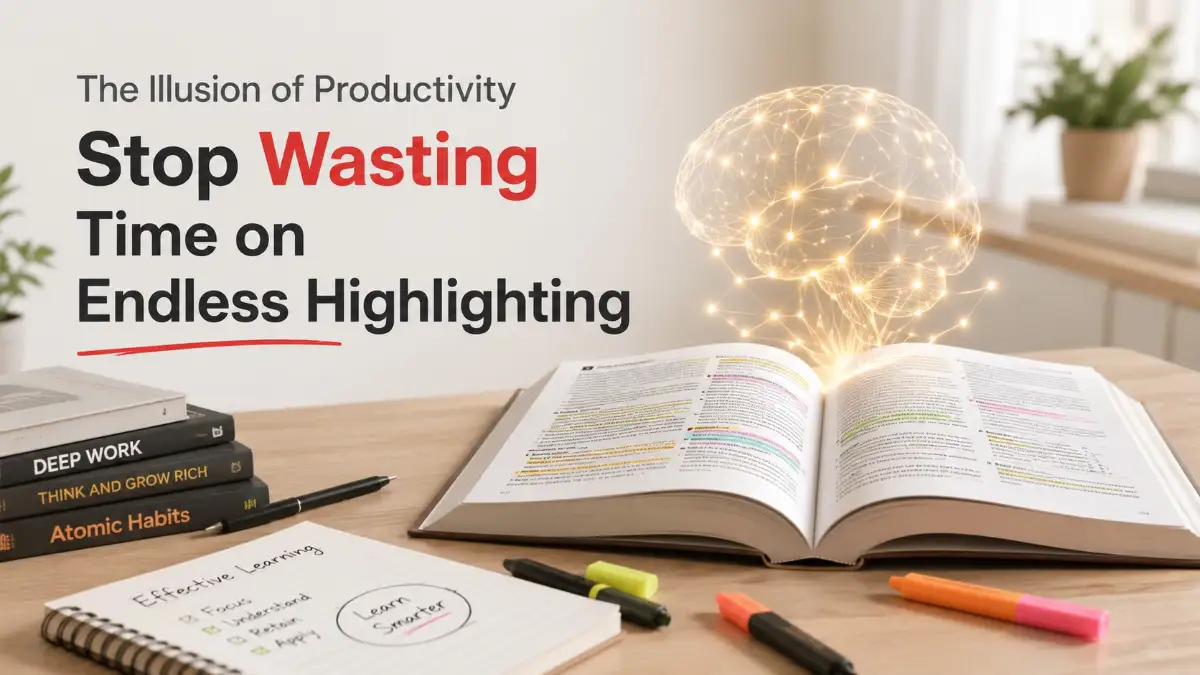
The Myth: Highlighting important text with different colors helps your brain remember the details much better.
The Reality: Highlighting is a purely passive activity. It tricks your brain into thinking it did hard work, but zero actual memorization happened.
If you want to maintain a high level of concentration, you must first eliminate the hidden things stealing your attention. For a deeper understanding of this, read about The Secret Distractions Ruining Your Study Focus (And How to Fix Them).
Once you clear your mind, you can start applying highly effective methods.
The Science of Working Less and Remembering More
When you look at students who get top grades with minimal effort, they all share specific behavioral traits. They do not rely on motivation.
Instead, they rely on proven cognitive science. According to research published by the Association for Psychological Science, self-testing is one of the highest-rated learning techniques available today.
Let's break down exactly how you can apply these scientifically proven methods to your own daily routine.
Habit 1: Testing Yourself Before You Feel Ready
If you want to see exactly how active recall and self-testing look in real life, watch this short walkthrough below to completely transform how you study starting today.
Most students wait until the night before the exam to test their knowledge. This is a massive mistake.
Testing should not be a tool to measure what you know. Testing should be the actual method you use to learn the information in the first place.
This concept is called Active Recall. It is the absolute fastest way to force your brain to build strong neural pathways.
When you close your book and try to remember a fact, your brain has to work very hard. That feeling of struggle is the exact moment actual learning happens.
How to Apply This Today:
Back when I first tried active recall, I felt so awkward and frustrated trying to explain a complex history chapter out loud to an empty room instead of just highlighting the pages like everyone else. My honest pro tip from personal trial and error is to embrace that initial mental friction—if your brain feels like it's sweating through a workout, you are finally doing the real learning instead of faking it.
Instead of reading a full chapter, read just one single page. Then, immediately close the book.
Ask yourself out loud, "What were the three main points of this page?" Try to explain it to an imaginary friend in your room.
If you get stuck, open the book and check. Then close it and try again. This process takes ten minutes but replaces hours of useless rereading.
Pro Tip: Write your class notes as questions instead of statements. Instead of writing "The mitochondria is the powerhouse of the cell," write "What part of the cell acts as its powerhouse?"
Habit 2: Spreading Out Your Brain’s Workout
Imagine you want to build bigger muscles at the gym. You would not lift a heavy weight for ten hours straight on a Sunday and then never exercise again.
Your muscles would just tear, and you would be in extreme pain. Your brain works in the exact same way when it comes to storing information.
Cramming for ten hours before a test completely overloads your working memory. The brain simply deletes the information a few days later to make room for new things.
To make learning permanent, you must use Spaced Repetition. This means you review the material just as you are about to forget it.
Every time you remember something right on the edge of forgetting, the memory becomes significantly stronger.
Building Your Personal Review Schedule:
When you learn something new on Monday, do not look at it again on Tuesday. Wait until Wednesday to review it.
Then, wait until Sunday. Then, review it again two weeks later. This creates long-term retention without adding any extra daily hours to your schedule.
Before you try to implement spaced repetition, you need a clear system for your notes. Check out our guide on A Simple Framework for Organizing Study Materials Without Feeling Overwhelmed to set up a completely stress-free environment.
Habit 3: Mixing Up Your Topics for Better Problem Solving
When you practice math, do you solve twenty addition problems in a row, and then twenty subtraction problems?
This feels easy, but it actually harms your ability to perform well on exams. During a real test, the questions are completely mixed up.
If your brain only knows how to solve a problem when it expects that specific type of question, you will freeze during the exam.
The solution to this is called Interleaving. Instead of blocking your time by single subjects, you mix different topics together in one session.
A Real-Life Example:
Think of a baseball player practicing his swing. If the pitcher throws twenty fastballs in a row, the batter will hit them all perfectly.
But in a real game, the batter never knows what pitch is coming next. If he practices hitting mixed pitches, he will miss more during practice, but perform much better in the actual game.
When you study, mix chapter one with chapter four. Jump from history to biology after thirty minutes.
Your brain will have to constantly adapt and figure out which strategy to use. This makes you a master problem solver instead of just a robot who memorizes things.
Habit 4: Managing Mental Energy Instead of Just Time
Time management is a very popular topic. People love to create perfectly color-coded calendars scheduling every minute of their day.
But time is totally useless if you do not have the mental energy to focus during those hours. Two hours of low-energy studying is completely worthless.
Thirty minutes of high-energy, totally focused studying will always give you better results. You need to start protecting your mental energy like it is physical money.
The Task-Based Alternative:
Stop saying, "I am going to study biology for three hours tonight." That instantly makes your brain feel tired and overwhelmed.
Instead, say, "I am going to memorize the functions of the human heart, and then I am completely done for the day."
When you give yourself a specific task, your brain naturally works faster to finish it. You enter a state of deep focus because there is a clear finish line in sight.
If you finish the task in forty-five minutes, you get to close your books and enjoy the rest of your evening guilt-free.
This simple mindset shift removes the dread of long study sessions. It makes studying feel like a quick game you can win, rather than a prison sentence you must endure.
Mastering the Art of Deep Comprehension
You have already learned how to stop wasting your mental energy on passive reading. Now, we need to take those basic habits and upgrade them to an expert level.
The most successful students do not just remember facts for a test. They completely absorb the information so it becomes a natural part of their everyday thinking.
This level of mastery requires a specific shift in how you process complicated topics. Let's explore some advanced strategies that will make your study sessions incredibly powerful.
The Power of Teaching the Invisible Student
There is an old saying that if you cannot explain something simply, you do not actually understand it. This concept is the secret weapon of top-tier learners.
When you study alone, your brain often tricks you. It skips over confusing details, making you feel like you understand the whole picture.
To break this bad habit, you need to use the "Protégé Effect." This psychological phenomenon proves that we work harder to understand material when we expect to teach it to someone else.
According to research from Washington University in St. Louis, students who prepare to teach a topic score significantly higher on tests than those who simply study to pass.
How to Practice This Everyday:
Pretend you are tutoring a ten-year-old child. Stand up in your room and explain the concept out loud using the simplest words possible.
If you stumble, hesitate, or use heavy academic jargon, you have found a gap in your knowledge. Go back to your book, fill that specific gap, and try explaining it again.
Anchoring Memories to Your Environment
Your brain is constantly picking up clues from your surroundings. The lighting, the smell of the room, and the chair you sit in all become tied to your memories.
This is known as state-dependent learning. If you only ever study in your bed, your brain connects all that academic information to a place of sleep and relaxation.
When you sit in a cold, bright exam hall, your brain suddenly feels entirely out of place. It struggles to retrieve the information because the physical environment is completely different.
Creating a Trigger Environment:
You need to train your brain to enter a state of deep focus on command. Pick a specific spot in your house that is only used for studying.
Never watch movies, eat, or scroll on your phone in this specific chair. Over time, simply sitting in this exact spot will automatically trigger your brain to start working.
If you struggle to manage all your daily responsibilities while trying to maintain this habit, you might need a better overall system. Learning exactly How to Build a Study Routine That Fits Your Busy Life will help you keep this dedicated space sacred without feeling completely overwhelmed.
The "One Percent Better" Maintenance Strategy
Many people start a new study system with massive enthusiasm. They study perfectly for three days, get completely exhausted, and then quit.
Motivation is a terrible fuel source because it runs out very quickly. Instead of trying to be perfect, aim to make your study sessions just one percent better every day.
If you usually study with your phone on your desk, your one percent improvement for tomorrow is simply moving the phone to another room. You do not need to change anything else.
By stacking tiny, manageable changes over several weeks, you create permanent behavioral shifts. This completely removes the anxiety of trying to completely change your life overnight.

The Silent Traps That Destroy Academic Confidence
Even when you know the right strategies, it is very easy to fall back into old, comfortable habits. Our brains naturally prefer the path of least resistance.
When things get difficult, we often unknowingly sabotage our own progress. Let's look at the most dangerous traps that trick you into feeling productive while actually destroying your results.
Trap 1: The "Beautiful Notes" Paralysis
We all know someone who spends hours creating the most beautiful, color-coded study notes. They use fifteen different markers and draw perfect little diagrams.
At the end of the day, their notebook looks like an expensive piece of art. But if you take the notebook away and ask them a question, they cannot answer it.
They spent their entire mental energy on graphic design instead of active learning. Writing beautiful titles does not push the information into your long-term memory.
What to Do Instead:
Embrace messy, ugly notes. Your notes are simply a tool to capture main ideas quickly so you can start testing yourself.
Focus entirely on the actual content. A messy page of self-testing questions will always earn a higher grade than a beautiful page of perfectly copied text.
Trap 2: The Illusion of Multitasking
You are sitting at your desk with your math book open. At the same time, you are listening to a podcast, texting your best friend, and occasionally checking social media.
You might feel like a highly efficient machine, getting four things done at once. But cognitive science paints a very different, alarming picture.
The American Psychological Association states that the human brain cannot actually perform multiple complex tasks at once. Instead, it rapidly switches attention back and forth.
This constant switching drains your mental battery incredibly fast. It also blocks your brain from entering the deep concentration needed to understand complex subjects.
Your study time doubles, but your retention drops to almost zero. Turn off every single notification and give your brain the quiet space it desperately needs.
Trap 3: Treating Sleep as a Luxury
This is perhaps the most destructive mistake in the entire academic world. Students regularly brag about pulling all-nighters before a massive exam.
They drink heavily caffeinated energy drinks, force their eyes open, and try to cram hundreds of pages into their tired minds. This completely destroys the learning process.
Think of your short-term memory as a small desk, and your long-term memory as a giant filing cabinet. During the day, you pile new information onto the small desk.
When you sleep, your brain acts like a night-shift worker. It takes the papers from the desk and permanently stores them in the filing cabinet.
If you refuse to sleep, that night-shift worker never shows up. The small desk simply overflows, and all that hard work from the day is completely thrown away.
Understanding this biological process is essential for long-term success. If you want to dive deeper into why this happens, reading about Why Many Students Forget What They Learn and Practical Ways to Remember More will completely change how you view your bedtime routine.
Trap 4: Running Away from the Feeling of Confusion
When you try to solve a difficult problem and your mind goes blank, how does it make you feel? Most people feel embarrassed, frustrated, or simply unintelligent.
Because this feeling is so uncomfortable, students quickly flip to the back of the book to check the correct answer. They read the answer, nod their head, and say, "Oh, I knew that."
No, you did not know that. You just robbed your brain of the opportunity to grow.
That uncomfortable feeling of confusion is the exact moment your brain is building new pathways. Sweating through a tough problem is the equivalent of lifting a heavy weight at the gym.
If you drop the weight the second it feels heavy, your muscles will never grow. You must learn to sit with your confusion for at least five minutes before you look for the answer.
Your 24-Hour Action Plan for Academic Freedom
Reading this guide is a great first step, but reading alone will not change your grades. You need to take immediate action while these concepts are still fresh in your mind.
You do not need to overhaul your entire life by tomorrow morning. Taking small, deliberate actions will build unstoppable momentum over the next few weeks.
Here is a simple, stress-free checklist to apply these concepts during your very next study session.
Step 1: Clean Your Environment
Before you even open a book tonight, remove everything from your desk that is not related to your current subject. Put your phone in a completely different room.
Step 2: Set a Clear Target
Do not sit down with the vague goal of "studying history." Decide exactly what you want to achieve. Tell yourself, "I will successfully explain the causes of the French Revolution without looking at my notes."
Step 3: Test First, Read Later
Instead of blindly reading the chapter, look at the headings first. Turn those headings into questions and try to guess the answers.
Step 4: Embrace the Struggle
When the material gets tough, do not panic. Remind yourself that the feeling of mental strain means the strategy is actually working.
You hold the power to completely transform your academic journey. The days of endless frustration and sleep deprivation are officially behind you.
Start treating your study sessions like focused, high-energy games. Work smarter, trust the science, and watch as learning becomes one of the most rewarding parts of your daily life.
Shifting away from passive reading and marathon study sessions completely changed my academic life, turning late-night panic into actual confidence and free time. I promise you that making just one tiny change today will break the heavy cycle of burnout, so close this tab, pick up your book, and take that first simple step right now.
Disclaimer: The educational information provided in this article is for general informational purposes only. It is not intended as a substitute for professional academic advising or medical advice regarding cognitive health. Always consult with qualified educators or healthcare professionals regarding your specific study needs and mental well-being.
About the Author
Munira Parveen is a dedicated Digital Content Strategist and Lead Researcher with a passion for simplifying complex topics. From navigating personal finance and emerging tech trends to uncovering the best practical lifestyle solutions, she spends her time analyzing data to bring readers highly accurate, actionable, and easy-to-understand guides. Her ultimate goal is to empower everyday people to make smarter, more informed decisions in this fast-paced digital world.