
The Heartbreak of the Blank Mind
I still remember sitting in my high school chemistry final, staring at a question I had studied for six hours straight. Even though I had highlighted every single page in my book, my mind was a total desert. I felt so embarrassed and "slow" as I handed in a nearly empty paper, but that failure taught me that my brain wasn't the problem—my study habits were.
Imagine sitting in the exam hall. You have a fresh pen in your hand and a blank sheet of paper in front of you. The clock on the wall ticks loudly.
You look down at the first question, and your heart sinks. You know this topic. In fact, you spent three straight hours reading about it just last night.
You highlighted the textbook until the pages were mostly neon yellow. You nodded along, feeling incredibly confident that the information was safely locked inside your brain. But right now, in the exact moment you need it, your mind is completely empty.
It feels like someone hit the "delete" button on your memory. The harder you try to force the answer out, the more stressed you become.
If this scenario sounds familiar, I want you to know that you are not alone. Almost every student goes through this agonizing experience. It leads to late-night panic attacks, a massive drop in self-confidence, and a deep fear of failure.
You might start thinking that you are simply not smart enough. You might believe that other people are just born with better memory hardware.
Let me tell you a secret: your brain is not broken. Your intelligence is completely fine. The real issue is that we are never taught how to learn.
Our schools give us endless piles of books, but they never hand us the user manual for our own brains. We rely on studying methods that directly fight against our natural biology.
The Invisible Leaks in Your Memory Bucket
To fix this frustrating problem, we first need to understand what is actually happening inside your head. Think of your brain as a bucket that you are trying to fill with water.
Every time you read a textbook, watch a lecture, or listen to a teacher, you are pouring water into this bucket. The problem is that human memory is a bucket with massive holes at the bottom.
German psychologist Hermann Ebbinghaus proved this over a century ago with his famous Forgetting Curve. According to his research, you lose about 50% of new information within just one hour of learning it. By the end of the week, nearly 90% of that hard work has completely leaked out of your brain.
This happens because your brain is extremely energy-efficient. It actively throws away information that it thinks you will never use again.
Myth vs Reality in Learning
The Myth: If you read a chapter five times in a row, you will definitely remember it for the test.
The Reality: Rereading is a passive activity. It tricks your brain into feeling familiar with the words, but it does not build strong memory connections.
If you want to stop the leaks in your memory bucket, you have to convince your brain that the information is incredibly important. You have to force your mind to work for the answers.
Let us look at a few practical, science-backed steps you can start using today. These methods will permanently change how you study.
Step 1: Force Your Brain to Sweat (The Power of Retrieval)
If you are tired of forgetting everything you read, you need to see this. Watch this quick video to see exactly how to use Active Recall so you can stop wasting time and start remembering everything for your next test!
Most students study by consuming information. They watch videos, read chapters, and highlight text. This is a very comfortable process, but comfort does not build memory.
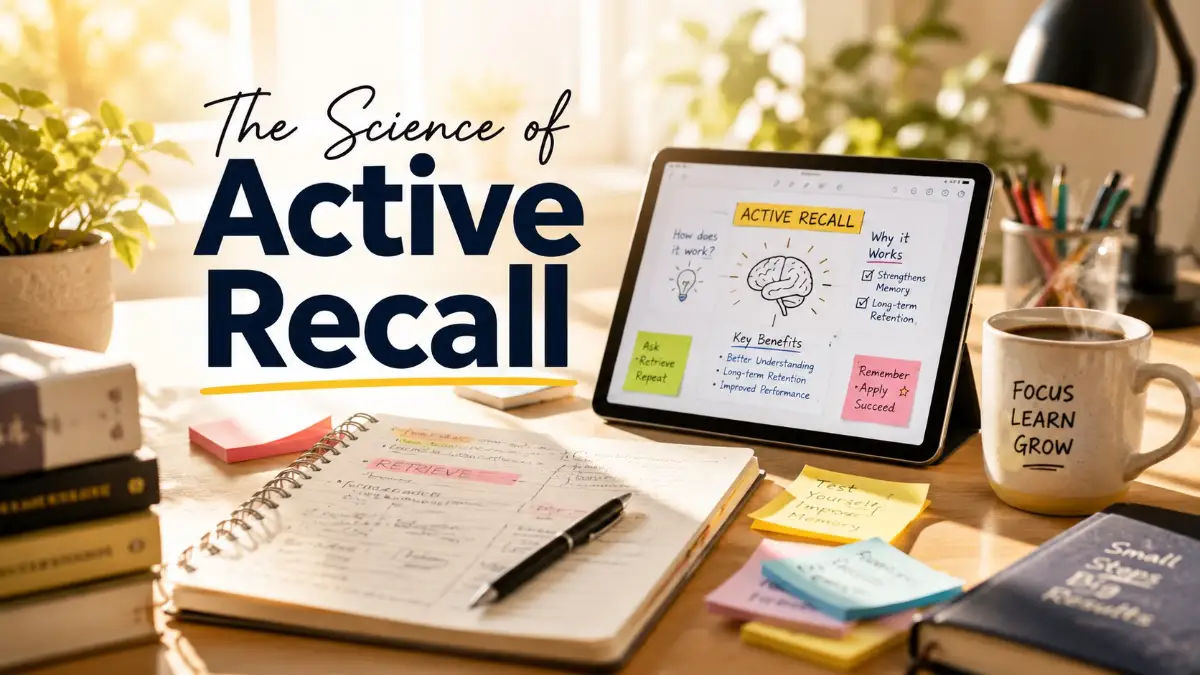
To remember things long-term, you must practice Active Recall. This means forcing your brain to retrieve information from scratch, without looking at your notes.
Think of it like going to the gym. If you just watch other people lift weights, your muscles will never grow. You have to actually pick up the heavy dumbbells yourself.
When you struggle to remember a fact, your brain works hard to rebuild the neural pathways. According to cognitive research published by the American Psychological Association (APA), retrieving information is one of the most effective ways to make learning permanent.
How to Practice Active Recall Today
I used to make the huge mistake of thinking that "looking at my notes" was the same thing as "learning them." Now, I never let myself finish a study session without closing my eyes and trying to explain the main idea out loud. If I can't say it simply, I know I haven't actually learned it yet.
Instead of reading a chapter twice, read it just once. Then, close the book completely. Take a blank piece of paper and write down everything you can possibly remember.
Do not worry if your notes are messy or if you forget some parts. The struggle to remember is exactly what builds the memory.
Once you are completely stuck, open the book again. Find the missing pieces, read them over, and then close the book to test yourself one more time. This single shift can cut your study time in half.
Step 2: Stop Cramming and Start Watering the Plant
Have you ever tried to keep a houseplant alive? If you pour a whole gallon of water on a small plant on Monday, and then ignore it for a month, the plant will die.
However, if you give that same plant a small cup of water every few days, it will grow beautifully. Your memory works exactly the same way.
This concept is known as Spaced Repetition. Instead of cramming for eight hours the night before a test, you space out your review sessions over days and weeks.
When you review a topic just as you are about to forget it, you send a powerful signal to your brain. You are telling your mind, "Hey, we keep needing this information, so please save it in the permanent storage folder."
Setting Up a Simple Spaced Schedule
You do not need complicated software to do this, though flashcard apps can be very helpful. You can start with a simple paper calendar.
Review your new notes one day after the lecture. Then, review them again three days later. After that, look at them one week later.
By spacing out your reviews, you interrupt the forgetting curve. You patch up the holes in your memory bucket. If you want to make this process even smoother, you need to build strong daily routines.
Creating a consistent environment helps your brain switch into learning mode faster. I highly recommend learning how to structure your day properly by reading about simple daily habits that make studying effortless. Small tweaks to your morning routine can make a massive difference.
Step 3: Be the Teacher (The Feynman Technique)
One of the main reasons we forget information is that we never truly understood it in the first place. We just memorized complicated words to pass a test.
Renowned physicist Richard Feynman noticed this problem decades ago. He realized that true understanding comes from simplicity. If you cannot explain a concept to a young child, you do not actually understand it.
We often hide behind big academic words. We memorize definitions without knowing what they mean in the real world.
A Real-Life Feynman Scenario
Imagine you are studying the human circulatory system. Instead of memorizing the textbook definition of the heart, pretend you are explaining it to a ten-year-old.
You might say, "The heart is basically a powerful water pump. It pushes blood, which acts like a delivery truck, carrying oxygen to all the tiny cities inside our body."
Notice how simple that sounds? When you connect complex ideas to simple, everyday concepts, your brain easily holds onto them.
Next time you finish studying a difficult topic, stand up and pace around your room. Speak out loud and try to teach an imaginary class. You will quickly discover exactly where your knowledge is lacking.
Step 4: Protect Your Brain’s Processing Factory
You can use all the best study techniques in the world, but they will fail if your brain is exhausted. Sleep is not a luxury for students; it is a biological requirement for memory.
During the day, your brain takes in millions of pieces of information. This data is temporarily held in a fragile state. It is highly unstable and easily forgotten.
When you fall into deep sleep, your brain goes to work. It acts like a giant filing cabinet, sorting through everything you learned. It throws away the useless information and permanently saves the important facts.
Research from the National Institutes of Health (NIH) clearly shows that a lack of sleep directly blocks the brain's ability to consolidate memories. Pulling an all-nighter is literally the worst thing you can do for a test.
The Hidden Memory Killers
Beyond sleep, constant interruptions are actively destroying your ability to retain facts. If you check your phone every ten minutes while studying, your brain never enters a deep state of focus.
Every time you switch your attention, you experience something called "attention residue." A part of your brain is still thinking about that text message, leaving less brainpower for your textbook.
You must learn to protect your focus blocks. For a deeper understanding of how to manage these modern problems, you should explore the secret distractions ruining your study focus and how to fix them. Eliminating these hidden traps will instantly improve your memory.
Pro Tip: Try keeping your phone in a completely different room while you study. Just removing the physical device from your sight reduces mental stress and allows your brain to absorb information much faster.
Step 5: Mix It Up for Maximum Retention
When most students sit down to study mathematics, they usually practice one specific type of problem for an hour. Once they master it, they move on to the next chapter.
This feels very productive, but it actually creates a false sense of security. When the exam comes, the questions will not be nicely organized by chapter. They will be mixed up randomly.
To prepare for this, you should use a technique called Interleaving. Instead of studying just one topic for hours, mix different but related topics together in one session.
For example, do not just practice addition problems. Do two addition problems, one subtraction problem, and one multiplication problem.
This forces your brain to constantly figure out which strategy to use. It feels much harder in the moment, but the long-term results are incredible. The struggle forces your memory to adapt and grow stronger.
Stepping Beyond the Basics: Master-Level Tactics for Permanent Memory
You already know that passively reading your textbook is a waste of time. But how do the top students seem to remember complex theories without breaking a sweat? They do not have a magical brain.
Instead, they use advanced psychological strategies that force the mind to hold onto information. These methods might feel a little strange at first. However, once you start applying them, you will notice a massive shift in how easily you recall facts.
Let us look at a few highly effective strategies that go far beyond standard studying. These are the daily habits that build a truly bulletproof memory.
The Power of Dual-Coding Your Notes
Most students only use words when they take notes. They write long, boring paragraphs filled with black ink. The human brain actually gets very tired when it only looks at large blocks of text.
To make information stick instantly, you should use a method called Dual-Coding. This means you combine words with simple visual images. You do not need to be an artist to do this.
Even drawing a basic timeline, a messy mind map, or a simple stick-figure comic can change everything. When you draw a picture next to a concept, you give your brain two completely different ways to remember it.
Think of it like locking a heavy door. Using just text is like having one lock. Adding a visual diagram adds a second, stronger lock. According to research published by the American Psychological Association (APA), combining visual and verbal materials significantly increases long-term retention compared to using words alone.
Q: But what if I am terrible at drawing?
A: Your drawing skills do not matter at all. The rougher and uglier the sketch, the more your brain actually pays attention to it. The goal is to create a visual connection, not a masterpiece.
Context Variation: Change Your Scenery
We often have a favorite spot where we do all our homework. Maybe it is your bedroom desk or a specific corner of the local library. Studying in the exact same spot every single day actually harms your memory over the long term.
When you study in one specific room, your brain naturally ties the information to the background noises, smells, and lighting of that room. If you take your exam in a completely different environment, your brain might struggle to access those memories.
To fix this, simply move around. Study your history notes at the kitchen table on Tuesday. On Wednesday, review those same notes at a local coffee shop.
By changing your environment, you force your brain to detach the facts from the room. The information becomes independent and much stronger. You will be able to remember the answers no matter where you are sitting.
The Interleaved Practice Strategy
Imagine a baseball player who only practices hitting fastballs for an entire month. When a real game happens, the pitcher throws a curveball, and the batter completely misses. This is exactly what happens when you study one subject for too long.
Most people practice math by doing twenty identical problems in a row. This is called "blocked practice." It feels easy, but it does not prepare you for a real test where the questions are completely random.
Instead, you should mix up your topics. Do two geometry problems, then switch to algebra, and then read a page of history. This technique is called Interleaving.
It feels much harder in the moment because your brain has to constantly switch gears. However, this struggle is exactly what builds a powerful, flexible memory. You are training your mind to identify which strategy to use in unpredictable situations.
To make all of these advanced techniques work, you need a system to manage your time. You cannot just use these tricks randomly and expect perfect grades. I highly recommend learning about how to build a study routine that fits your busy life. Creating a consistent schedule is the secret to turning these hacks into permanent daily habits.

The Silent Saboteurs: Why Your Hard Work is Fading Away
There is a very unique type of pain that happens in the exam hall. You look at a question and you know for a fact that you studied it. You can even picture the exact page in your textbook.
Yet, the actual answer remains completely blank in your mind. This leads to a crushing feeling of disappointment. You start to think that you are simply not smart enough.
Please understand that this has nothing to do with your natural intelligence. You are likely just falling into common psychological traps that trick your brain into feeling prepared. If you want to see a real improvement in your grades, you must immediately stop doing these damaging activities.
The Dangerous Illusion of Competence
This is the biggest trap in the educational world. The illusion of competence happens when you confuse recognizing a concept with actually mastering it.
Imagine watching a professional chef chop an onion on a cooking show. It looks incredibly easy and smooth. You nod your head and think, "I totally know how to do that."
Then, you go into your kitchen, grab a knife, and completely ruin the onion. The same exact thing happens with your textbooks.
When you read a perfectly written solution or review highlighted notes, your brain feels a false sense of familiarity. You feel comfortable. But the moment the exam removes the textbook from your desk, that comfort shatters.
You must stop confusing passive reading with active knowing. The only way to expose what you truly do not know is to test yourself blindly, without any notes in front of you.
The Marathon Cramming Disaster
We have all done it. You stay up until four in the morning the night before a huge test. You drink multiple cups of coffee and try to force an entire semester of knowledge into your head.
Cramming is like trying to overwater a plant. If you pour a whole bucket of water on a small flower in one day, the soil cannot absorb it. The water just spills everywhere, and the plant eventually dies.
Your brain has a strict limit on how much new data it can process at one time. When you try to cram, you are simply pushing older information out of your short-term memory to make room for the new stuff.
Worse yet, pulling an all-nighter destroys the specific sleep cycles needed to save memories permanently. A comprehensive study by the Division of Sleep Medicine at Harvard Medical School clearly outlines that sleep deprivation severely reduces the brain's ability to consolidate and recall newly learned facts. You are literally deleting your own hard work.
The Messy Desk and the Cluttered Mind
Your physical environment has a direct impact on your mental clarity. If your study space is covered in old wrappers, empty cups, and random papers, your brain is constantly processing that visual trash.
Every time you sit down, your focus is naturally pulled away from your work. This creates low-level anxiety and completely ruins your concentration.
A clean space tells your brain that it is time for serious work. If you struggle with keeping your papers and notes sorted, you need a reliable system. Take some time to read about a simple framework for organizing study materials without feeling overwhelmed. Getting your physical space under control is the fastest way to clear your mental fog.
Quick Do's and Don'ts for Your Next Study Session
To keep things extremely simple, print out these rules and keep them near your desk. They will save you from making the same painful mistakes again.
- Don't use a neon highlighter to color entire paragraphs.
- Do write a one-sentence summary of the paragraph in your own simple words.
- Don't listen to music with heavy lyrics while reading complex topics.
- Do use instrumental beats or white noise to block out distracting background sounds.
- Don't study on your soft, comfortable bed where you usually sleep.
- Do sit at a proper desk or table to signal to your brain that it is time to focus.
If you avoid these common pitfalls, you will instantly notice a massive reduction in your exam anxiety. You will walk into your tests knowing that your memory is actually ready to perform.
A Word From the Expert: Your Personal Blueprint for Exam Success
Learning how to remember more is not about becoming a robot who studies ten hours a day. It is about working with your natural biology instead of constantly fighting against it.
Your brain is incredibly powerful. It wants to learn. It wants to solve problems. You just have to give it the right tools and the right environment to do its job.
We covered a lot of psychological ground today. You learned that drawing simple pictures can lock facts into your mind. You discovered that changing your study environment keeps your memory fresh and flexible.
Most importantly, you learned that struggling during a practice test is actually a very good sign. That feeling of frustration is exactly what makes your brain grow stronger.
Your Action Plan for Tomorrow
Do not try to change your entire life overnight. If you try to use every single technique all at once, you will quickly become overwhelmed and give up.
Tomorrow, just pick one new habit. When you finish reading a chapter, close the book and try to explain the main idea out loud to an empty room. Just see how it feels.
Once you get comfortable with that, try moving your study session to a completely different room in your house. Small, consistent actions will eventually build a completely unbreakable memory.
You are entirely capable of achieving the grades you want. Start respecting your brain, give it the proper rest it deserves, and approach your next study session with complete confidence. You absolutely have what it takes to master any subject in the world. Now, take a deep breath, clear off your desk, and get started!
It took me years of trial and error to stop fighting my brain and start working with it, and it completely changed my life. You don’t need a "genius" memory to get the grades you want; you just need to start with one small shift today. Pick one technique from this list and try it for just ten minutes—I promise you’ll be shocked at how much you can actually remember!
Disclaimer: The information provided in this educational guide is for general informational and educational purposes only. It does not constitute professional academic, psychological, or medical advice. Every individual student has unique learning styles and cognitive needs. If you are experiencing severe academic anxiety, chronic memory issues, or learning difficulties, please consult with a qualified educational counselor or healthcare professional for personalized support.
About the Author
Munira Parveen is a dedicated Digital Content Strategist and Lead Researcher with a passion for simplifying complex topics. From navigating personal finance and emerging tech trends to uncovering the best practical lifestyle solutions, she spends her time analyzing data to bring readers highly accurate, actionable, and easy-to-understand guides. Her ultimate goal is to empower everyday people to make smarter, more informed decisions in this fast-paced digital world.