
Why I Finally Stopped Blaming My Coffee for the Afternoon Slump
For months, I honestly thought I was just getting older or losing my edge at work. Every day around 2 PM, a heavy blanket of brain fog would roll in, making even simple emails feel like complex math problems. I would drink my third cup of coffee, splash cold water on my face, and still feel entirely drained. My neck always carried a dull ache, and my motivation was completely gone before the day was even over. Then, one random afternoon, I caught my reflection in the dark monitor screen. I was hunched over like a turtle, my chest caved in, and my neck stretched far past my shoulders—and that is when it hit me.
Millions of people wake up every morning feeling rested, only to lose all their mental peace by the afternoon. We live in an era where we sit for incredibly long hours, staring at screens, typing away like tiny dinosaurs. You might be blaming your diet, your sleep schedule, or the stress of your job.
But what if the real thief stealing your energy is simply how you are holding your body right now?
When you slouch, you are secretly fighting a battle against gravity. This bad habit slowly drains your physical battery, leaving you feeling emotionally exhausted and irritable. Ordinary folks are dealing with strange headaches, sudden mood swings, and a total lack of patience with their loved ones. They go to doctors, buy expensive vitamins, and try new diets, completely missing the silent physical habit that is ruining their days.
Are you constantly stretching your neck, trying to pop the stiffness away? Do you feel a strange heaviness behind your eyes when trying to read a long report? These are not just signs of a tired mind. They are desperate signals from a struggling body.
We often think of the mind and body as two different rooms in a house. The truth is, they are exactly the same room. If you mess up the physical foundation, the mental ceiling will absolutely crash down on you.
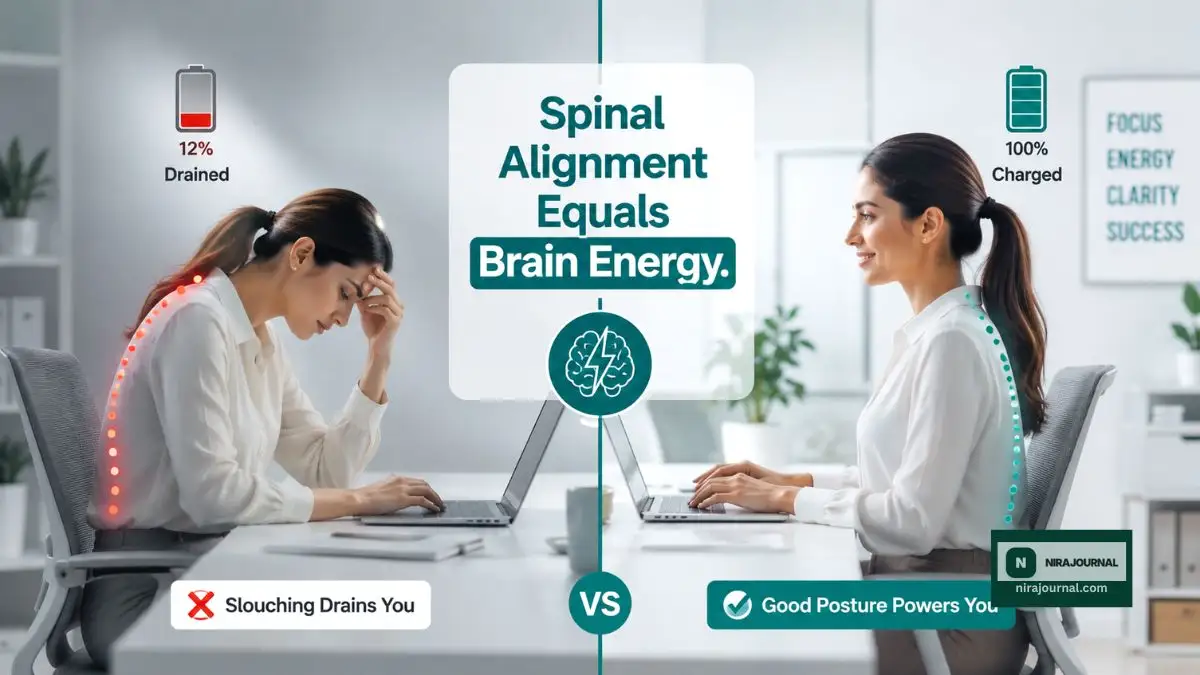
The Hidden Science Behind Your Desk Slouch and Brain Fog
Let us break down exactly what happens inside you when you sink into that comfortable but terrible desk chair. It is not just about looking lazy or having a sore back.
Your brain uses about 20% of your body's total oxygen supply. When you round your shoulders forward and collapse your chest, you actually squish your lungs. You simply cannot take a full, deep breath.
Because you are taking shallow breaths, less oxygen makes its way to your brain. This creates a mild but constant state of physical panic and fatigue. You might wonder why you feel so sleepy during important meetings, even when the topic is interesting.
Your brain is literally running on low power mode because it is starving for fresh oxygen. According to researchers at the Cornell University Human Factors and Ergonomics Laboratory, poor physical alignment can significantly restrict respiratory function, directly leading to decreased cognitive performance and rapid fatigue.
Think about your head like a heavy bowling ball. An average human head weighs about 10 to 12 pounds. When your ears line up perfectly with your shoulders, your spine supports that weight effortlessly.
But for every single inch you push your head forward to look at a screen, that weight doubles on your neck and shoulder muscles.
The Heavy Toll on Your Daily Stamina
Imagine walking around all day holding a 30-pound dumbbell right in front of your chest. You would be exhausted in ten minutes.
Yet, this is exactly what you are doing to your upper back muscles when you lean forward to squint at your phone or laptop. No wonder your daily energy levels are completely wiped out by dinnertime.
Your muscles are working overtime, burning through the energy that you should be using for creative thinking, problem-solving, and enjoying your evening.
To make this easier to picture, let us look at a simple breakdown of what happens when you change your physical habits.
When your nervous system is constantly dealing with muscle strain, it releases small amounts of stress hormones. Your body thinks it is under attack because it is constantly uncomfortable.
This low-level stress eats away at your mental focus. You simply cannot write a brilliant proposal or handle a difficult client when your body is silently screaming in discomfort.
Actionable Fixes to Reclaim Your Mental Clarity
Fixing this problem is not about sitting stiff as a board or buying a thousand-dollar ergonomic chair. It is about building small, smart habits that support your physical structure.
Let us look at some highly practical changes you can make right now, without turning your life upside down.
Setting Up a Workspace That Supports Your Spine
Your environment dictates your behavior. If your laptop is sitting flat on your desk, you are naturally going to look down.
The very first thing you need to do is raise your screen. The top of your monitor should be perfectly level with your eyes. You can use a stack of thick books, a sturdy box, or a dedicated laptop stand.
When your eyes look straight ahead, your neck automatically aligns itself. This single change can save you from hours of physical tension.
Next, pay close attention to your feet. They should be completely flat on the floor. If they are dangling or crossed tightly under your chair, your pelvis tilts backward.
When your pelvis tilts, your lower back rounds, and the rest of your spine follows like a collapsing line of dominoes. If your chair is too high, grab a small footrest or even an empty shoebox to support your feet.
My personal realization here: I used to spend hours working from my soft living room couch, thinking I was being highly efficient and comfortable. I quickly realized that sinking into those soft cushions was secretly destroying my lower back and making me incredibly sleepy. The moment I forced myself back to a proper table setup, my focus instantly doubled.
Simple Movement Habits to Reboot Your Brain
Staying in one perfect position all day is impossible. Even the most perfectly aligned sitting posture will cause fatigue if you hold it for eight hours.
The secret to maintaining high energy levels is consistent, gentle movement. You need to reset your physical alignment every single hour.
Try a simple technique called the "Shoulder Blade Squeeze." Simply sit up, pull your shoulders back, and pretend you are trying to hold a pencil between your shoulder blades.
Hold that position for five seconds, then release. Do this three times. This instantly wakes up the muscles that have been stretched out by slouching.
Watch this incredibly helpful visual breakdown on how to reset your desk posture in under two minutes.
Another amazing habit is the "Doorway Stretch." Every time you get up to grab water or go to the bathroom, stand in a doorway.
Place your forearms on the door frame and gently lean your chest forward. You will feel an amazing stretch across your chest and shoulders.
This simple action opens up your breathing pathways and sends a fresh rush of oxygen straight to your brain, washing away that sluggish feeling.
For those who want to start their day with maximum physical freedom, having a dedicated morning routine is life-changing. If you want to dive deeper into starting your day right, you should check out this guide on Proven Morning Stretching Routines to Eliminate Lower Back Stiffness Safely.
Myth vs. Reality: The Truth About Sitting
There is a lot of confusing advice out there about how we should sit and work. Let us clear up some common misunderstandings.
The Myth: You need a highly expensive ergonomic chair to fix your slouching habit.
The Reality: A good chair helps, but it will not magically fix your bad habits. If you have weak core muscles, you will still slouch in a three-thousand-dollar chair. Awareness and simple adjustments matter much more than expensive furniture.
The Myth: Standing desks solve all physical problems.
The Reality: Standing all day brings its own set of issues, like knee joint pain and lower back compression. The true goal is changing positions frequently, not just replacing sitting with standing.
When you understand these realities, you stop looking for magic fixes. You start paying attention to your daily habits and how your body actually feels in the moment.
Aligning Your Mind and Body During Stressful Hours
Stress is the biggest enemy of good physical habits. When deadlines approach and pressure builds, we naturally tense up.
Our shoulders creep up toward our ears, and our breathing becomes shallow. We literally curl into a defensive ball without even noticing it.
You must learn to recognize your own physical stress triggers. Catch yourself when you are clenching your jaw or tightening your shoulders.
Take a deep breath through your nose, let your belly expand, and consciously drop your shoulders away from your ears. This simple breathing exercise sends a powerful safety signal to your nervous system.
It lowers your heart rate and clears the mental fog caused by panic. It is fascinating how a small physical reset can completely change your emotional state.
According to the American Psychological Association, chronic muscle tension from stress and poor habits can trigger a loop of anxiety, making it increasingly difficult to concentrate on detailed tasks. By actively managing your alignment, you break this negative cycle.
Sometimes, the environment you work in makes it very hard to stay relaxed and aligned. If you are dealing with constant negative pressure from colleagues or bosses, your physical tension will skyrocket.
Learning to separate your mental peace from your physical environment is a powerful skill. To understand how to protect your energy in tough situations, you might find immense value in reading A Complete Beginner’s Blueprint to Practicing Mindfulness in a Toxic Workspace.
We often underestimate the profound connection between how we carry ourselves physically and how we feel mentally. Changing your physical posture changes how others perceive you, but more importantly, it changes how you perceive yourself.
When you sit up straight, open your chest, and breathe deeply, your brain receives a very specific message. It tells your mind that you are alert, capable, and ready to handle whatever challenges come your way.
Beyond Basic Adjustments: Training Your Body for Long-Term Stamina
Fixing your physical alignment for one afternoon is entirely different from building a lifetime of natural energy. Many people try to sit up straight for a few hours, feel slightly sore, and immediately give up. If you want to permanently stop feeling exhausted by mid-day, you have to train your nervous system to accept a new normal.
Think about when you first learned to ride a bicycle or drive a car. In the beginning, every single movement required your full mental attention. You had to actively think about your hands, your feet, and your balance all at the same time.
Correcting your physical habits works exactly the same way. At first, it takes conscious mental effort to remind yourself to pull your head back and open your chest. But if you stick with small, daily adjustments, your brain eventually puts this habit on autopilot.
One of the greatest secrets to maintaining all-day mental sharpness is learning how to actively engage your core while you sit. I am not talking about doing intense abdominal workouts at your desk. I am talking about a gentle, barely noticeable tightening of your stomach muscles.
When your core is entirely relaxed, your spine takes all the heavy impact of gravity. By simply tightening your stomach by about 10%, you create a natural support belt for your lower back. This takes the extreme pressure off your neck and shoulders, allowing fresh blood and oxygen to flow freely to your brain.
According to Harvard Medical School research on core stability, maintaining a gently engaged core is one of the most effective ways to protect your spine from daily fatigue. When your spine feels supported, your nervous system stops sending out exhausting panic signals.
The Hidden Power of Spinal Hydration
Most people have no idea that drinking water directly impacts their ability to sit upright comfortably. Your spine is made up of bones separated by soft, cushion-like discs. These discs are very much like jelly donuts, and they rely heavily on water to stay plump and supportive.
When you sit at a desk for hours without drinking enough water, those discs literally begin to flatten out. As they lose moisture and shrink, you naturally begin to hunch forward because the physical support is gone.
This creates a terrifying cycle of exhaustion. You feel tired, so you slouch. The slouch compresses your lungs and drains your brain energy further.
Then, to wake up, you drink more coffee. But caffeine naturally dehydrates you even faster, causing your spinal discs to flatten even more. If you are caught in this exhausting loop, you might find incredible relief in reading Beating Afternoon Brain Fog When Caffeine No Longer Keeps You Awake or Focused.
To fix this, you must keep a large glass of water right next to your computer screen. Every time you take a sip, use that exact moment as a mental trigger to check your physical alignment. Sit tall, breathe deep, and let the hydration rebuild your internal support system.
Mastering the Art of the "Micro-Break"
You do not need to step away from your desk for twenty minutes to reset your physical battery. The most productive people in the world use a technique known as the "micro-break." These are tiny, fifteen-second resets that happen right in your chair.
Imagine you are in the middle of a very stressful afternoon meeting. You are on mute, staring at a spreadsheet, and you can feel a tension headache starting to build behind your eyes. Instead of rubbing your temples and accepting defeat, try a micro-break.
Simply drop your hands to your lap, close your eyes for exactly five seconds, and roll your shoulders backward three times. Take one massive breath in through your nose, expanding your stomach like a balloon, and slowly blow the air out through your mouth.
This simple physical action instantly lowers your heart rate and sends a rush of fresh oxygen directly to your brain. It takes less than fifteen seconds, but it can easily buy you another two hours of high-quality mental focus.

The Sneaky Traps Derailing Your Physical Progress
When people finally decide to fix their sitting habits, they often jump in with way too much enthusiasm. This aggressive approach almost always leads to painful mistakes that make the original problem much worse. Let us look at the most dangerous traps you must avoid on your journey to better energy.
The Danger of the "Military Spine"
The absolute biggest mistake people make is trying to force a perfectly straight, stiff posture. They violently pull their shoulders back, puff their chest out like a soldier, and hold their breath. This is completely unnatural and highly damaging.
Your spine is not supposed to be a perfectly straight stick. It naturally has three gentle curves that act as shock absorbers for your body. When you try to force a stiff, military-style pose, you are actually creating massive amounts of muscle tension.
This tension burns through your daily energy reserves faster than anything else. Good alignment should feel relaxed, effortless, and comfortable, never stiff or painful. If your back is burning from trying to sit up straight, you are pushing way too hard.
The "Weekend Warrior" Healing Trap
Another massive trap is thinking you can undo a whole week of terrible physical habits with one single stretching session on Saturday morning. You cannot sit like a curled-up shrimp for forty hours and expect a single yoga class to fix your spine.
Your body adapts to whatever position you put it in the most frequently. If you spend most of your life hunched over a keyboard, your chest muscles will physically shrink and shorten. Your brain will adapt to this shallow breathing, keeping your energy locked in a permanent low state.
Consistency will always beat intensity. Doing a gentle two-minute stretch every single day is completely life-changing compared to doing a painful one-hour stretch once a week.
The Late-Night Scrolling Sabotage
Perhaps the most heartbreaking mistake happens right before you go to sleep. You spend all day trying to keep your head up and your chest open. Then, you get into bed, prop your head up on three thick pillows, and stare down at your phone for an hour.
This position completely ruins your neck alignment right when your body is supposed to be healing itself. The extreme forward bend of your neck compresses your airways, making it impossible to get deep, restorative sleep.
You wake up feeling groggy, your neck is incredibly stiff, and the brain fog is thicker than ever. If you struggle with breaking this specific nighttime habit, you need to explore a better routine by checking out Creating a Sustainable Evening Wind-Down Ritual Without Relying on Digital Screens.
Action Plan: Reclaiming Your Natural Energy Flow
Fixing the way you hold your body is not a punishment or a strict set of rules to follow. It is a completely free, highly effective way to unlock the daily mental clarity that you naturally deserve. When you stop fighting gravity and start supporting your spine, everything else in your life becomes noticeably easier.
We must stop treating our bodies like cheap rental cars that just carry our brains around. Your physical alignment is the absolute foundation of your emotional patience, your creative thinking, and your memory retention.
It is fascinating to realize that simply changing how you sit can actually change your brain chemistry. According to studies published by the Association for Psychological Science, adopting an upright, open physical stance actively reduces stress hormones and immediately boosts feelings of self-confidence and mental sharpness.
Start small tomorrow morning. Focus entirely on setting your screen at eye level and keeping your feet flat on the ground. When the afternoon slump tries to sneak up on you, do not reach for a sugary energy drink.
Instead, stand up, stretch your chest in a doorway, and take three massive, deep breaths. You will be absolutely amazed at how quickly your brain wakes back up. The power to control your daily energy has always been resting right inside your own muscles.
My personal realization: I spent years believing I was naturally a low-energy person who simply could not handle long work days. The moment I finally corrected my desk habits and stopped suffocating my own lungs, my entire life changed. I now finish my work days with enough mental fuel left over to actually enjoy my evenings, and I want that exact same freedom for you.
Real Questions People Ask About Posture and Brain Fog
Can slouching actually cause headaches and brain fog?
Yes, it absolutely can. When you lean your head forward, it severely strains the muscles at the base of your skull. This tension restricts smooth blood flow to your brain, directly causing dull headaches and making it very hard to concentrate on your work.
How long does it usually take to see improvements in my daily energy?
Many people feel a noticeable difference in their mental clarity on the very first day they improve their breathing and alignment. However, building the muscle memory so it feels completely natural usually takes about three to four weeks of consistent, gentle practice.
Is it normal to feel a little sore when I start sitting properly?
Yes, a mild feeling of muscle tiredness is completely normal. Your back and core muscles might feel slightly fatigued because they are finally working again after being asleep for a long time. Just remember to take frequent breaks and never force a position that causes sharp pain.
Will buying a wearable posture corrector fix my afternoon fatigue?
A wearable brace can serve as a temporary physical reminder, but it will not fix the root problem. Relying entirely on a brace actually makes your core muscles weaker over time. Your best defense against fatigue is actively building your own internal muscle strength and awareness.
Disclaimer: The information provided in this article is for educational and informational purposes only and does not constitute medical advice. Always consult with a qualified healthcare professional or physical therapist before starting any new stretching routines or making significant changes to your physical health habits, especially if you experience chronic pain.
About the Author
Munira Parveen is a dedicated Digital Content Strategist and Lead Researcher with a passion for simplifying complex topics. From navigating personal finance and emerging tech trends to uncovering the best practical lifestyle solutions, she spends her time analyzing data to bring readers highly accurate, actionable, and easy-to-understand guides. Her ultimate goal is to empower everyday people to make smarter, more informed decisions in this fast-paced digital world.
![7 Proven Ways to Beat Afternoon Brain Fog [Step-by-Step]](https://nirajournal.com/storage/uploads/blogs/1786249553_7-proven-ways-to-beat-afternoon-brain-fog-step-by-step.webp)
![The Ultimate Guide to a Screen-Free Night Routine [Step-by-Step]](https://nirajournal.com/storage/uploads/blogs/1786126225_the-ultimate-guide-to-a-screen-free-night-routine-step-by-step.webp)