The "Too Long; Didn't Read" Version
If you're in a rush, here are the big wins for your brain:
- Fix your breath: Use the 4-second "box breathing" to stop a stress spike.
- Dump your brain: Write tasks down so your mind doesn't have to keep track of them.
- Morning Rule: Don't check your phone for the first 30 minutes of the day.
- Move a little: A short walk is better than any "stress-relief" app.
The Hidden Weight We Carry Every Single Day
Have you ever felt like your brain has too many tabs open? I’m talking about that heavy feeling in your chest where even a simple text message feels like a huge chore. It’s not just you being "tired"—it’s your nervous system screaming for a break. Let's talk about how to actually quiet that noise and get your focus back, without the usual "just meditate" advice that doesn't always work.
Many of us live in this state of "high alert" without even realizing it. You might wake up feeling like you are already behind schedule before your feet touch the floor. Maybe you find yourself snapping at loved ones over small things or feeling a constant, nagging worry that refuses to go away. This state of persistent stress is not just annoying; it is a physical burden that your body carries. When the nervous system remains stuck in this "on" mode, it begins to affect everything from your digestion to your ability to focus on simple tasks. It is as if you are trying to run a high-performance engine while the parking brake is engaged, and eventually, the friction starts to wear everything down.
The reality is that we often view stress as an external problem—if only the emails would stop or the bills were lower, we would be fine. But true balance comes from understanding how we respond to these pressures internally. If you feel like you are just surviving rather than thriving, you are not alone in this experience. Many professionals and students face this exact cycle of exhaustion, yet we rarely pause to look at the biology behind it. Breaking this cycle requires a shift in how we process our environment, rather than just trying to change the environment itself.

Decoding the Biology of Your Nervous System
To manage stress, we first need to understand that your brain is hardwired for survival. When you perceive a threat, your body releases hormones like cortisol and adrenaline to help you fight or flee. In the modern world, your brain often treats a crowded inbox or a difficult conversation exactly like a physical threat. This is why you feel that physical "tightness"—your body is preparing for a battle that never happens.
Research from the National Institutes of Health highlights that chronic activation of this stress response can lead to significant long-term health challenges. Your goal is not to eliminate stress entirely, which is impossible, but to teach your body to return to a "rest and digest" state more quickly. Think of it like a muscle; you are training your nervous system to be more flexible. When you understand that this physical response is just biology, you stop feeling like you are "broken" and start seeing it as a system you can regulate.
Quick Check: Is it Stress or Burnout?
Step-by-Step Guide to Reclaiming Your Inner Calm
1. The Power of Controlled Breathing Patterns
The fastest way to signal safety to your brain is through your breath. When you are stressed, your breathing becomes shallow and rapid, which further triggers the fight-or-flight response. By intentionally slowing your exhale, you stimulate the vagus nerve, which acts as a brake for your heart rate.
Try the "box breathing" method: inhale for four seconds, hold for four, exhale for four, and hold for four. You can do this at your desk, in your car, or before a meeting. It is a simple, invisible tool that forces your nervous system to downshift. When you practice this, you are literally hacking your own physiology to restore order.

My "3-Minute Reset" Routine
If you feel a panic spike coming on, try this sequence right away:
- Minute 1: Drink a full glass of cold water (it shocks your system into the present).
- Minute 2: Stand up and stretch your arms as high as you can.
- Minute 3: Write down the ONE thing that is bothering you most on a scrap of paper.
2. Identifying and Managing Your Mental Load
Often, our stress comes from trying to hold too much information in our working memory. Our brains are designed for processing ideas, not for storing long lists of to-dos. If you feel like your head is cluttered, it is because you are using your mental energy to "remember" rather than to "think."
You can manage this by creating a external brain—a place where you write everything down immediately. If you want to know more about balancing your personal life while managing heavy projects, you might find it useful to think about Navigating the Early Stages of a Startup: Common Pitfalls to Avoid. By offloading your tasks, you give your mind the permission it needs to rest. This is a practice of mental decluttering that prevents the buildup of daily anxiety.
3. Creating Boundaries for Digital Consumption
A Quick Lesson I Learned: I used to think I was a "pro" at multitasking. I’d have a podcast running while answering emails and eating lunch. Honestly? I was just burning myself out. I started "single-tasking"—only doing one thing at a time—and the constant buzzing in my head finally stopped. It felt slow at first, but I actually finished my work an hour earlier than usual.
We live in an era where information is constant, and our attention is constantly being sold to the highest bidder. This constant stream of news, emails, and social media creates a low-grade, constant stress that we often ignore. To restore balance, you must set strict "no-phone" zones in your home.
I personally realized that my morning anxiety was linked directly to checking my emails before I even brushed my teeth. My realization was that by allowing the world into my bedroom first thing in the morning, I was giving away control of my mood before the day even began. Once I stopped doing this, my baseline level of stress dropped significantly. You should try to protect your first and last hour of the day from digital interference.
4. Physical Movement as a Stress Outlet
Movement is the primary way our ancestors processed adrenaline. When you feel "keyed up," your body has pent-up energy that needs to be moved. You don't need a heavy gym workout to achieve this; a simple twenty-minute walk can suffice.
Scientific studies published in journals like The Lancet suggest that rhythmic movement helps regulate mood and improves cognitive function. It allows your brain to transition from a focused state to a relaxed state, helping you process the day's events. If your daily devices have become a source of stress due to constant repairs or technical issues, you might want to consider Understanding the Lifespan of Smart Devices: When to Repair or Replace to simplify your physical environment. By optimizing your tools, you reduce the "micro-stresses" that add up over time.
If you want to see exactly how these physical techniques look in practice, watch this short guide below to help you integrate them into your day.
5. Prioritizing Deep Rest Over Simple Distraction
There is a massive difference between "zoning out" and "resting." Watching a show while scrolling through your phone is a distraction, not rest. Real rest involves activities that allow your prefrontal cortex—the part of your brain responsible for decision-making—to power down.
True recovery happens when you engage in activities that are low-stimulation, such as reading a physical book, stretching, or simply sitting in silence. When you learn to distinguish between these two states, you can choose to give your mind the genuine recovery it needs to perform at its best. Remember, your productivity is directly tied to the quality of your recovery.
6. The Art of Single-Tasking
Multitasking is a myth that creates unnecessary friction in our brains. Every time you switch between tasks, your brain pays a "switching cost," which leads to mental fatigue. By focusing on one task at a time, you actually get more done in less time, and with much lower stress.
Try to group your tasks into blocks. Spend thirty minutes on one type of work, take a short break, and then move to the next. This creates a sense of achievement and rhythm throughout your day. When you finish a task, you feel a sense of completion, which is the perfect antidote to the "never-ending" feeling of chronic stress.
7. Assessing Your Environment for Triggers
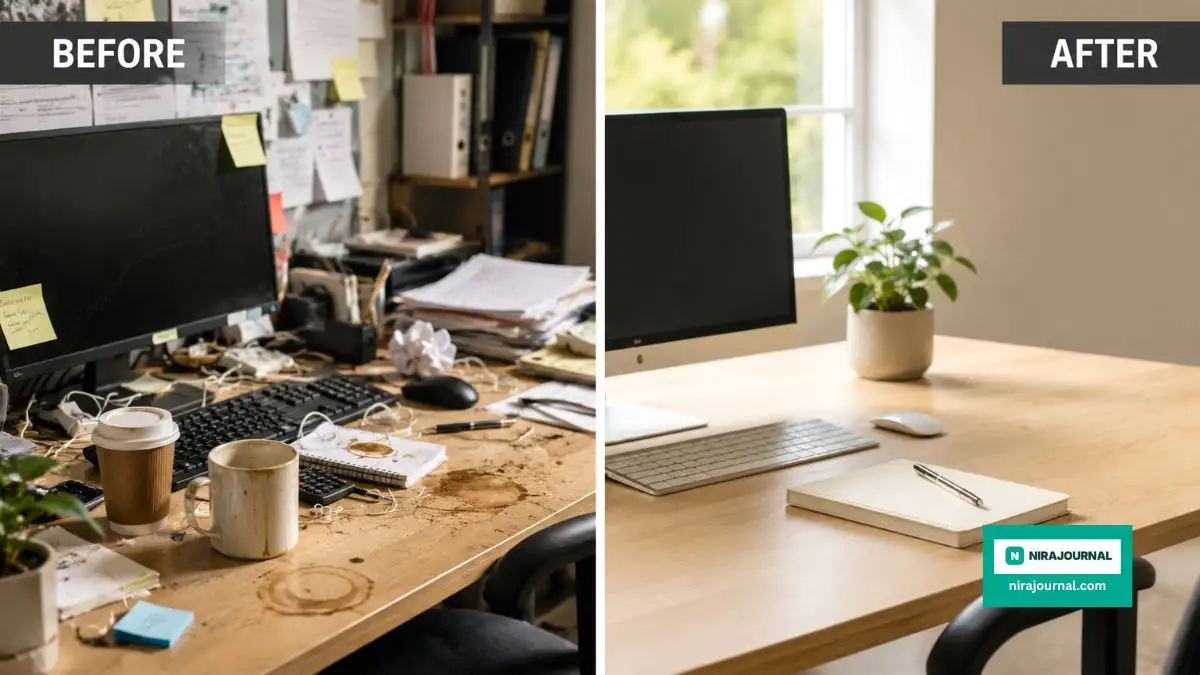
Your physical environment impacts your mental state more than you think. A cluttered space often leads to a cluttered mind. Spend some time organizing your workspace to ensure that everything you need is easily accessible, and everything you don't need is removed.
A clean, minimalist desk provides a sense of control and calm. When you walk into your workspace, it should feel like a place of focus, not a place of chaos. Making small, incremental changes to your environment can have a compounding effect on your daily stress levels.
8. Cultivating Compassion for Yourself
Finally, remember that you are a human, not a machine. Some days will be more stressful than others, and that is perfectly normal. Do not be hard on yourself if you feel overwhelmed; instead, acknowledge the feeling and use the tools we discussed to gently steer yourself back to center.
Your mental balance is a journey, not a final destination. By consistently applying these small, science-backed changes, you build resilience. You are not just managing stress; you are building a life where you have the capacity to handle whatever comes your way with grace and composure. Keep practicing, stay observant of your patterns, and remember that you always have the power to pause and reset.
Mastering Your Inner Resilience: Pro-Level Strategies
Moving beyond the basics of breathing and task management requires a shift in how you view your own identity. You are not a machine that can be tuned, but a living system that needs to be nurtured. To reach a state where you are truly resilient, you have to start looking at your long-term energy management rather than just short-term stress reduction.
The Secret of Micro-Recovery Sessions
Most people believe that rest only happens after work, but the secret lies in "micro-recovery." These are brief periods—sixty to ninety seconds—where you consciously disconnect from your mental work. You can do this by looking out a window at a distant object or simply relaxing your jaw and shoulders. By doing this every hour, you prevent the buildup of tension that usually hits you by the end of the day.
Aligning Your Daily Rhythm with Natural Cycles
Your body operates on internal clocks that dictate energy levels. Some of us are sharpest in the early morning, while others find their stride in the late afternoon. If you force yourself to do high-focus work when your energy is naturally low, you create unnecessary stress. Track your energy for a few days to find your natural peak, then guard that time for your most demanding tasks.
The Power of Cognitive Reframing
When a challenging situation happens, your first reaction is often emotional. To build a higher level of resilience, practice "cognitive reframing," which means looking at the problem from a different angle. Instead of asking, "Why is this happening to me?" try asking, "What can I learn from this to make my process better next time?" This simple shift moves you from a state of victimhood to a state of agency.
Sustaining Your Energy for the Long Run
Maintaining these results requires consistency in your environment. Just as we look to Energy Independence: Practical Steps to Reduce Your Home’s Carbon Footprint to simplify our living space, we must also simplify our mental habits. You cannot expect to stay calm if you are surrounded by unnecessary clutter or toxic digital environments. Make it a habit to audit your workspace and your digital habits every month to ensure they still serve your need for peace.

The Invisible Traps That Keep You Stuck
It is easy to fall into habits that promise relief but actually increase your stress over time. We often think that "venting" to friends or scrolling through feeds after a hard day is helping us unwind. In reality, these activities often keep our minds trapped in the same stressful loop. When you repeat the story of your stress over and over, your body re-experiences the same cortisol spike, preventing you from ever truly recovering.
Another common trap is the "all or nothing" mindset. You might feel that if you cannot meditate for twenty minutes or get to the gym for an hour, you might as well do nothing at all. This perfectionist trap is a major enemy of progress. Even a three-minute walk or a two-minute breathing exercise is infinitely better than doing nothing, yet we often discard these small wins because they don't seem "enough."
Many people also struggle with the habit of "productive procrastination." This is when you spend your energy on easy, low-impact tasks just to avoid the one big thing that is causing you anxiety. This creates a false sense of being busy while the real source of your stress grows in the background. If you want to build a career or a business, you must learn to face these challenges head-on. If you are starting a new journey, you might want to look at Building a Sustainable Online Income: Avoiding Common Traps for Beginners to see how professionals manage this exact pitfall.
Your Path to a Balanced and Calm Life
You have the tools and the knowledge to shift your perspective today. Start by picking just one small habit from this guide and applying it consistently for a week. You do not need to overhaul your entire life overnight to see significant changes in how you feel. The goal is progress, not perfection.
When you start to notice the moments where you feel calm, acknowledge them. This positive reinforcement tells your brain that safety is possible, and that you are capable of creating it for yourself. Remember that your mental balance is the most important asset you own in your professional and personal life.
I know how difficult it is to change when everything around you feels demanding and loud. But I have found that when I choose to prioritize my peace, everything else seems to fall into place much more easily. Start small, be kind to yourself, and keep moving forward one step at a time. Your future self will thank you for the calm you are building today.
Common Questions About Stress and Mental Balance
Why do I feel stressed even when nothing bad is happening?
Your brain might be reacting to internal pressure or a habit of constant worrying. Sometimes, your nervous system gets stuck in a "high alert" mode because it is used to being busy. Learning to consciously relax is a skill that takes practice.
Is it normal to feel tired after a day of sitting at a desk?
Yes, mental work is just as demanding as physical work. Your brain consumes a huge amount of energy when you are focusing, solving problems, or making decisions. You need to provide your mind with downtime just like an athlete rests their muscles.
How do I stop worrying about tomorrow?
Focus on your "next right move" rather than the whole day ahead. By narrowing your focus to the immediate task, you prevent your mind from spinning stories about future events that may never happen. Staying present is the most effective way to lower anxiety.
Can food affect my stress levels?
Yes, what you put in your body changes how your system handles stress. Blood sugar crashes can mimic or worsen the physical sensations of anxiety. Keeping your energy stable with simple, consistent nutrition helps keep your mood steady.
How long does it take to see results?
You might feel a shift in your baseline stress within a few days of practicing these techniques. The more consistent you are, the more your body will default to a calm state. It is a process of retraining your system, so be patient with yourself.
Disclaimer: The information provided in this article is for educational purposes only and does not constitute professional medical or psychological advice. Always consult with a qualified health professional regarding any health concerns or before making significant changes to your wellness routine.
About the Author
Munira Parveen is a dedicated Digital Content Strategist and Lead Researcher with a passion for simplifying complex topics. From navigating personal finance and emerging tech trends to uncovering the best practical lifestyle solutions, she spends her time analyzing data to bring readers highly accurate, actionable, and easy-to-understand guides. Her ultimate goal is to empower everyday people to make smarter, more informed decisions in this fast-paced digital world.

![5 Hidden Secrets to a Zero-Carbon Home [Avoid These Common Mistakes]](https://nirajournal.com/storage/uploads/blogs/1787275347_5-hidden-secrets-to-a-zero-carbon-home-avoid-these-common-mistakes.webp)
![Are These 5 Common Pitfalls Ruining Your Business? [How to Fix Them]](https://nirajournal.com/storage/uploads/blogs/1787210673_are-these-5-common-pitfalls-ruining-your-business-how-to-fix-them.webp)