
The Crushing Weight of an Unwanted Idea
I remember staring at my laptop screen at two in the morning, feeling a heavy weight pressing down on my chest. I had just launched what I thought was an absolute genius business idea. I poured my savings, my energy, and months of sleepless nights into building the perfect product. I sat back, refreshing my screen, waiting for the massive wave of sales notifications to roll in.
But instead, there was complete silence. Not a single person bought my product. I felt physically sick to my stomach. I realized right then that I had made the most expensive mistake a beginner can make.
I built the entire solution before asking if anyone actually had the problem.
This is the exact reason why so many bright ideas end up failing miserably. We get so completely caught up in the excitement of our own imagination that we forget to check reality. We empty our bank accounts, borrow cash from friends, and sacrifice our mental peace for something based purely on guesswork.
The financial stress alone is enough to ruin your everyday life. You wake up wondering how you will ever recover the lost money. Your confidence takes a massive hit, and you start feeling like you let yourself and your family down. You start doubting if you are even meant to be an entrepreneur at all.
But here is the honest truth I had to learn the hard way. Your business idea is nothing more than a guess until a complete stranger is willing to give you their hard-earned money for it.
You absolutely do not need to empty your wallet to find out if your concept is profitable. You just need a smart, logical system to test the waters before you jump into the deep end.
Mastering the Art of Zero-Cost Demand Testing
So, how do we actually find out if people want what we are selling without building it first? We have to stop acting like inventors and start acting like scientists. We need to run experiments.
Testing your market demand does not require an expensive marketing agency or a fancy prototype. It requires observation, psychology, and a willingness to hear the truth. Let us break down the exact methods you can use starting today to see if your idea has real buying potential.
The Illusion of the Perfect Product
Most beginners think they need a polished, flawless product before they can show it to anyone. This is a massive trap. People do not buy products because they look pretty; they buy them to solve a very specific pain point.
If your core solution is not something they desperately need, adding shiny features will not change their minds. You have to strip your idea down to its most basic form. Ask yourself what the main promise of your business is.
Once you know that core promise, you can test it using completely free tools available on the internet. You just need to measure if people care enough to stop scrolling and take an action.
This is exactly Why Most Side Hustles Fail Within the First Year: A Reality Check. People spend all their time decorating the shop instead of figuring out if anyone even wants to walk through the door.
Setting Up a Digital Smoke Test
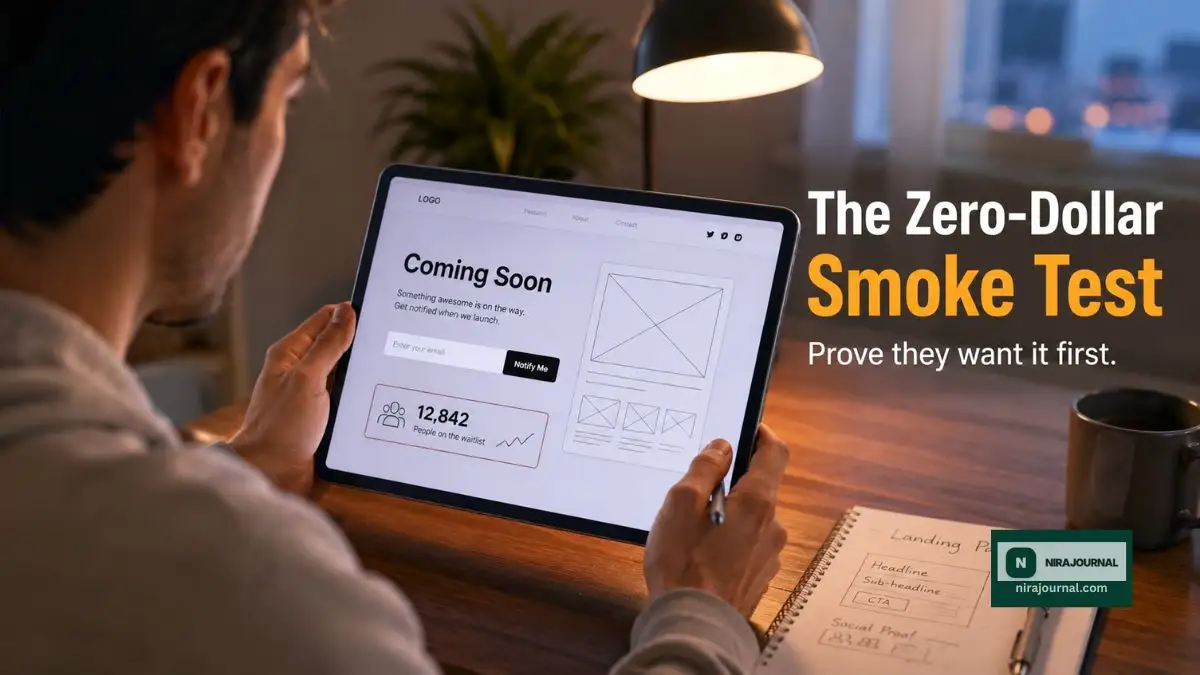
One of the most powerful and scientific ways to gauge interest is by running what the industry calls a "smoke test." A smoke test is essentially a fake front door for a business that does not exist yet.
You create a very simple, one-page website that explains your product exactly as if it were ready to buy right now. You highlight the main benefits, show a mockup image, and include a clear call-to-action button.
But here is the trick. When a visitor clicks the "Buy Now" or "Sign Up" button, they are not taken to a checkout page. Instead, they see a polite message saying, "We are currently out of stock" or "We are launching soon, leave your email to get early access."
This method is brilliant because it measures real purchase intent. Asking your friends if they like your idea is useless because they will lie to protect your feelings. But if a stranger clicks a button expecting to pay, you have undeniable proof that they want your solution.
If you set up a simple landing page and absolutely nobody clicks that button, you just saved yourself thousands of dollars and months of wasted effort. You can use free platforms like Carrd, Mailchimp, or System.io to build these pages in less than an hour.
Watch this breakdown on how to properly set up your first validation landing page to capture high-converting leads.
The Power of Shadowing Your Competitors
If you have a business idea, chances are someone else is already doing something similar. Do not let this discourage you. Competition is actually the best free validation tool on the market.
If there is competition, it means there is money moving around in that space. Your job is to figure out what those competitors are doing horribly wrong. You can do this by diving deep into their customer reviews.
Go to Amazon, Trustpilot, or industry forums and search for the top products in your niche. Completely ignore the five-star reviews. They do not help you. Ignore the one-star reviews too, as they are usually just angry rants about shipping delays.
You need to focus exclusively on the three-star reviews. This is where the magic happens. Three-star reviews are left by rational people who liked the concept but were disappointed by a specific missing feature.
They will literally tell you exactly what they wish the product had. If you see the same complaint popping up twenty times, congratulations. You just found a validated, profitable angle for your own business idea, and it did not cost you a single penny to discover it.
Engaging in Stealth Social Listening
People love complaining on the internet. It is one of human nature's most consistent habits. As a smart entrepreneur, you can turn these complaints into your biggest asset.
Social listening means quietly observing where your target audience hangs out online and reading their unedited thoughts. Reddit is an absolute goldmine for this. Find specific communities (subreddits) related to your niche and sort the posts by the most popular discussions.
Look for posts that start with phrases like "How do you guys deal with..." or "I am so tired of...". Read the comments. See what solutions people are desperately begging for.
Do not try to sell anything in these groups. If you drop a link to your idea immediately, you will get banned. Instead, join the conversation naturally. Ask open-ended questions to dig deeper into their daily frustrations.
I once spent three weeks just reading comments in a Facebook group for independent graphic designers. By simply paying attention, I realized they did not need another design software; they desperately needed a way to manage difficult client contracts.
Pro Tip: I used to think I had to sound like a massive corporation when talking to potential users online. I quickly realized that people hate talking to logos. The moment I started using my real name, sharing my genuine curiosity, and asking for simple advice, my response rate skyrocketed. People want to help a real human who is trying to solve their problem.
Mastering the Customer Interview
Once you have identified a few people who fit your ideal customer profile, you need to talk to them directly. This terrifies a lot of beginners, but it is a non-negotiable step.
You can reach out to them on LinkedIn or Twitter with a very humble message. Tell them you are doing research to solve a specific problem in their industry and ask for just fifteen minutes of their time. Do not mention your product idea at all in the pitch.
When you get them on a call, your job is to listen, not to pitch. If you pitch your idea, they will naturally nod along and say it sounds nice just to be polite. Polite feedback is the enemy of profitable validation.
Instead, ask them to walk you through the last time they experienced the specific problem you are trying to solve. Ask them how much money or time it cost them. Ask them what tools they are currently using to fix it.
According to Harvard Business School's guide on customer discovery, asking users to recall specific past behaviors is vastly more accurate than asking them to predict their future actions. People are terrible at guessing what they will do tomorrow, but they are very honest about what they did yesterday.
If they tell you that the problem is annoying, but they have not spent any money or effort trying to fix it yet, walk away. If they are not actively looking for a solution, they will never pay for yours.
The Pre-Sale Strategy: The Ultimate Proof
There is only one true form of validation in the business world. It is the exchange of money. Everything else is just a very strong hint.
If you want to be one hundred percent sure your idea will work, try to sell it before you build it. This works exceptionally well for software, coaching, courses, and digital products. You can create a detailed proposal of what the final product will look like and offer it at a massive discount to early adopters.
Be completely honest with them. Tell them the product is still in development, but if they secure their spot now, they get lifetime access for a fraction of the future retail price. If you get enough pre-orders, you now have the cash to actually build the thing.
If you get zero pre-orders, you simply refund anyone who might have paid, apologize, and move on. You lose absolutely nothing but a bit of time.
Handling this initial influx of cash properly is a whole different skill set. If you do manage to secure pre-orders, make sure you know exactly how to manage that money. If you want to keep your business alive, Understanding Cash Flow vs. Profit: A Critical Distinction for Founders is something you must master early on.
Avoiding the Trap of "Yes Men"
When you are testing your idea, you have to be highly careful about who you take feedback from. Taking advice from the wrong crowd will send you down a very dangerous path.
Never ask your mom, your spouse, or your best friend if your business idea is good. They love you. They want you to be happy. They will absolutely lie to your face and tell you it is brilliant just to support your dreams.
Even if they do tell you the truth, their opinion does not matter unless they are your target demographic. If you are building a tool for freelance video editors, your uncle's opinion on the software is completely irrelevant.
You must protect yourself from false positive validation. Only seek feedback from people who would actually pull out their credit card to buy the final product.
I see so many new founders post their ideas on generic entrepreneurial forums asking, "Would you use this?" The responses are always flooded with other entrepreneurs saying, "Great idea, keep going!" But those people are never going to be actual paying customers.
You have to be ruthless about ignoring feedback from people outside your market. Every minute you spend talking to the wrong person is a minute stolen from finding your actual paying customers.
Looking at Search Intent Data
We live in an era where data is freely accessible if you know where to look. One of the best ways to validate an idea is to see what people are typing into Google late at night.
Google Trends is a fantastic, completely free tool for this. You can plug in the main keywords related to your business idea and see if the search volume is growing, flat, or dying. If you want to start a business selling a specific type of pet accessory, but Google Trends shows a massive five-year decline in interest, you might want to pivot.
You can also use tools like AnswerThePublic. You just type in a broad topic, and it generates a massive visual map of every single question people are asking search engines about that topic.
This gives you an incredible look directly into the minds of your potential buyers. If you see thousands of people asking "How to fix..." related to your niche, you know there is a desperate need for a solution.
By combining search intent data with the CB Insights research on startup failure—which proves that "no market need" is the number one reason businesses collapse—you build a safety net. You ensure you are stepping into a market where hunger already exists, rather than trying to force people to be hungry.
Building a Minimum Viable Audience First
Instead of building a product and then looking for an audience to sell it to, flip the script entirely. Build the audience first.
Start writing articles, posting short-form videos, or sending out a weekly newsletter about the specific topic your business idea revolves around. Share your unique perspective, give away valuable tips for free, and build a small community of loyal followers.
As you interact with this audience over a few weeks, they will naturally tell you exactly what they are struggling with. They will practically hand you the blueprint for the exact product they want to buy.
Once you have an audience that trusts you, validating any future idea becomes incredibly easy. You just send out a single email asking, "If I built this, would you buy it?" and you get real-time, honest answers from people who already value your expertise.
Building an audience takes patience, but it guarantees that when you finally do launch your product, you will not be launching it to an empty room.
Beyond the Basics: Pro-Level Validation Strategies
Once you have a basic grasp of talking to potential customers, it is time to step up your game. You want to move past simple conversations and start testing actual buying behavior. People will often tell you what they think you want to hear, but their wallets never lie.
To get absolute proof of demand, you have to look at what people actually do, not just what they say. Let us explore some advanced methods that the smartest founders use to test the waters. These tactics require zero financial investment, but they do require a bit of hustle and creativity.
The Magic of the Manual Illusion
One of my absolute favorite ways to test a business idea is using something called a "Concierge Test." The concept is incredibly simple but mind-blowingly effective. You pretend your fully automated, perfect product already exists, but behind the scenes, you are doing all the work completely manually.
Let us say you want to build a highly advanced artificial intelligence app that plans weekly custom meal plans for busy parents. Building that app would cost thousands of dollars in software development. Instead of building it, you offer the exact same service manually for a small fee.
You go into a local parenting Facebook group and offer to personally write their meal plans and grocery lists for the next week based on their dietary needs. You use a simple Google Form to collect their preferences. Then, you sit at your kitchen table, research recipes yourself, type them out, and email them directly to the customer.
To the customer, the result is exactly the same as using an app. They get a personalized meal plan delivered to them. For you, the result is pure gold. You get to see if people are actually willing to pay for this specific solution before you write a single line of code.
If nobody wants to pay you twenty dollars to manually solve their problem, they definitely will not pay a monthly subscription for an app to do it. You just saved yourself a massive financial disaster. Once you validate the demand manually and start getting overwhelmed with orders, you can use those early profits to actually build the automated software.
Mastering the Micro-Commitment Ladder
When you are testing a brand new idea, asking someone to hand over a large amount of money right away can scare them off. This does not always mean your idea is bad; it might just mean you lack trust. This is where the concept of micro-commitments comes into play.
A micro-commitment is a tiny, frictionless action you ask a potential customer to take. It is a stepping stone that proves they are genuinely interested. You start small and gradually increase the "cost" of their commitment.
First, you might ask them to simply trade their email address in exchange for a free guide related to your product. If they give you their email, they have taken step one. Next, you send an email asking them to reply with their biggest frustration regarding that topic. If they spend five minutes typing out a thoughtful reply, they have taken step two.
They are giving up their valuable time, which is a massive indicator of intent. Finally, you offer them a small, low-priced version of your solution. Maybe it is a short consultation call or a basic template. If they pull out their credit card for a five-dollar purchase, you have successfully validated a paying customer.
Understanding this sequence of behavior is incredibly powerful. According to a detailed study on consumer behavior and micro-commitments by the Stanford Graduate School of Business, getting a small initial "yes" dramatically increases the chances of a larger purchase later. You are building a psychological habit of saying yes to your brand.
The "Broken Competitor" Strategy
Another brilliant way to test demand without spending money is to find where your competitors are dropping the ball. Almost every popular product on the market has a group of highly frustrated users. Your job is to locate these unhappy people and offer them a lifeboat.
Go to websites where people openly review software or physical products. Look for the massive industry giants in your niche. Filter the reviews to only show the negative ones. You are looking for a very specific pattern of complaints.
Maybe everyone loves the competitor’s project management tool, but they absolutely hate the customer service. Or maybe they love a specific brand of organic soap, but complain that the scent fades too quickly.
Once you identify this exact pain point, you build your entire zero-cost marketing test around solving that one specific issue. You can create a simple landing page that boldly states, "Tired of your project management tool crashing? Try our stable alternative." You run this message past those exact frustrated users and see if they bite.
You do not need to invent a completely new category to build a successful business. You just need to listen to what the current market hates and offer a slightly better alternative.

The Hidden Traps That Will Drain Your Wallet
Even when you are trying to be careful, it is incredibly easy to fall into psychological traps during the validation phase. I have seen brilliant, hardworking people completely ruin their chances because they let their emotions take over the data.
Testing a business idea is not just about finding positive feedback. It is equally about actively hunting for reasons why your idea might fail. If you ignore the warning signs, you will end up building something nobody wants. Let us walk through the most dangerous pitfalls you must avoid at all costs.
The Danger of "Happy Ears"
The most common trap entrepreneurs fall into is something I like to call "Happy Ears." This happens when you only hear the feedback that confirms what you already believe. It is a very dangerous form of selective hearing.
When you ask someone what they think of your idea, they might say, "Oh, that sounds really interesting, I might use that someday." If you have Happy Ears, you immediately translate that vague politeness into "They love it and they are going to buy it right now!"
This is a classic psychological blind spot. As detailed in a comprehensive psychological overview of confirmation bias by the American Psychological Association (APA), humans naturally seek out information that validates their existing hopes and ignore data that challenges them.
You must train yourself to be a pessimist during the testing phase. If a potential customer does not explicitly ask you how they can pay for the product today, you should count it as a rejection. Vague enthusiasm does not pay your bills.
Offering Things for Free as "Validation"
This is a mistake that absolutely breaks my heart because I see it happen so often. A founder will create a basic version of their service and offer it to people completely for free, just to see if they like it.
Hundreds of people sign up for the free service. The founder gets incredibly excited, assuming they have hit the jackpot. They spend the next six months building the premium, paid version of the product.
When they finally launch the paid version and ask those free users to upgrade, every single person disappears. Crickets.
Why does this happen? Because giving something away for free validates nothing except the fact that humans like free things. The only way to prove someone values your solution is to ask them to exchange something of value for it.
If you are terrified of asking for money early on, you are setting yourself up for failure. Even if you only charge ten dollars for a beta test, that ten-dollar transaction proves infinitely more than a thousand free sign-ups.
This hesitation to charge often comes from a deep misunderstanding of business mechanics. Many founders fail because they do not understand how money actually flows through a healthy business model. This is exactly why these blind spots are considered The Silent Killers of New Startups: Common Pitfalls Entrepreneurs Overlook. You have to get comfortable with the financial realities early.
Getting Stuck in Analysis Paralysis
On the opposite end of the spectrum, some people become so obsessed with researching and validating that they never actually launch anything. They spend months tweaking their landing page, conducting endless surveys, and reading countless business books.
They are terrified of getting a negative result, so they keep delaying the actual test. I have been guilty of this myself. I once spent three weeks changing the background color of a "Coming Soon" page because I convinced myself it was not perfect yet.
The harsh reality is that your potential customers do not care about your background color. They care about whether you can solve their headache.
A validation test should be quick, dirty, and slightly embarrassing. If you are not a little bit embarrassed by your first landing page or your initial outreach message, you spent way too much time on it. The goal is rapid learning, not perfection.
Trying to Do Everything in a Vacuum
Another massive mistake is isolating yourself during the testing phase. You sit in your room, furiously working on your idea, and refuse to share your process with anyone else. You think someone is going to steal your million-dollar idea.
Let me be very clear. Ideas are entirely worthless on their own. Execution is the only thing that matters.
By hiding your idea, you are cutting yourself off from valuable feedback, potential partnerships, and harsh realities you need to hear. You need to talk about your concept openly with other business owners who have been in your shoes.
As your test starts showing positive results and you prepare to actually build the business, you will quickly realize you cannot do it all alone. You will need to learn how to trust others to help you grow. Mastering The Art of Delegating Tasks Without Losing Control of Your Vision becomes absolutely necessary once your zero-dollar test proves successful and you need to scale up quickly.
Quick Checklist: Warning Signs Your Validation is Flawed
- You only asked family and friends for their opinion.
- You talked for more than 50% of the time during customer interviews.
- You have collected zero emails or micro-commitments.
- You are giving your core service away for completely free.
- You are waiting for the product to be "perfect" before showing it to anyone.
Your Blueprint for Action Starting Today
We have covered a massive amount of ground today. You now understand exactly why building without testing is a recipe for disaster. You also have the exact tools, strategies, and psychological insights to test your market for free.
But reading about these strategies will not change your life. Action is the only thing that moves the needle. You do not need to quit your day job tomorrow. You do not need to take out a massive bank loan. You just need to take one small, calculated step.
Here is what I want you to do over the next forty-eight hours. Write down the core promise of your business idea in one simple sentence. Do not use fancy jargon. Just clearly state who you are helping and what specific problem you are solving for them.
Next, use a free tool to set up a basic landing page or a simple feedback form. Share that form directly with five strangers who fit your ideal customer profile. Do not try to sell them immediately; just ask them if this specific problem is something they actively struggle with.
Listen closely to their answers. If they ignore you, tweak your message and try five different people. Keep adjusting your approach until you find a nerve.
Remember, a failed test is actually a massive victory. Finding out an idea is bad before you spend your savings on it is the smartest business move you can ever make. It frees up your time and energy to find the idea that actually works.
I know exactly how terrifying it feels to put your precious idea out into the real world for the first time. I remember pacing around my living room, heart pounding, right before I sent my very first cold email to a potential customer. But let me tell you, the absolute freedom and confidence you feel when a complete stranger finally says, "Yes, I need this," makes every single moment of doubt entirely worth it. Take that first step today, trust the process, and watch your reality change.
Real Questions People Ask About Zero-Cost Validation
How do I validate an idea if I do not have a social media following?
You do not need a personal audience to validate an idea. You simply need to go where your target audience already hangs out. Join specific Facebook groups, industry forums, or Reddit communities and start having genuine, helpful conversations with people there.
What should I do if my zero-dollar validation test fails completely?
First, take a deep breath and celebrate. You just saved yourself thousands of dollars! Now, look at the feedback you received during the test. Usually, a failed test will highlight what people actually want instead, giving you the perfect pivot for your next, much stronger idea.
Is a simple landing page really enough to prove people will buy?
A landing page is an excellent first step, but the true proof comes from the action they take on that page. If they simply visit and leave, that is not validation. If they enter their email for early access or attempt to click a "buy" button, that shows a very high level of real purchase intent.
Can I use these methods for a physical product, or just software?
You can absolutely use these methods for physical products! Instead of a software mockup, use AI image generators or simple sketches to show what the physical item will look like. You can take pre-orders for the physical item to fund your very first manufacturing run.
How many positive responses do I need before I start building?
There is no magical number, but a good rule of thumb is finding at least ten strangers who are willing to give you a micro-commitment, like a small deposit or joining an exclusive waitlist. Ten highly eager strangers usually indicate a much larger hidden market waiting for your solution.
Disclaimer: The information provided in this blog post is for educational and informational purposes only and should not be construed as professional financial or business advice. Every business carries inherent risks, and individual results will vary based on market conditions, effort, and execution. Always conduct your own thorough research and consult with a certified professional before making any major financial or business decisions. We are not responsible for any financial losses or damages resulting from the use of the strategies mentioned above.
About the Author
Munira Parveen is a dedicated Digital Content Strategist and Lead Researcher with a passion for simplifying complex topics. From navigating personal finance and emerging tech trends to uncovering the best practical lifestyle solutions, she spends her time analyzing data to bring readers highly accurate, actionable, and easy-to-understand guides. Her ultimate goal is to empower everyday people to make smarter, more informed decisions in this fast-paced digital world.


![Profit vs. Cash Flow: The Secret Blueprint Every Founder Needs [Step-by-Step]](https://nirajournal.com/storage/uploads/blogs/1785486728_profit-vs-cash-flow-the-secret-blueprint-every-founder-needs-step-by-step.webp)