
The Night My Profitable Startup Almost Died
I remember sitting in my dark home office, staring at a spreadsheet that told me I was successful. My accounting software showed a beautiful green number: $45,000 in net profit for the month. I felt like a genius. I felt like I had finally made it as a founder.
But then, I opened my actual business bank account. The balance was $112. My heart dropped. I had a team of five people expecting their salaries in two days. I had rent for the office space due the next morning.
How could a "profitable" business have no money? I felt like a complete failure. I couldn't sleep, my hands were shaking, and I spent the whole night wondering where the money went. It was a cold, hard lesson that almost cost me everything I had built.
Many people think that making a profit is the only thing that matters. They see a big sales number and think they are safe. But the truth is much scarier. You can be profitable and still go bankrupt by next Friday.
This confusion is why so many new businesses fail within their first few years. Founders get blinded by the "profit" dream and forget to look at the actual cash moving in and out. It is a silent killer that ruins dreams and breaks spirits.
The stress of not knowing if you can pay your bills is heavy. It stays with you when you try to eat dinner with your family. It keeps you awake at 3 AM. I have been there, and I know how much it hurts to feel like your hard work is disappearing into a black hole.
We need to talk about the real difference between these two things. It is not just accounting talk. It is about keeping your business alive. It is about making sure you can actually enjoy the success you are working so hard to achieve.
Why Your Bank Balance Doesn't Match Your Profit
Most of us were taught that profit equals success. If you sell a product for $100 and it costs you $60 to make, you have $40 in profit. This sounds simple, right? But in the real world, it never works that way.
The biggest reason for this gap is timing. Profit is recorded the moment you make a sale. But cash only exists when the money actually hits your bank account. If you sell $10,000 worth of services today but your client pays you in 60 days, your profit looks great, but your bank account stays empty.
You still have to pay your electricity, your internet, and your staff today. You cannot pay your landlord with "expected profit." This is the gap where most founders fall and get hurt. You are basically lending money to your customers while you struggle to pay your own bills.
I used to think that as long as I kept selling more, things would get better. But I was wrong. Sometimes, selling more actually makes the problem worse. More sales can mean more expenses today while you wait even longer for the cash to arrive.
You have to realize that profit is an accounting concept. It is an opinion on how well you did. Cash flow, however, is a fact. It is the physical reality of what you can actually spend right now.
To really understand this, we need to look at how money moves through a business. According to a study by the U.S. Small Business Administration, poor cash flow management is one of the top reasons small businesses fail. It is not always about bad products; it is about bad timing.
The "Water Tank" Way to Understand Your Money
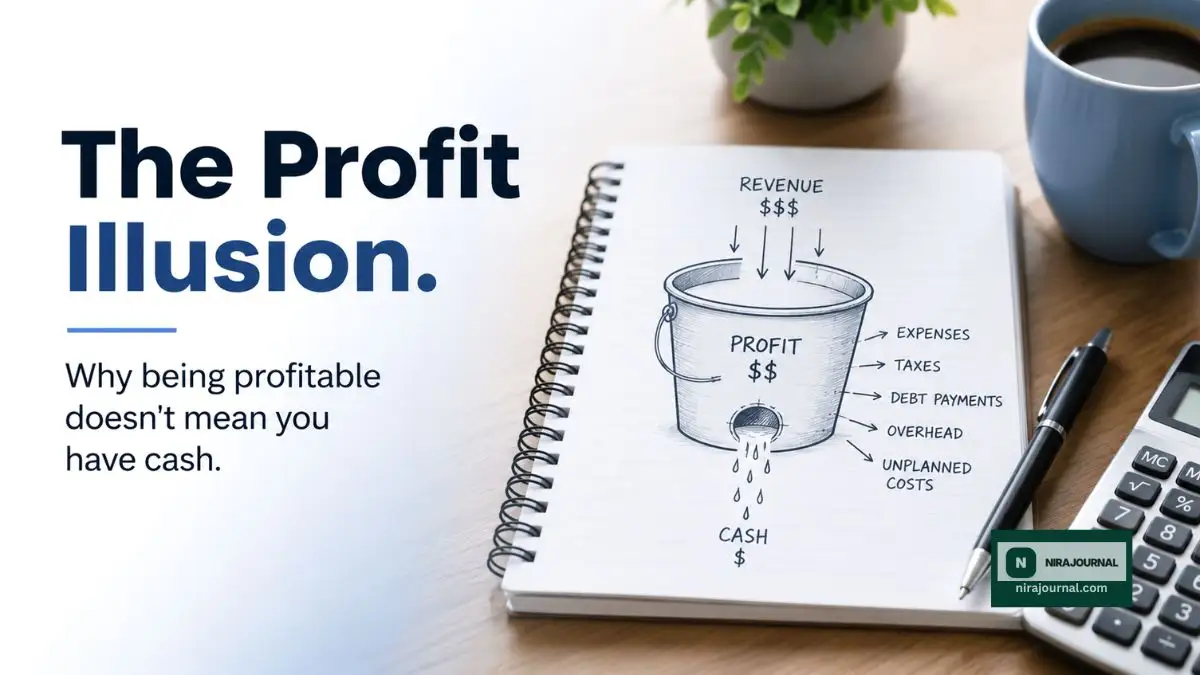
Think of your business like a large water tank. The water inside the tank is your cash. The profit is the rain falling into the tank. You want it to rain a lot, of course. But if the pipes leading into the tank are clogged, the rain never reaches the bottom.
At the same time, there are holes at the bottom of the tank where water is constantly leaking out. These are your expenses. If the water leaks out faster than the rain reaches the tank, the tank will eventually go dry. Even if it is raining outside, if the water isn't in the tank, you can't drink it.
This is exactly how 7 Brutal Reasons Why Side Hustles Fail So Fast [Reality Check] happens. People focus on the rain and ignore the clogs in the pipes. They don't see the leaks until the tank is empty.
Pro Tip: I learned the hard way that I needed to check my cash flow daily, not just once a month. I started using a simple notebook to track every single dollar that left my account. This small habit saved me from making bad hiring decisions when I thought I was "rich" on paper.
How to Spot a Cash Flow Trap Before It Hits You
There are signs that your business is in trouble even if you are making sales. One big sign is when your "Accounts Receivable" keeps growing. This means people owe you money, but they aren't paying quickly.
Another trap is spending too much on inventory or equipment too soon. You might think buying a new machine will help you grow. It shows up as an asset on your books, but that cash is now gone. You can't use that machine to pay your team's health insurance.
You also need to watch your "burn rate." This is how much cash you are spending every month just to stay open. If you spend $5,000 a month but only $3,000 in cash is coming in, you are in danger. It doesn't matter if you have $10,000 in "sales" if that money isn't coming in yet.
Many founders skip the step of checking if their business model actually brings in cash quickly. This is why you should always try to 7 Proven Ways to Validate Your Business Idea for Free [Step-by-Step] before spending your life savings. Validation helps you see if customers are willing and able to pay you on time.
Watch this video to see a visual breakdown of how cash flow works in a real startup:
The Science of Staying Liquid
In the world of finance, being "liquid" means you have cash ready to use. This is much more important than being "profitable" in the short term. A liquid business can survive a bad month. A profitable but "illiquid" business can die in a week.
Scientists and economists often look at the "Cash Conversion Cycle." This is a fancy way of measuring how long it takes for a dollar you spend to come back to you as more money. The shorter this cycle is, the healthier your business will be.
If you pay for materials today but don't get paid by the customer for 90 days, your cycle is very long. You need a lot of extra cash to survive those 90 days. Most startups don't have that kind of cushion.
To stay safe, you need to negotiate better terms. Ask your suppliers if you can pay them in 45 days instead of 30. Ask your customers to pay you in 15 days or even upfront. Every day you shave off that cycle is more cash in your tank.
Research from the Harvard Business Review shows that managing these small gaps is the key to surviving tough economic times. It is the difference between a business that grows and one that disappears.
Mastering the Balance Sheet Mentality
Most founders only look at their "Profit and Loss" statement. They see the revenue and the expenses and call it a day. But the real secrets are hidden in the Balance Sheet.
The Balance Sheet shows you what you own and what you owe. It shows you how much of your "profit" is actually tied up in things you can't spend. If your profit is sitting in "Unpaid Invoices," it isn't helping you.
I started treating my balance sheet like a health report. If my cash was low, I stopped all new spending immediately. I didn't care what the profit statement said. If the cash wasn't there, the answer was "no."
This change in my mindset was the turning point. I stopped being a "sales-first" founder and became a "cash-first" founder. This didn't mean I stopped growing. It meant I grew in a way that didn't keep me awake at night.
Common Myths About Business Money
One myth is that "growth solves everything." This is a dangerous lie. Growth usually eats cash. When you grow, you need more stock, more staff, and more space. You spend cash today to get profit tomorrow.
Another myth is that you need a huge investment to start. Actually, having too much money can make you lazy about cash flow. You don't feel the "burn" because you are spending someone else's money. When that money runs out, you realize you never built a real cash-generating machine.
I also used to believe that my accountant would handle all of this for me. That was a big mistake. An accountant looks at the past. They tell you what happened last month. As a founder, you need to look at the future. You need to know what will happen next month.
You are the pilot of the plane. The accountant is the person reading the flight recorder after the plane has landed. You need to be the one looking at the fuel gauge while you are still in the air.
Building a Cash Buffer for Your Peace of Mind
The best thing you can do for your mental health as a founder is to build a "cash runway." This is a pile of money that can keep your business running even if you have zero sales for three to six months.
Having this buffer changes how you make decisions. You don't take bad deals just because you are desperate for money. You don't panic when a client is a week late with a payment. You can think clearly and lead your team with confidence.
Building this buffer takes time. It means not taking a big salary for yourself right away. It means being frugal with your expenses. But the freedom it gives you is worth more than any fancy office or expensive car.
When I finally built my six-month buffer, I felt like a weight had been lifted off my chest. I could finally focus on my long-term vision instead of just surviving until Friday. It was the best investment I ever made in my business.
Smart Ways to Keep Your Business Bank Account Healthy
Now that we know the big difference between profit and cash, we need to talk about how to manage it like a pro. Most founders wait until their bank account is near zero before they panic. I used to do the same thing. I would check my balance, see a few thousand dollars, and think everything was fine. But that is a trap. You need to look ahead, not just at what you have today.
One of the best things I ever did was start a "rolling forecast." This sounds like a fancy word, but it is actually very simple. Every Friday, I spend thirty minutes looking at the next four weeks. I write down exactly what bills are coming due and what money I expect to receive. This helps me see a "cash hole" before I fall into it. If I see that I have a big rent payment in three weeks but no big checks coming in, I can take action now.
This kind of planning is what separates a hobby from a real company. You can find many great best practices for financial forecasting that show how even a simple spreadsheet can save your life. I started small, and now I can't imagine running my business without it. It gives me a clear map of the month ahead.
I also learned to stop being shy about asking for my money. Many founders feel bad about reminding clients to pay. They think it makes them look desperate or unprofessional. But the truth is, your business is not a charity. If you did the work, you deserve the payment. I started setting up automated email reminders.
Now, my system sends a friendly note three days before a bill is due. This small change improved my cash flow by almost thirty percent in just two months. It turns out that most people aren't trying to avoid paying you; they just get busy and forget. A gentle nudge is often all they need to click that "pay" button.
Another expert secret is to always keep your personal money away from your business money. I know it is tempting to use your personal credit card for a quick business expense. But this makes your accounting a mess. It hides the true health of your company. When you mix the two, you never really know if your business is standing on its own feet.
I made this mistake early on, and it took me months to untangle the knot. Keep them separate from day one. Open a dedicated business checking account and pay yourself a fixed salary. This keeps your personal life stable and your business books clean. It makes tax time a lot less scary, too.
You should also look at your "subscription creep." We all sign up for software that costs twenty or fifty dollars a month. It feels small at the time. But when you have fifteen of these, they start to eat your cash like termites. I now do a "cash audit" every three months.
I look at every single recurring payment and ask, "Is this actually helping us make money today?" If the answer is no, I cancel it immediately. You would be surprised how much money is hiding in apps you no longer use. I once saved four hundred dollars a month just by cutting out three tools we hadn't touched in weeks.
Staying healthy for the long term also means having a plan for your taxes. Many founders see a big profit and spend it all, forgetting that the government wants a piece of it later. I started putting twenty percent of every dollar I receive into a separate "Tax Savings" account. I don't even look at that money.
It doesn't belong to me. Doing this means I never have to scramble or take a loan when tax season arrives. It gives me a sense of peace that is worth more than any purchase. Knowing that my taxes are already covered allows me to focus on growth without that constant fear in the back of my mind.
Managing your cash flow is like taking care of a garden. You can't just plant the seeds and hope for the best. You have to pull the weeds and check the water levels every single day. If you stay on top of these small tasks, your business will grow strong and survive any storm. This is how you move from being a stressed-out owner to a confident leader.
When you start to grow, you might feel the urge to hire everyone at once. But you have to be careful. Every new person is a permanent monthly expense. Before I hire anyone now, I ask myself if I can solve the problem with a better process or a freelancer first. This is a big part of The Art of Delegating Tasks Without Losing Control of Your Vision. You want to grow your team, but you don't want to drown in salaries before you are ready.

The Dangerous Traps That Drain Your Cash
It is easy to make mistakes when you are busy trying to grow your dream. I have seen founders make the same errors over and over again. One of the most painful ones is "ego spending." This happens when you spend money to look successful before you actually are. You buy the fancy office, the expensive chairs, and the top-tier laptops because you want to feel like a "real" CEO.
But these things don't bring in customers. They only take cash away from your survival fund. I remember a friend who spent forty thousand dollars on a beautiful office design. He felt great for a month. But then his main client left, and he didn't have enough cash to pay his staff.
He had to close his business while sitting in a very expensive chair. It was heartbreaking to watch. He focused on the image of success instead of the reality of cash. Don't let your ego make your financial decisions. Keep your costs low until your cash flow is rock solid.
Another huge mistake is ignoring your "burn rate." This is the total amount of money you spend each month just to keep the lights on. If you don't know this number by heart, you are flying a plane in the fog. I once met a founder who thought his burn rate was five thousand dollars.
When we actually looked at his bank statements, it was closer to nine thousand. He was losing four thousand dollars a month and didn't even know it. This is one of The Silent Killers of New Startups: Common Pitfalls Entrepreneurs Overlook that can end your journey before it really begins. You must track every penny that leaves your account.
Being too nice to slow-paying customers is also a trap. I know you want to be liked. You want people to think you are easy to work with. But if a client is always late, they are using you as a free bank. This puts your own business at risk. I had to learn how to be firm.
If a client doesn't pay on time, I stop working for them until they do. It felt scary the first time I did it, but it actually earned me more respect. It showed that I value my work and my business. You cannot pay your team with your client's excuses.
Sometimes founders rely too much on one big customer. This looks great on your profit sheet, but it is a cash flow nightmare. If that one customer pays late, your whole world stops. Or worse, if they leave, your business dies instantly.
I always try to make sure no single client makes up more than twenty percent of my total income. Financial experts at The Hartford emphasize the danger of customer concentration, explaining how it can destabilize your entire financial foundation. Diversifying your income is the best way to keep your cash flow safe and steady.
Lastly, don't forget the hidden costs of growth. When you get more orders, you often have to spend money on supplies and shipping before you get paid. This is called the "growth gap." If you don't have enough cash saved up, a big spike in sales can actually bank-rupt you.
It sounds crazy, but many businesses fail because they grew too fast without enough cash in the tank. You might need to buy more inventory or hire extra help to fulfill those orders. If the money from the sales doesn't come in for thirty days, you are stuck with the bills today. Always keep a close eye on your bank balance when things start to pick up speed.
Your Map to Financial Freedom
Success in business is not just about how much you make. It is about how much you keep and how well you manage it. Understanding the difference between profit and cash flow is your first step toward true freedom. It changes you from someone who is just "playing business" to someone who is building an empire.
It gives you the power to make smart choices and the strength to say "no" to things that don't serve your future. I want you to feel the same peace I felt when I finally mastered my money. No more waking up at 4 AM to check your bank app. No more sweating when you have to send out payroll.
When you respect your cash flow, your business respects you back. You start to see opportunities that others miss because they are too busy putting out fires. You become a calm and steady leader who can handle anything that comes your way.
The road might be long, and you might make a few mistakes. That is okay. Every mistake is a lesson that makes you a better founder. Just remember to keep your eyes on your cash, not just your sales. Treat every dollar with respect, and it will work hard for you.
You have the talent and the drive to make this work. Now you have the financial knowledge to keep it working for years to come. I believe in you and your vision. Start today by looking at your numbers with fresh eyes. Don't be afraid of what you see.
Use it as a starting point to build something amazing. I really hope you take these lessons and use them to build a business that is both profitable and full of cash. It is the best way to make sure your hard work pays off in the end. Trust yourself, stay disciplined, and watch your dream grow into a stable reality.
Common Questions About Cash Flow and Profit
Can a business be profitable but have a negative cash flow?
Yes, this happens very often. If you sell a lot of products but your customers haven't paid you yet, your profit looks high on paper. However, because the money isn't in your bank account, your cash flow is negative. This is why you must track both numbers separately.
How much cash should I keep as a safety net?
Most experts suggest keeping enough cash to cover at least three to six months of your business expenses. This is called your "runway." Having this buffer allows you to survive slow months or unexpected repairs without needing to take out high-interest loans.
What is the easiest way to improve my cash flow right now?
The fastest way is to ask for payments sooner. You can offer a small discount for early payments or ask for a deposit before you start a project. Also, try to negotiate longer payment terms with your suppliers so you can keep your cash for a few extra days.
Is profit or cash flow more important for a new founder?
In the beginning, cash flow is much more important. Profit is the goal for the long term, but cash flow is what keeps you alive today. You can survive for a while without profit, but you cannot survive a single day without cash to pay your bills.
Should I use accounting software to track these things?
Yes, using tools like QuickBooks or Xero can make this much easier. These programs can create reports for you with just one click. However, you still need to look at these reports and understand what they mean for your daily business decisions.
Disclaimer: This article is for informational purposes only and does not constitute financial, legal, or professional accounting advice. Every business is unique, and financial regulations can vary by location. Always consult with a certified public accountant (CPA) or a qualified financial advisor before making major business decisions. We are not responsible for any financial losses or damages resulting from the use of this information.
About the Author
Munira Parveen is a dedicated Digital Content Strategist and Lead Researcher with a passion for simplifying complex topics. From navigating personal finance and emerging tech trends to uncovering the best practical lifestyle solutions, she spends her time analyzing data to bring readers highly accurate, actionable, and easy-to-understand guides. Her ultimate goal is to empower everyday people to make smarter, more informed decisions in this fast-paced digital world.


![7 Brutal Reasons Why Side Hustles Fail So Fast [Reality Check]](https://nirajournal.com/storage/uploads/blogs/1785472996_7-brutal-reasons-why-side-hustles-fail-so-fast-reality-check.webp)