
Quick Summary: What You Need to Know
- Your brain cannot actually multitask; it simply switches between tasks, which drains your energy and lowers your focus.
- Every time you look at a quick notification, it takes up to 20 minutes to get your full attention back.
- Writing down your random thoughts on paper helps clear your mind and stops you from forgetting things.
- Working in short, distraction-free blocks is the best way to get high-quality work done without burning out.
The Invisible Trap of "Doing It All" at Once
Did you catch yourself checking your phone just before clicking on this post? You are definitely not alone. We have totally normalized trying to work on a laptop, text a friend, and listen to a podcast all at the exact same time. But honestly, this constant juggling act is quietly burning us out and wrecking our focus. Let me share what happens when we stop trying to do everything at once.
One afternoon, I sat in front of my computer and realized I had been staring at the same sentence for twenty minutes. My brain felt like a foggy window. I was physically there, but my mind was scattered into a thousand tiny pieces. That was my wake-up call. I realized that my "superpower" of multitasking was actually my biggest weakness. It wasn't helping me; it was slowly breaking my ability to think deeply.
Many of you probably feel this same way right now. You have your phone next to you, several browser tabs open, and a million thoughts running through your head. We live in a world that rewards "hustle," but it rarely talks about the quality of that work. We are taught that being busy is the same as being successful. But is it? Or are we just spinning our wheels in the mud?
This constant state of distraction ruins our mental peace. We become more irritable because our brains are constantly working at 100% capacity. There is no room left for creativity or joy. We are simply reacting to the loudest noise around us. It is a exhausting way to live, and it leads straight to burnout. We want to be productive, but we are actually sabotaging our own success by refusing to focus on one thing.

The Science: Why Your Brain is Not a Computer
We often compare our brains to computers, but that is a big mistake. A computer can run multiple programs in the background without getting tired. Your brain, however, is a biological organ with limited energy. Scientists have discovered that the human brain lacks the architecture to perform two high-level tasks at the same time.
When you think you are multitasking, you are actually performing what researchers call "task switching." You are moving your attention from one thing to another and back again. Every time you do this, there is a "switch cost." Your brain has to stop the rules for the first task and load the rules for the second task. This process uses up a lot of glucose—the fuel your brain needs to stay sharp.
According to a study by the University of London, multitasking can actually lower your IQ by 10 to 15 points. That is equivalent to losing a full night of sleep. By trying to do more, you are literally making yourself less intelligent in the moment. You are making it harder for your brain to process information and make good choices.
The Hidden Psychological Triggers That Influence Your Daily Decision Making
I found this study very hard to believe at first. I didn't want to admit that I was hurting my own brain. But when I looked at my work, the truth was obvious. When I focused on one thing, I was brilliant. When I tried to do three things, I was average. This realization changed everything for me. I had to learn how to stop the "switch" and start the focus.
Understanding the "Attention Residue" Effect
One of the biggest problems with multitasking is a concept called "attention residue." This was coined by Professor Sophie Leroy. It means that when you switch from Task A to Task B, part of your attention stays stuck on Task A. Your brain doesn't just "reset" instantly.
If you are writing a report and quickly check a Slack message, your brain is still partially thinking about that message while you try to go back to the report. This "residue" makes your thinking slow and messy. It takes about 20 minutes to fully regain your focus after a single interruption. If you check your phone every ten minutes, you are essentially never operating at full focus.
This is why "quick checks" of your phone are so dangerous. You think it only takes five seconds, but the damage to your focus lasts for much longer. You are living in a state of fragmented attention. This makes it impossible to do what experts call "Deep Work." Without deep work, you can never produce anything truly great.
Real-World Example: The Hidden Cost of "Quick Checks"
Let's do some simple math. If you check your phone just 5 times during a two-hour work session, and each check costs you 20 minutes of "attention residue" to get back on track, you have essentially wasted over an hour of actual productive time. You thought you were working for two hours, but your brain was only truly focused for a fraction of that time.
The Dopamine Loop: Why Distraction Feels Good
If multitasking is so bad for us, why do we keep doing it? The answer lies in our brain chemistry. Every time you see a new email or get a "like" on social media, your brain releases a small hit of dopamine. Dopamine is the "feel-good" hormone that rewards us for seeking new information.
Our brains are literally wired to love distraction. We get a tiny pleasure spike every time we switch tasks. This creates a dangerous loop. We become addicted to the "newness" of the next notification. We feel like we are achieving something because we are "active," even if that activity is meaningless.
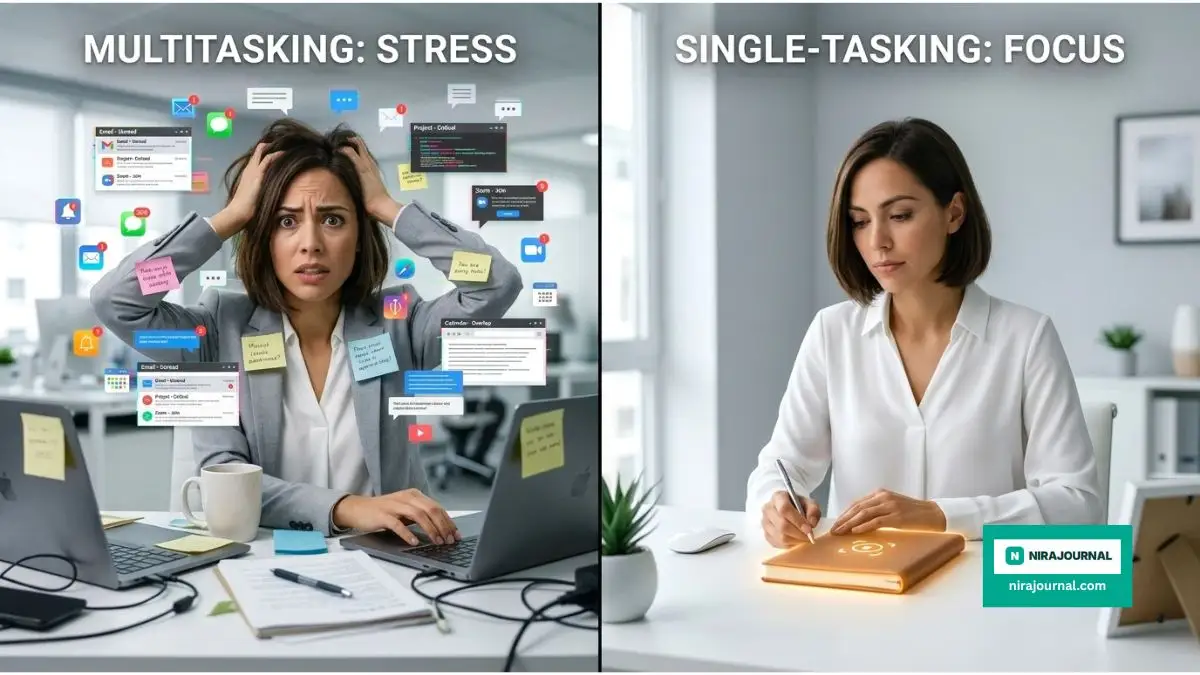
To break this habit, you have to realize that the feeling of productivity is not the same as actual productivity. Just because you answered 50 emails doesn't mean you moved your goals forward. Most of those emails were probably distractions from your real work. We have to learn to ignore the dopamine hits and focus on the long-term satisfaction of a job well done.
Check out this expert breakdown on how to train your brain to resist distractions and find your focus again.
The Physical Cost of a Scattered Mind
Multitasking doesn't just hurt your work; it hurts your body. When you are constantly switching tasks, your brain produces more cortisol and adrenaline. These are stress hormones. Staying in a high-stress state all day leads to physical exhaustion. It can even lead to long-term health problems like high blood pressure and a weakened immune system.
I noticed that on the days I multitasked the most, I ended the day with a massive headache. My neck felt tight, and my eyes were sore. I used to think it was just "part of the job." Now I know it was my body telling me that I was pushing my brain too hard. Your brain needs rest and single-pointed focus to stay healthy.
When we focus on one thing, our breathing slows down. Our heart rate becomes more stable. We enter a state of "calm productivity." This is much more sustainable than the frantic energy of multitasking. You will find that you have more energy at the end of the day if you stop trying to do everything at once.
Practical Steps to Reclaim Your Focus
Breaking a multitasking habit is not easy, especially since our technology is designed to keep us distracted. However, it is possible if you follow a few simple steps. You have to be the boss of your time and your tools.
Step 1: Audit Your Daily Distractions
The first step is to see where your time is going. For one day, write down every time you switch tasks. Every time you check your phone, open a new tab, or answer a random question, make a mark on a piece of paper. Most people are shocked by what they find. We think we are focused, but we are actually switching tasks hundreds of times a day.
Once you see the truth, you can start to make changes. You will realize that most of those "quick checks" were not necessary. You can start to build a "wall" around your most important work hours.
Step 2: Create a Distraction-Free Zone
You cannot rely on willpower alone. If your phone is on your desk, you will eventually look at it. If your email is open, you will eventually read a notification. You must design your environment for success.
Put your phone in another room or in a desk drawer.
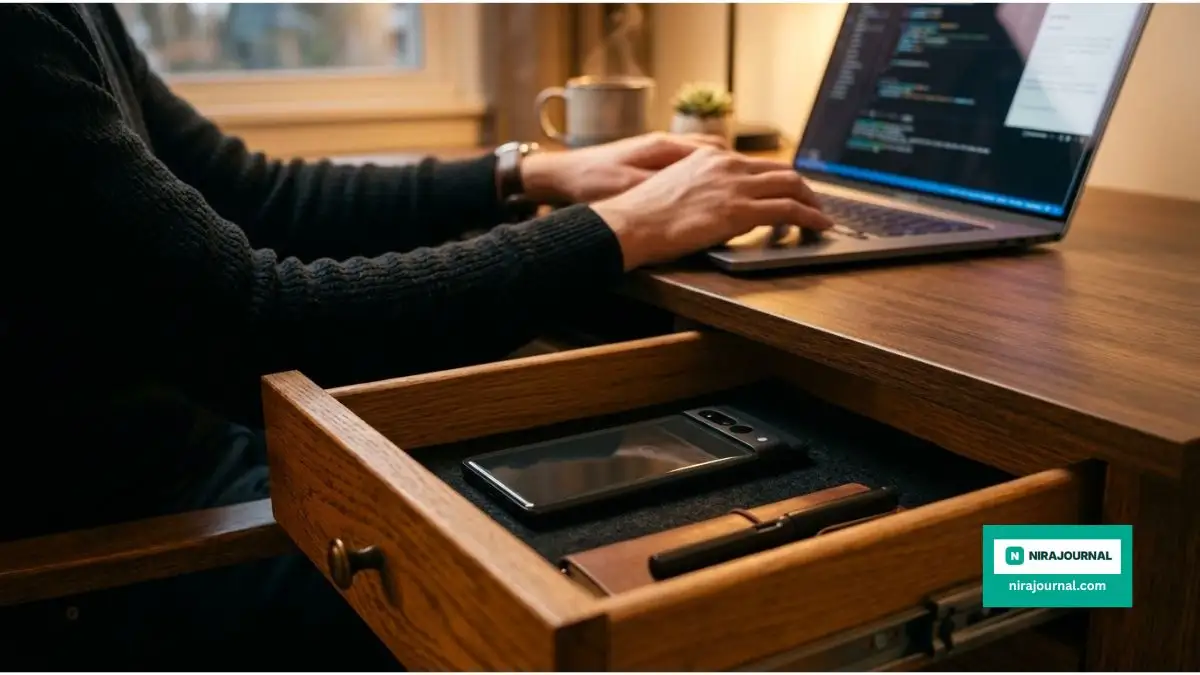
Close all the tabs on your browser that are not related to the task you are doing right now. If you work in a noisy office, use noise-canceling headphones. This sends a signal to your brain (and your coworkers) that you are in "focus mode."
A Beginner’s Guide to Mastering Digital Minimalism in a Distracted World
Step 3: Practice the "Rule of Three"
Every morning, write down only three things you want to achieve that day. Just three. We often make long lists that are impossible to finish. This makes us feel overwhelmed and leads us back into the multitasking trap.
Focus on your first task until it is 100% finished. Do not even think about the second task until the first one is done. This creates a sense of momentum. When you finish a task completely, you get a much bigger and healthier dopamine hit than you do from checking an email.
The Power of Saying "Not Now"
One of the hardest parts of stopping multitasking is dealing with other people. We feel like we have to answer every message immediately. We are afraid that if we don't respond, we will look lazy or rude. But the opposite is actually true. People who focus and produce great work are more respected than people who are always "available" but never finish anything.
I started telling my team, "I will be checking messages at 11 AM and 4 PM. If you need me for something urgent, please call me." Guess what happened? No one called. Most things are not urgent. By setting these boundaries, I gave myself permission to focus. I stopped being a slave to other people's schedules.
You have the right to protect your mental space. If someone asks you for something while you are focused, it is okay to say, "I would love to help you with that, but I am focusing on this project right now. Can we talk at 2 PM?" Most people will respect that. They might even start doing the same thing themselves!
Rebuilding Your Attention Span
Our modern world has "broken" our ability to pay attention. We are used to 15-second videos and instant updates. Rebuilding your focus is like rebuilding a muscle. It takes time and practice. Don't be upset if you find it hard to focus for even ten minutes at first.
Start with "Focus Sprints." Set a timer for 15 minutes and promise yourself you won't look at anything else. When the timer goes off, take a two-minute break. Walk around, stretch, or drink some water. Then, do it again. Over time, you can increase the 15 minutes to 30, 45, and eventually 90 minutes.
Pro Tip: During my breaks, I used to check my phone. This was a mistake! A break should be a rest for your brain. Checking social media is not a rest. Now, I just look out the window or do a quick breathing exercise. I find that my focus is much stronger when I give my brain a real rest between tasks.
Why Monotasking is Your Secret Career Weapon
As more people become distracted by technology, the ability to focus is becoming a rare and valuable skill. If you can be the person who produces high-quality work without mistakes, you will stand out in any company. Focus is the new "IQ."
When you stop multitasking, you start to see the "big picture." You start to see how your work fits into the goals of your company or your business. You become a proactive leader instead of a reactive worker. This is how you get promoted. This is how you grow a successful business. This is how you reclaim your life.
The journey away from multitasking is a journey toward excellence. It is about choosing to do fewer things, but doing them with all of your heart and mind. It is about quality over quantity. It is about being the master of your brain, rather than a victim of your notifications.
Mastering the Art of Unbroken Focus: Elite Strategies for High Performance
Now that we understand the science of why our brains struggle with multiple tasks, it is time to look at how the world’s most successful people actually get things done. They don't just "try harder" to focus. They build systems that make focus inevitable. This is not about being a robot; it is about respecting how your mind works so you can achieve more with less stress.
One of the most powerful secrets used by top performers is the "Mental Runway" technique. Think about an airplane taking off. It doesn't just jump into the sky; it needs a long, clear path to gain speed. Your brain works the same way. When you start a complex task, you need about ten to fifteen minutes of "warm-up" time before you reach peak efficiency.
Most people ruin their runway by checking a text message or an email just as they are about to "take off." Every time you do this, you have to go back to the start of the runway and begin the process all over again. To avoid this, try setting a "no-interruption" rule for the first twenty minutes of any big project. Tell yourself that no matter what happens, you will not look away from your screen until that warm-up period is over. Once you are in the "flow zone," staying there is much easier than getting there.
Another advanced strategy is the concept of "Sensory Anchoring." Our brains are very good at associating environments with specific behaviors. If you always check social media while sitting on your couch, your brain will automatically want to do that whenever you sit there. You can use this to your advantage by creating a "Focus Anchor."
This could be a specific pair of headphones that you only wear when you are doing deep work. It could be a specific type of instrumental music or even a specific scent, like a peppermint candle. Over time, when you put on those headphones or light that candle, your brain gets a physical signal that it is time to stop multitasking and start working. It acts like a switch that bypasses the urge to be distracted.
Beyond the Comfort Zone: Simple Shifts to Build Unstoppable Resilience
I personally started using a specific "work-only" lamp on my desk. When the lamp is on, my phone is in the drawer, and I am only allowed to work on one thing. When I turn the lamp off, I am free to check my messages or relax. This simple physical boundary helped me stop the habit of "half-working" while I was trying to relax. It made my work hours more intense and my rest hours more peaceful.
The Science of Brain Dumping and Cognitive Offloading
Sometimes the reason we multitask is that we are afraid of forgetting something. You are working on a report, and suddenly you remember you need to buy milk. Instead of stopping your work to write a grocery list, you try to "hold" that thought in your head. This uses up what scientists call "Working Memory," leaving less space for your actual work.
To solve this, use a "Brain Dump" notebook. Keep a physical piece of paper next to you. Whenever a distracting thought or a new task pops into your head, write it down immediately and then go back to your work. By writing it down, you are "offloading" the thought from your brain. Your mind can relax because it knows the information is safe and you won't forget it. This keeps your mental "RAM" clear for the task at hand.
Research from the Cleveland Clinic shows that the brain is much more efficient when it is not trying to store random information while processing complex logic. By clearing your mental workspace, you allow your neurons to fire more effectively on the one thing that truly matters right now.
Myth vs. Fact: How Your Brain Actually Works
- Myth: Multitasking gets more things done in less time.
- Fact: You are just task-switching. This drains your mental energy fast and makes tasks take up to 40% longer to finish.
- Myth: Your brain has unlimited short-term memory, like a computer hard drive.
- Fact: Human working memory can only hold about 3 to 5 chunks of information at once before things start dropping out.

Heartbreaking Mistakes That Keep You Stuck in the Busy Trap
Even with the best intentions, many people fall back into old habits because of a few common mistakes. These errors are often disguised as "efficiency," but they are actually productivity killers. If you are not careful, these traps will keep you feeling exhausted and unfulfilled.
The biggest mistake is the "Just Five Seconds" lie. We tell ourselves that checking a single notification won't hurt. We think, "I'll just see who liked my photo," or "I'll just read this one headline." But as we discussed in Part 1, there is no such thing as a five-second distraction. The "attention residue" left behind can ruin your focus for the next twenty minutes.
When you tell yourself this lie, you are slowly destroying your ability to concentrate. It is like trying to fill a bucket with water while there is a hole in the bottom. No matter how much you pour in, the bucket never stays full. Over time, this leads to a deep sense of frustration. You feel like you are working all day, but you have nothing to show for it.
Another dangerous pitfall is the "Availability Trap." This happens when you feel you must be available to everyone at all times. You answer every email the second it arrives. You respond to every chat message immediately. You think this makes you a good worker or a helpful friend. In reality, it makes you a "reactive" person rather than a "proactive" one.
Critical Mistakes That Prevent You from Reaching Your Potential
If you are always available to others, you are never available to your own big goals. You are essentially letting other people's minor problems dictate how you spend your life. This can lead to a lot of hidden resentment. You might start to feel like everyone is "taking" from you, leaving you with nothing for yourself. This emotional drain is often the first step toward total burnout.
The Illusion of Technology as a Solution
Many people try to fix their multitasking problem by downloading five different "productivity apps." They spend hours setting up calendars, color-coding tasks, and trying out new tools. This is often just another form of multitasking. It is a way to feel productive without actually doing any real work.
The truth is that tools cannot fix a broken habit. If you don't change how you think about your focus, no app in the world can save you. In fact, more tools often mean more notifications and more things to manage. This creates even more complexity in your life. The most productive people usually have the simplest systems. They don't need fancy apps; they just need a clear mind and a quiet space.
According to an article in the Harvard Business Review, the mere presence of a smartphone—even if it is turned off—reduces our cognitive capacity. We are so used to the distractions they provide that our brains have to work hard just to ignore them. This means that by simply having your phone on your desk, you are making your work harder than it needs to be.
How to Sustain Long-Term Focus Without Burning Out
To make single-tasking a permanent part of your life, you need to understand that focus is a finite resource. You cannot focus for eight hours straight. If you try to do that, your brain will eventually force you to multitask just to get a break. The secret to long-term success is "Rhytmic Working."
This means working in blocks of intense focus followed by short, total breaks. During these breaks, you should not look at a screen. Looking at a screen is "input," and your brain needs "output" time to process what it has learned. Go for a walk, do some stretching, or just close your eyes for five minutes. This allows your brain to refresh its energy so you can start the next focus block with full power.
If you don't take these breaks, your brain will start to "leak" focus. You will find yourself clicking on random websites or checking your phone without even thinking about it. This is your brain's way of saying it is tired. Instead of fighting it with more coffee or more willpower, give it the rest it needs. This is how you stay productive for years, not just for a few days.
Building Your "Focus Muscle" Over Time
Think of focus like going to the gym. You wouldn't try to lift 500 pounds on your first day. You would start with small weights and slowly build your strength. Single-tasking is the same. If you are used to multitasking all day, trying to focus for an hour will feel impossible.
Start with just fifteen minutes of pure focus. Once that feels easy, move to twenty. The goal is to gradually stretch your attention span. Over a few weeks, you will find that you can sit and work on one thing for an hour or more without even feeling the urge to check your phone. This is a massive competitive advantage in a world where most people can't focus for more than sixty seconds.
A New Path to Your Greatest Work
We have reached a point where we must choose. We can continue to be busy, scattered, and stressed, or we can choose to be focused, calm, and effective. The science is clear: multitasking is a lie that steals our time and our intelligence. It makes us feel like we are doing a lot, but it prevents us from doing anything that truly matters.
By embracing the power of one thing at a time, you are taking back control of your life. You are deciding that your goals are more important than the random noise of the internet. You are giving yourself the space to be creative, to be thoughtful, and to be truly excellent at what you do.
This journey is not about being perfect. You will still get distracted sometimes. You will still feel the urge to check your phone. But now you have the tools to recognize those moments and come back to your focus. Every time you choose one task over many, you are winning. You are building a better brain and a better future.
I used to be a slave to my notifications, but changing my habits changed my entire life. I now get more done in four hours of focused work than I used to do in an entire week of multitasking. I want you to feel that same sense of freedom and accomplishment. Start small, be patient with yourself, and watch how your world changes when you finally decide to give your full attention to the present moment. You have the power to do great things, but only if you stop trying to do them all at once.
Common Questions About Focus and Multitasking
Is it okay to multitask during simple chores?
Yes, you can listen to a podcast while washing dishes or folding laundry. These are automatic physical tasks that do not require high-level thinking. Multitasking only becomes a problem when both tasks require mental focus, like writing an email while listening to a meeting.
How can I stop multitasking if my boss expects instant replies?
The best way is to have a conversation about "Deep Work" hours. Suggest specific times during the day when you will be offline to focus on big projects. Most bosses prefer high-quality results over fast, messy replies once they understand the benefits.
Does listening to music count as multitasking?
It depends on the music. Music with lyrics can distract the language-processing part of your brain if you are reading or writing. However, instrumental music or "lo-fi" beats can actually help some people focus by blocking out background noise.
Can some people be naturally good at multitasking?
While a very small percentage of the population (about 2%) are "super-taskers," the vast majority of us are not. Most people who think they are good at it are actually just very used to the high-stress feeling of switching tasks. Their work quality still suffers even if they don't realize it.
How long does it take to break a multitasking habit?
It usually takes about three to four weeks of consistent effort to start feeling comfortable with single-tasking. Your brain needs time to rewire itself and get used to the lack of constant digital dopamine hits.
Disclaimer: This article is for informational purposes only and does not provide medical or psychological advice. If you are experiencing chronic stress, anxiety, or inability to focus that interferes with your daily life, please consult a qualified healthcare professional. We are not responsible for any actions taken based on the suggestions in this post.
About the Author
Munira Parveen is a dedicated Digital Content Strategist and Lead Researcher with a passion for simplifying complex topics. From navigating personal finance and emerging tech trends to uncovering the best practical lifestyle solutions, she spends her time analyzing data to bring readers highly accurate, actionable, and easy-to-understand guides. Her ultimate goal is to empower everyday people to make smarter, more informed decisions in this fast-paced digital world.
![Are You Sabotaging Your Own Future? [The Ultimate Blueprint]](https://nirajournal.com/storage/uploads/blogs/1787112986_are-you-sabotaging-your-own-future-the-ultimate-blueprint.webp)
![Why You Feel Stuck and How to Break Free [Avoid These Mistakes]](https://nirajournal.com/storage/uploads/blogs/1787057847_why-you-feel-stuck-and-how-to-break-free-avoid-these-mistakes.webp)
![3 Smart Ways to Practice Digital Minimalism [Save Time & Money]](https://nirajournal.com/storage/uploads/blogs/1787026264_3-smart-ways-to-practice-digital-minimalism-save-time-money.webp)