
The Silence After the Application: Why "Perfect" Numbers Still Fail
Just a few years ago, I walked into my local bank branch feeling on top of the world because of my new promotion and a solid salary. I was completely ready to get approved for my first home loan, but instead, I walked out feeling embarrassed and confused after a quick rejection. It felt like a punch to the gut, making me wonder if all my hard work meant nothing to them. I had to learn the hard way that making good money just isn't enough to get a "yes" from a lender.
Imagine this scenario. You have worked at the same company for five years. Your salary arrives on time every single month like clockwork. You have no massive debts, and you finally decided to apply for that dream home loan or a personal fund for a new project.
You hit the submit button with total confidence. You already started planning where the furniture would go or how you would spend the funds. Then, three days later, a cold, automated email hits your inbox. "We regret to inform you..."
The world feels like it stops for a second. Your heart sinks. You feel a mix of anger and deep confusion. "How is this possible?" you ask yourself. Your income is high, your job is secure, and you are a responsible adult.
This rejection is not just about money; it feels personal. It feels like a judgment on your lifestyle and your future. You might start doubting your financial worth. You wonder if the bank made a mistake or if there is something "wrong" with your life that you cannot see.
The truth is, banks do not just look at your paycheck. They look at a digital version of you that is much more complex. This hidden profile is often full of small "traps" that even wealthy people fall into. Let’s talk about why this happens and how you can stop the cycle of rejection.
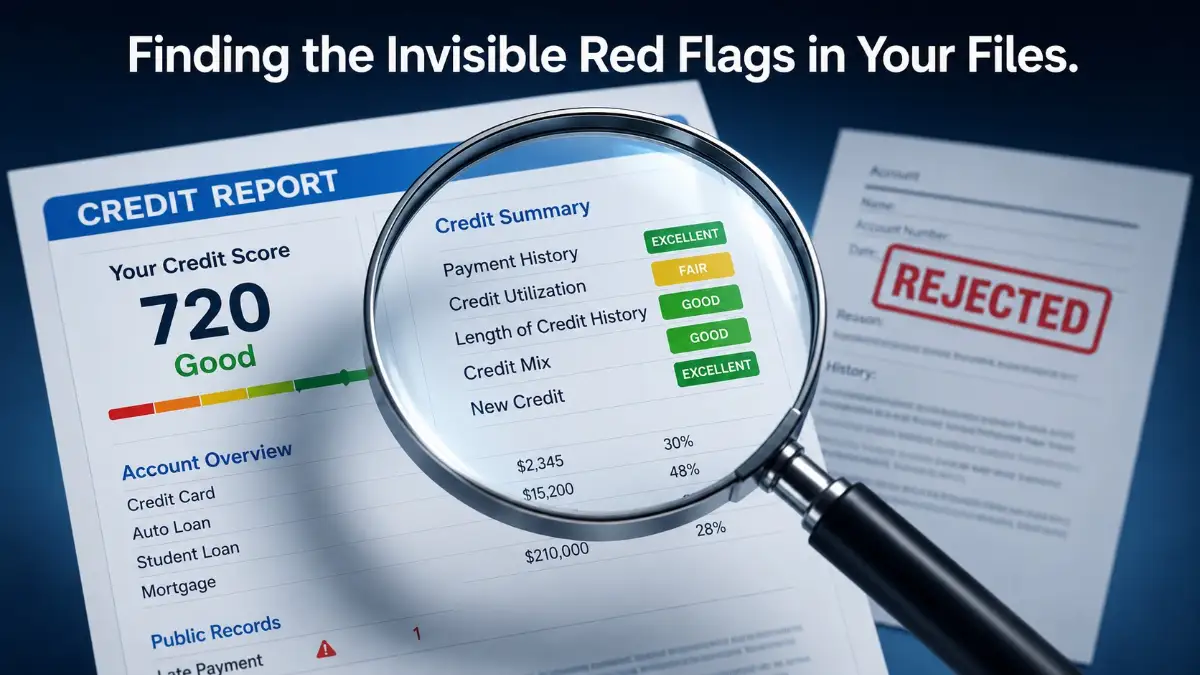
The Invisible Math: It Is Not Just About What You Earn
Most people think that a high salary is a golden ticket to any loan. They believe that if they earn $5,000 a month and the loan payment is only $500, the bank will say yes instantly. This is a very common mistake.
Banks do not just care about your income. They care about your "disposable income" and your "risk weight." You might earn a lot, but if your lifestyle costs a lot, you are actually a high-risk person in their eyes.
The Heavy Weight of Your Existing Commitments
One of the biggest reasons for rejection is something called the Debt-to-Income (DTI) ratio. Think of it like a bucket. Your income fills the bucket, but your existing expenses are holes in the bottom.
If you are already paying for a car, three credit cards, and a lifestyle subscription, your bucket is leaking. Even if you earn a lot, the bank sees those leaks. They worry that one small emergency will make you stop paying them.
To fix this, you need to look at your "leaks" before you apply. Sometimes, closing a small credit card you don't use can actually help. Even if the balance is zero, the "limit" on that card is seen as a potential debt.
The "Job Hopper" Warning Label
You might think that moving to a new job for a higher salary is a great move. In your career, it is. But in the eyes of a loan officer, it might look like instability.
Banks love "boring" profiles. They love people who have been in the same role for a long time. If you just started a new job last month, even with a 20% pay hike, the bank might see you as being in a "probation risk" period.
They fear that if the new company doesn't like you, you will be out of work soon. Most experts suggest waiting at least six months in a new job before asking for a big loan. This shows the bank that your new high income is here to stay.
Your Credit Score is Only Half the Story
We are told constantly to check our credit scores. While a high score is good, it is not the only thing that matters. You can have a score of 800 and still get rejected. Why?
It is because of your "Credit Mix" and "Credit Depth." If your high score only comes from one credit card you have had for a year, you have a "thin file." The bank doesn't have enough history to see how you handle different types of debt over a long time.
The Danger of Too Many Questions
Every time you apply for a loan or a credit card, the lender does a "hard inquiry." This is like a footprint in the snow. If the bank sees ten footprints in the last two months, they get scared.
They think, "Why is this person so hungry for money? Are they in trouble?" Even if you were just "shopping around" for the best rate, too many inquiries make you look desperate.
To avoid this, do your research first. Do not hit the "Apply" button on five different websites. Use "soft search" tools that do not hurt your score. Only make a formal application when you are 90% sure you meet the criteria.
Small Errors with Big Consequences
Did you know that a simple typo could cost you a loan? It sounds silly, but it happens every day. Your address on your application must match your address on your utility bills and your credit report exactly.
If you live at "Apartment 4B" but your bank report says "Unit 4-B," a computer algorithm might flag you for fraud or inconsistency. These "automated rejections" happen before a human even looks at your file.
The "Social" Connections You Didn't Know About
Sometimes, the reason for rejection isn't even you. It could be a "financial association." If you once had a joint bank account with an ex-partner or a family member who has terrible credit, your files might be linked.
When the bank checks you, they see their bad habits too. You must write to credit bureaus to ask for a "notice of disassociation" if you no longer share finances with that person. This cleans your digital history and keeps your path clear.
The Reality of Industry Risks
Sometimes, you can do everything right and still get a "No." This is because banks sometimes black-list or "grey-list" certain industries. If you work in a sector that is currently struggling—like travel during a lockdown or a niche tech sector—the bank might lower its risk.
They are not saying you are a bad person. They are saying your industry is "volatile." In these cases, you might need to provide a larger down payment. This proves to the bank that you are putting your own skin in the game.
How Much of Your Credit are You Using?
This is called "Credit Utilization." If you have a credit card with a $10,000 limit and you regularly spend $9,000, you look like you are struggling. Even if you pay it off every month, the bank sees "90% usage."
The sweet spot is staying under 30%. If you want a loan soon, try to pay down your card balances so they look low when the bank pulls your report. It shows you use credit for convenience, not for survival.
I used to make the terrible mistake of keeping my credit cards nearly maxed out, thinking it was perfectly fine as long as I paid them off in full every single month. I finally realized that lenders saw this as me living on the edge, not as me being responsible! My biggest tip for you is to pay off a large chunk of your balance a few days before your statement actually closes, so the bank only sees a tiny balance when they check your file.
Practical Steps to Take Today
Before you rush to check your credit report, watch this quick video to see the exact steps I took to bounce back from my own rejection. It will make the rest of the tips below so much easier to follow!
If you just got rejected, do not panic. Do not apply again immediately. Instead, take these steps:
- Ask for the Specific Reason: By law, lenders usually have to tell you why you were denied if you ask.
- Audit Your Report: Get a free copy of your credit report. Look for names, addresses, or old debts that should not be there.
- The "Cool Down" Period: Wait at least three to six months before your next try. Use this time to lower your balances and stay steady at your job.
- Talk to a Human: Sometimes, online applications are too strict. Visiting a local branch and talking to a manager can help. They can look at the "human side" of your story.
Getting a loan is a game of strategy. It is not just about having money; it is about proving that you don't "need" the money desperately. When you look like you are in total control, the banks will be the ones chasing you.
Remember, a "No" today is just a "Not Yet." By fixing these hidden traps, you are building a much stronger financial future for yourself. Your stable income is a great foundation—now let's make sure the rest of the house is just as strong.
Mastering the Advanced Mechanics of Loan Approvals
Building a high income is only the first step in your financial journey. To ensure you never face another rejection, you must understand the advanced mechanics of how banks view your "reliability."
Banks use a specialized scoring system that goes beyond your basic credit score. They look for patterns in how you move money between accounts. They want to see that you are not just earning money, but that you are keeping it and growing it.
If you want to be a top-tier applicant, you need to treat your bank statements like a professional resume. Every transaction tells a story about your discipline. Let’s look at how you can polish that story to look perfect to any lender.
The Science of Banking Hygiene and Cash Flow
Professional lenders look for something called "Account Hygiene." This refers to how clean and organized your bank statements look over a three-to-six-month period.
If your statement is filled with tiny, erratic transfers to digital wallets or gambling sites, it creates a "noisy" profile. Even if you have a high balance, this noise suggests that you might have impulsive spending habits.
To fix this, I recommend keeping a "Clean Period" of at least ninety days before you apply. During this time, limit your transactions to regular bills and standard living expenses. This makes your cash flow look predictable and low-risk.
Why Your Credit Limit Strategy Matters
Most people think that having a lot of credit cards is a bad thing. In reality, having high limits can be a strength, but only if you use them correctly.
Lenders look at your "Total Exposure." If you have $50,000 in available credit across five cards but you only owe $500, you look very responsible. It shows that you have the power to spend but the discipline to say no.
However, if you are planning a major loan, avoid closing old credit cards. Closing an account can shorten your credit history and hurt your score. Instead, focus on why your credit utilization ratio is the secret to getting better loans to keep your profile in the "gold zone."
The "Seasoning" of Your Down Payment
If you are applying for a large loan like a mortgage, the bank will check the source of your down payment. They hate seeing a massive, unexplained deposit hit your account a week before the application.
This is because they worry you took an "under-the-table" loan from a friend. They call this "unseasoned" money. To the bank, this looks like a hidden debt that you will have to pay back later.
To avoid this, make sure any large sums of money are in your account for at least two to three months. This makes the funds "seasoned" and yours in the eyes of the law. If you receive a gift, ensure you have a "Gift Letter" ready to prove it is not a debt.
Choosing the Right Lender for Your Specific Profile
Not all banks have the same rules. A large national bank might have very strict, automated systems. If your profile is even slightly unusual, their computer might reject you without a human ever looking at it.
For many, a local credit union or a community bank is a better choice. These smaller institutions often have a "manual underwriting" process. This means a real person looks at your story and your stable income.
They are often more willing to listen to explanations about a one-time financial hiccup. You can research more about fair lending practices on the Consumer Financial Protection Bureau website to know what to expect.

Critical Pitfalls That Sabotage High-Income Applicants
Even with a six-figure salary, you can fall into traps that freeze your borrowing power. I have seen many successful professionals get rejected because they made a simple, avoidable mistake at the last minute.
The most dangerous time for your loan is the "Quiet Period." This is the time between your application and the final approval. Many people make the mistake of celebrating too early.
The "New Debt" Trap During Application
Imagine you have just submitted your loan application. You feel confident, so you go out and buy a new car or furniture on a "buy now, pay later" plan.
This is a disaster for your application. Any new credit inquiry or new debt triggers an automatic alert to your lender. It changes your debt-to-income ratio instantly.
Banks often do a final credit check just hours before releasing the money. If they see a new car loan, they might cancel your approval on the spot. Wait until the money is in your hand before making any other big financial moves.
The Hidden Danger of Co-Signing
Being a helpful friend or family member can cost you your dream loan. When you co-sign for someone else’s car or credit card, that debt is legally 100% yours.
Lenders calculate your borrowing power as if you are the one making those payments. If you co-signed for a $500-a-month car loan, the bank subtracts that $500 from your available income.
This is one of the 7 surprising personal finance mistakes that quietly kill your credit health that most people forget. If you want to get a loan, try to avoid having any co-signed obligations on your report.
Ignoring Your Digital "Financial Shadow"
Every time you apply for credit, it leaves a "hard inquiry" footprint. If you apply at five different places in one week, you look desperate for cash.
Banks see "Inquiry Clusters" as a sign of financial trouble. They wonder why you need so much credit all at once. It is much better to research first and only apply at the one or two places where you are most likely to get a "Yes."
You should also check for "Financial Associations." If you once had a joint account with a spouse or partner who has bad credit, your files might still be linked. You may need to file a "Notice of Disassociation" to separate your clean record from their mistakes.
Why Small Errors Lead to Big Rejections
I have seen applications rejected because a person listed their 'Gross Income' instead of 'Net Income,' or vice versa. These small numbers matter. Always double-check every line of your application for accuracy.
To better understand how lenders evaluate your numbers, you should read The Simple Guide to Understanding Debt-to-Income Ratio for New Borrowers. Catching a minor error now can save you from a long wait for a new application later.
Your Blueprint for Financial Approval and Freedom
The journey to a successful loan is about proving that you are a person of habit and discipline. A stable income is your engine, but your credit history and financial behavior are the steering wheel.
Do not let a past rejection define your future. Banks are not your enemies; they are businesses looking for safe partners. When you show them that you are low-risk, they will compete to give you the best rates.
Start by taking small steps today. Clean up your bank statements, pay down your small balances, and monitor your report for any errors. This proactive approach will make you a "Preferred Borrower."
A Final Message of Encouragement
You have the power to change your financial story. Whether you are looking for a home for your family or a loan to start a business, the path is clear. It requires patience and a little bit of strategy.
Every "No" from a bank is actually a guide on what to fix. Take that feedback, use the tips we discussed, and come back stronger. Your income is stable, your goals are valid, and your success is just a few adjustments away.
Stay focused on your long-term health rather than quick fixes. When you manage your money with respect, the financial world will treat you with respect in return. You are now equipped with the secrets to win this game.
Go out there and secure your future. The "Yes" you are looking for is waiting for you at the end of this journey. Believe in your plan and take the first step toward your approved loan today!
Getting that first rejection letter was honestly one of the best things that ever happened to me because it forced me to clean up my messy financial habits. If I could turn my risky file into a profile that lenders love, I promise you can do it too. Take a deep breath, follow these simple steps today, and watch how quickly those painful rejections turn into happy approvals.
Disclaimer: The content provided in this article is for informational and educational purposes only and should not be considered as professional financial, investment, or legal advice. Lending criteria and banking regulations vary by country and institution. Always consult with a certified financial advisor or a qualified credit counselor before making significant financial decisions. The author is not responsible for any personal financial outcomes resulting from the use of this information.
About the Author
Munira Parveen is a dedicated Digital Content Strategist and Lead Researcher with a passion for simplifying complex topics. From navigating personal finance and emerging tech trends to uncovering the best practical lifestyle solutions, she spends her time analyzing data to bring readers highly accurate, actionable, and easy-to-understand guides. Her ultimate goal is to empower everyday people to make smarter, more informed decisions in this fast-paced digital world.