The Monthly Envelope That Ruins Your Mood
I still remember the sinking feeling I got every time I opened my mailbox and saw that utility bill staring back at me. It felt like I was working just to keep the lights on, constantly stressing over every thermostat click and every bulb left burning. I was tired of renting my electricity, so I decided it was time to stop complaining and finally figure out if I could take control of my home's energy for good.
You walk out to the mailbox after a long day at work. Among the junk mail and grocery flyers, you spot it. The envelope from your local utility company.
You open it up, scan down to the total amount due, and your heart sinks. If you have central air conditioning running all summer or heavy electric heaters blasting all winter, that number can easily feel like a second mortgage.
Every single month, you are effectively renting your electricity. You pay for it, you use it, and you never see a return on that investment.
This endless cycle of paying rising utility rates creates a silent, ongoing stress in our daily lives. You find yourself yelling at the kids to turn off the lights. You hesitate to turn on the air conditioner on a boiling hot afternoon because you are terrified of the next bill.
Your home is supposed to be your ultimate sanctuary. Instead, it feels like an expensive machine that constantly drains your bank account.
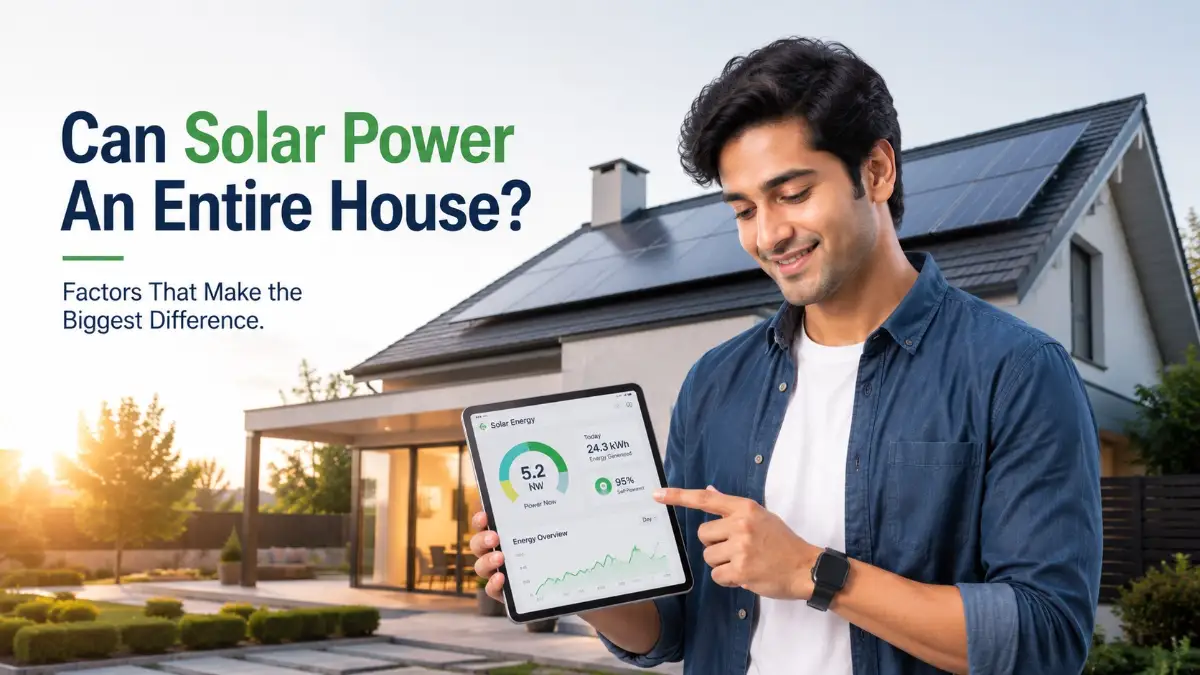
Eventually, almost every homeowner looks up at their empty roof and asks themselves a very logical question. Could I just put up enough solar panels to power my entire house?
Can you actually disconnect from this stressful billing cycle, generate your own clean energy, and run every single appliance without relying on the grid?
The short answer is absolutely yes. You can power a whole house using only the sun.
However, making this dream a reality is not as simple as buying a few panels online and screwing them onto your roof. The actual success of running a full household on solar energy depends entirely on a few specific variables.
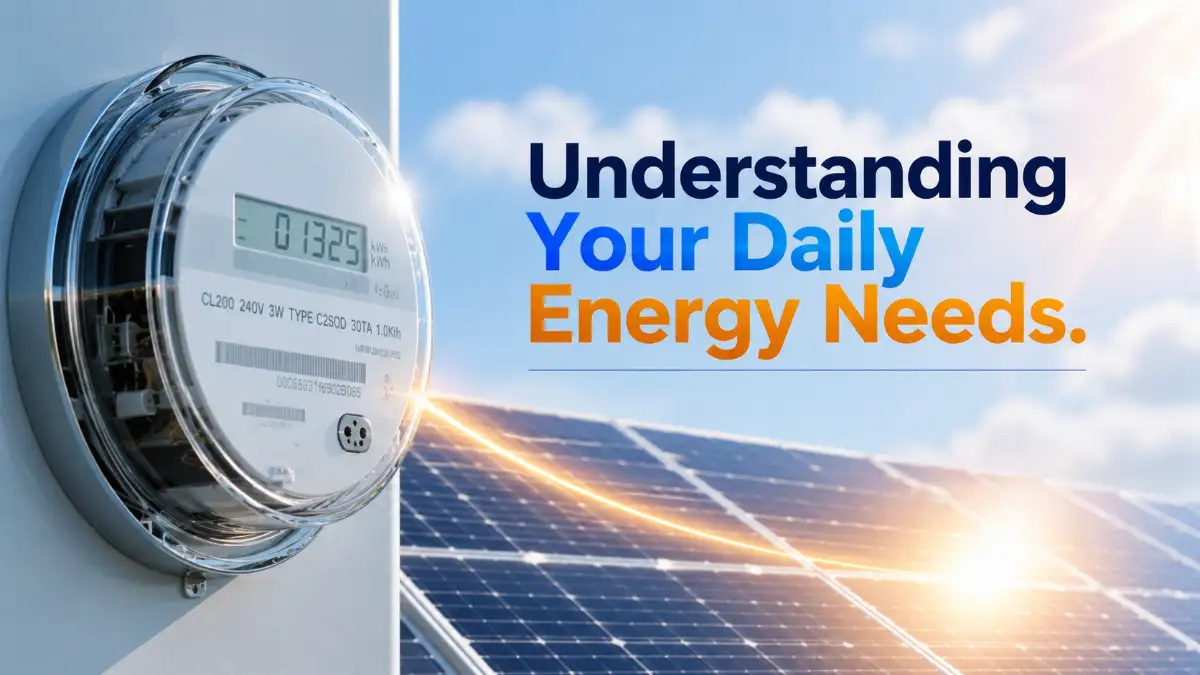
Assessing Your True Everyday Power Habits
If you want to know if the sun can handle all your needs, we first have to understand exactly what those needs are. Every single house is unique, and every family has completely different lifestyle habits.
Your neighbor might have a small three-bedroom house, but they run high-end gaming computers, an electric vehicle charger, and an old, inefficient air conditioner. Meanwhile, you might have a massive five-bedroom house, but you use smart appliances, LED lighting, and hang your clothes outside to dry.
Size does not dictate your power requirements. Your daily habits dictate your power requirements.
To figure out how many panels you need, you have to find a specific number: your total kilowatt-hours (kWh) used per year. You can easily find this number by logging into your online utility account and downloading your last twelve months of billing statements.
Adding up those twelve months will give you a giant number. The average American home, for example, uses roughly 10,000 to 11,000 kWh per year.
Once you have this baseline, you understand the exact target your future solar setup needs to hit. From Sunrise to Sunset: How a Residential Solar Power System Works.
If your system cannot generate this specific amount of kWh, you will still be buying power from the electric company.
The Magic of Peak Sun Hours
Want to see how sunlight actually turns into the power that runs your appliances? Watch this breakdown to see the process in action, then keep reading to learn how to apply this to your own home.
Now that we know how much power you eat, we need to know how much power the sky can actually feed you. This is where a lot of first-time buyers get confused.
Just because the sun is up for fourteen hours during the summer does not mean your roof is generating maximum electricity for fourteen hours. We have to look at a metric called "peak sun hours."
A peak sun hour is essentially an hour during the day when the intensity of the sunlight is strong enough to generate maximum output from your equipment. Usually, this happens in the middle of the day when the sun is highest in the sky.
If you live in a notoriously sunny place like Arizona or California, you might get five to six peak sun hours every single day. If you live in a cloudy, northern region like Seattle, you might only average three peak sun hours.
Why does this matter? Because the amount of intense sunlight you get directly changes how much equipment you have to buy.
A homeowner in a very sunny state can easily power their whole house with just fifteen to twenty high-efficiency panels. A homeowner in a gloomy state might need thirty-five panels to generate the exact same amount of electricity.
You cannot control the weather, but you can definitely design around it. You just need to know your local weather data before you start making purchases.
Roof Real Estate and Angles
Let’s imagine you have perfectly calculated your energy needs and your local sunshine hours. The next massive factor is the physical shape and size of your house.
Solar panels are quite large. A modern, high-output panel is usually about five and a half feet tall and three feet wide.
If you need twenty-five panels to cover your family's daily usage, you need enough completely unobstructed roof space to fit them. This is often where people run into a frustrating roadblock.
Your roof might be chopped up with dormer windows, multiple chimneys, skylights, or complex architectural angles. If you do not have a wide, open, uninterrupted space, placing enough units to run your whole property becomes a difficult puzzle.
Furthermore, the direction your roof faces changes everything. In the northern hemisphere, roofs that face directly south get the absolute most direct sunlight throughout the day.
If your only open roof space faces north, the production of your equipment will drop significantly. Stop Believing These Home Solar Energy Myths: What First-Time Homeowners Must Know.
You can absolutely still use east or west-facing roofs, but you will likely need to buy a few extra units to make up for the slight loss in daily production.
Shade is the Ultimate Enemy
We also have to talk about your immediate surroundings. You might have the perfect south-facing roof, but if a massive hundred-year-old oak tree blocks the sun from 10:00 AM to 2:00 PM, your energy production will plummet.
Shade is the biggest hidden enemy of renewable energy. Even a tiny bit of shade covering just ten percent of a single panel can heavily drag down the performance of the entire connected system.
Before you commit to powering your whole life with the sun, step outside and look at your property at different times of the day. Notice where the shadows fall in the morning, at noon, and in the late afternoon.
Sometimes, achieving complete energy independence is as simple as trimming back a few large tree branches. Other times, it means you have to get creative and install the equipment on a ground mount in your backyard instead of on your roof.
The Storage Dilemma: What Happens at Night?
When I first started, I made the mistake of thinking panels alone would solve everything. I learned the hard way that without a battery backup, I was still tied to the grid the moment the sun went down. Don't repeat my error—investing in storage from the start is what actually turns a solar system into true energy independence.
Here is a very obvious fact that often gets overlooked in the excitement of going green: the sun goes down every single night.
If your goal is to power your entire house exclusively with your own equipment, you need a way to keep the refrigerator running and the lights on when the sky is pitch black.
During the middle of a sunny day, your roof will likely generate way more electricity than you are actively using. If you do not have a way to catch and hold onto that extra power, it simply flows back into the public grid.
To truly run your whole house on your own terms, you need to invest in a deep-cycle solar battery bank. Modern lithium-ion batteries are sleek, highly efficient, and can be mounted right on your garage wall.
They act like a giant bucket. All day long, your roof fills the bucket with free electricity.
When the sun sets and your family starts turning on the television, cooking dinner, and doing laundry, your house automatically starts drinking from that battery bucket.
Adding storage is the ultimate key to completely detaching from the utility company. Without batteries, you are only powering your house with the sun during the daylight hours.
According to data from the U.S. Department of Energy, combining your rooftop generation with a dedicated home battery system is the most effective way to maximize your financial return and achieve true home resilience during grid outages.
However, storage is not cheap. Adding enough battery capacity to run heavy appliances overnight will significantly increase your upfront budget. You have to weigh the initial cost against the long-term peace of mind.
Plugging the Energy Leaks in Your Home
Before you even think about putting a single piece of glass on your roof, there is a secret step that smart homeowners take to make everything cheaper and easier.
They aggressively lower their baseline consumption first.
Think of your house like a bucket of water with tiny holes drilled into the bottom. Before you try to figure out how to pour more water into the bucket, you should probably plug the holes.
Running a whole house on renewable power is infinitely easier if that house is highly efficient.
Start by walking through your rooms. Swap out every single old incandescent lightbulb for an LED equivalent. This small step alone can shave a surprising amount of waste off your daily usage.
Check the seals around your doors and windows. If you are leaking expensive, air-conditioned air out into the yard, your cooling system has to work twice as hard.
Upgrading to smart thermostats, wrapping your water heater in an insulating blanket, and swapping out ten-year-old appliances for energy-star-rated models will drastically shrink your daily power footprint.
When you shrink your footprint, you shrink the size of the solar array you need to buy. This saves you thousands of dollars in equipment and makes it much easier to fit everything on your roof.
The Heavy Hitters: Heating and Cooling
Let us get highly specific about the appliances that will drain your batteries the fastest. If you want to run a complete household, you have to plan around your heavy hitters.
Your heating, ventilation, and air conditioning (HVAC) system is the absolute biggest monster in your home. It consumes more electricity than almost anything else you own.
If you plan to run a large central air conditioner purely on sunshine, you will need a massive system and multiple high-capacity batteries. The start-up surge required to kick on a heavy AC compressor is immense.
Many homeowners who successfully go completely off the grid decide to transition away from traditional central air. Instead, they install modern mini-split heat pumps.
Mini-splits are incredibly efficient. They use a fraction of the electricity to heat and cool a room, making them the absolute best friends of a solar-powered home.
Similarly, your electric water heater and your electric oven are massive energy hogs. If you try to bake a turkey while running the dryer and taking a hot shower, you could easily drain your battery reserves in a few hours.
Understanding this balance is the core secret to success. You absolutely can run an entire property on sunlight, but it requires mindful management of when and how you use your biggest machines.
Mastering the Off-Grid Mindset: Next-Level Energy Strategies
Once you have a basic understanding of your home’s power appetite and your local weather, it is time to think like a true energy expert. Generating your own electricity is only half the battle.
The real secret to completely eliminating your utility bill lies in how intelligently you use the power you produce. Simply throwing a bunch of expensive equipment on your roof is a very inefficient strategy.
Instead, smart homeowners adapt their daily routines to match the natural rhythm of the sun. This professional technique is called "load shifting," and it can save you thousands of dollars in battery costs.
Think about your current laundry habits. Most families toss a load of clothes into the washing machine right after dinner, when the sun is already setting.
If you do this in a solar-powered home, your heavy washing machine and electric dryer will drain your expensive battery reserves almost immediately. You are forcing your system to work extremely hard when it is most vulnerable.
To win this game, you simply shift that heavy load to the middle of the afternoon.
Run your dishwasher, do your laundry, and charge your electric vehicles right at high noon. During this time, your panels are generating maximum electricity, and that power is flowing directly into your appliances instead of draining your batteries.
This simple lifestyle tweak ensures your home battery stays completely full for the dark evening hours.
Upgrading to a Smart Electrical Panel
If you want to take your energy independence to an elite level, you should look beyond just panels and batteries. The traditional grey electrical box sitting in your garage is completely outdated.
Modern homes are now upgrading to smart electrical panels. These intelligent devices connect directly to your smartphone and give you ultimate control over every single circuit in your house.
Let us imagine a real-life scenario where a heavy winter storm rolls in and blocks the sun for three straight days. Your battery backup is getting dangerously low.
With a traditional electrical panel, your entire house will just suddenly go dark when the battery finally dies.
With a smart panel, you can open an app on your phone and instantly shut off power to the guest bedrooms, the outdoor lights, and the basement entertainment center. You can direct every last drop of remaining battery power straight to your refrigerator and your medical devices.
According to research shared by the National Renewable Energy Laboratory, actively managing your home's electrical loads can dramatically extend the life of your battery backup systems during extended grid outages.
This type of active management transforms you from a passive consumer into the CEO of your own home micro-grid.
The Power of Pre-Cooling and Pre-Heating
Another massive secret that off-grid professionals use is using their house itself as a giant thermal battery. Heating and cooling demand is exactly what causes most solar setups to fail.
During the summer, do not wait until 5:00 PM to turn on your air conditioner. By 5:00 PM, the sun is dropping, and your panels are slowing down.
Instead, blast your air conditioner at 2:00 PM when you have an overwhelming abundance of free, intense solar energy. Cool your entire house down to a very crisp, cold temperature while the sun is still high in the sky.
When evening arrives, your house is already freezing cold. You can then turn the air conditioner completely off and coast through the night using just a few ceiling fans.
This single trick prevents your heavy AC compressor from attacking your battery reserves after dark.
Of course, none of these advanced strategies will work if your house is constantly leaking hot and cold air through drafty windows. Taking the time to discover Easy Ways to Reduce Household Energy Waste Before Going Solar will ensure your pre-cooling efforts actually stay trapped inside your living room.
Energy independence is not just about producing electricity. It is about actively defending the energy you already created.
The Heartbreaking Traps: Where First-Time Solar Buyers Fail
The journey to complete energy independence is incredibly exciting, but the road is lined with expensive traps. Every single day, well-meaning homeowners make massive mistakes that turn their green energy dreams into a financial nightmare.
I want to share the most dangerous pitfalls you will face, so you can walk into this process with your eyes wide open.
Imagine spending tens of thousands of dollars on a beautiful rooftop array, only to open your mail a month later and see that your utility bill barely dropped. This heartbreaking scenario happens far more often than you might think.
The "Good Enough" Roof Disaster
The single most expensive mistake people make has absolutely nothing to do with electricity. It has everything to do with the physical condition of their house.
High-quality solar equipment is designed to sit up on your roof, completely untouched, for twenty-five to thirty years. The panels are incredibly durable and built to withstand massive hail, high winds, and heavy snow.
But what about the roof underneath those panels?
Far too many eager homeowners install brand-new, heavy equipment on an asphalt shingle roof that is already fifteen years old. They ignore the curled shingles and the soft spots because they are just too excited to get off the grid.
A few years later, that old roof starts leaking into their attic.
To fix the leak, they now have to hire a specialized crew to completely dismantle the entire solar system, store it safely, replace the roof, and then reinstall the electrical array. This double-work can easily cost an extra ten thousand dollars out of pocket.
If your roof is showing its age, you must replace it before you mount anything on top of it. Always treat your roof and your solar panels as one unified, long-term project.
Falling for the "Zero Down" Illusion
Another dangerous trap involves the financial paperwork. We have all seen the aggressive advertisements promising "free solar" or "zero money down" installations.
These high-pressure sales pitches are usually selling you a Power Purchase Agreement (PPA) or a long-term solar lease.
When you sign a lease, you do not actually own the equipment on your roof. A large corporate company owns the panels, and they simply agree to sell you the electricity those panels generate at a locked-in rate.
While this might slightly lower your monthly bill, it completely robs you of the true benefits of energy independence. You will not receive any federal tax credits, and the equipment will not increase the resale value of your property.
Even worse, trying to sell a house with an active solar lease can be a nightmare. Many new home buyers refuse to take over an awkward twenty-year contract from a third-party leasing company.
If your ultimate goal is to power your entire house and break free from the system, you need to own your equipment outright. Whether you pay cash or secure a traditional home improvement loan, ownership is the only path to real financial freedom.
Ignoring the Micro-Climate of Your Yard
We touched on shading earlier, but the way first-time buyers completely ignore their property's unique environment is truly alarming.
Many people trust automated online calculators to design their entire system. These simple web tools look at a basic satellite image of your roof and spit out a random estimate.
An automated satellite image does not know that your neighbor’s new chimney casts a long, dark shadow right across your roof every afternoon at 3:00 PM.
It does not know that the massive pine tree in your backyard drops sticky sap and heavy needles all over your southern exposure, drastically reducing your electrical output.
According to guidelines from the Solar Energy Industries Association, a professional, in-person site assessment is an absolute requirement before any contracts are signed or equipment is ordered.
You must have a trained professional stand in your actual yard and measure the real-world sun exposure.
If your roof is simply too shaded or too complicated, you need to know immediately. Finding A Practical Guide to Choosing the Right Location for Solar Panels on Your Property will help you realize that a sunny spot in your backyard might actually be a much better option than a shaded, difficult roof.
Never guess with your hard-earned money. Demand a rigorous, physical inspection of your property before making a single decision.
Your Personal Blueprint for Total Energy Independence
Powering an entire house exclusively with the sun is no longer a futuristic fantasy. It is a very achievable, practical reality that thousands of families are enjoying right now.
However, it is a project that requires deep respect, careful math, and a willingness to change your daily habits.
You cannot simply buy your way out of bad energy habits. A massive, oversized rooftop array will never fully compensate for a home that leaks air, leaves lights on all night, and runs heavy appliances recklessly.
Success requires a perfect partnership between advanced technology and mindful human behavior.
The Action Plan for Tomorrow
If you are serious about disconnecting from your stressful monthly utility bills, your journey begins tomorrow morning. Do not start by calling high-pressure salespeople.
Start by walking over to your computer and downloading your last twelve months of electrical usage. Find that giant yearly number.
Next, walk through your house with a critical eye. Where are you wasting power? Are your windows drafty? Is your water heater incredibly old?
Make a commitment to shrink your energy footprint first. Every single watt of power you save today means one less expensive panel you have to buy tomorrow.
Once your home is tight, efficient, and optimized, you can confidently step into the world of renewable generation. You can calculate your perfect battery size, find the sunniest spot on your property, and build a system that perfectly matches your life.
You have the power to stop renting your electricity. With careful planning, a bit of upfront investment, and a smart approach to your daily routine, you can finally turn your home into an independent, self-sustaining sanctuary.
Take a deep breath, gather your utility bills, and start plotting your escape from the grid today.
Taking back control of my power has been one of the most rewarding projects of my life. It won't happen overnight, but once you start taking these small steps, you will realize that you really can stop paying the utility company forever. My advice? Just take that first look at your energy usage today and start building your own path to a stress-free home.
Disclaimer: The information provided in this article is for educational and informational purposes only. Home improvement projects, electrical work, and financial investments involving renewable energy carry inherent risks. Always consult with a licensed, certified solar installer, a qualified electrician, and a registered financial advisor before making any major purchases, signing contracts, or altering your home’s electrical system. Local building codes, tax incentives, and utility regulations vary widely by location.
About the Author
Munira Parveen is a dedicated Digital Content Strategist and Lead Researcher with a passion for simplifying complex topics. From navigating personal finance and emerging tech trends to uncovering the best practical lifestyle solutions, she spends her time analyzing data to bring readers highly accurate, actionable, and easy-to-understand guides. Her ultimate goal is to empower everyday people to make smarter, more informed decisions in this fast-paced digital world.