The Silent Struggle of Driving on Battery Power
I still remember the exact feeling of panic during my first week of owning an electric car. I was driving on a highway, miles away from my house, and I could not stop staring at the dashboard display. My eyes were glued to that little battery percentage icon as it slowly ticked downward.
Every time I pressed the accelerator, a wave of anxiety hit me. I kept thinking I was somehow damaging the expensive battery by driving too fast or using the air conditioning too much. I read so many confusing opinions online that I became afraid to even plug my car in at night.
I was constantly worrying about whether I should charge it to 100%, or if I was ruining my investment by letting it drop below 50%. My beautiful new car was supposed to give me peace of mind, but instead, it turned me into a nervous wreck. I was losing sleep over charging schedules and battery degradation myths.
This is a reality for so many new electric vehicle owners today. You buy an EV to save money on gas and enjoy a smooth, quiet ride, but you end up inheriting a whole new type of stress. You start questioning every little driving habit.
Can I leave it plugged in while I go on vacation? Will the cold winter morning destroy my range permanently? The fear of accidentally killing the battery pack takes away the joy of driving. It feels like you are walking on eggshells with your own vehicle.
People are spending hours reading forums, only to find conflicting advice that makes them even more confused. We just want to get in our cars and drive without constantly doing math in our heads. The good news is that taking care of an electric car is actually incredibly simple once you understand the basic science behind it.
Breaking Down the Chemistry: How Your EV Battery Actually Works
To stop worrying about your battery, you first need to understand what is happening under the floorboards of your car. Your electric vehicle uses thousands of small lithium-ion cells packed together tightly. You can think of these cells as tiny buckets that hold electrical energy.
When you charge the car, you are pushing lithium ions from one side of the cell to the other. When you drive, those ions flow back to their original position, releasing energy to turn the wheels. This constant back-and-forth movement is what gives your car life.
However, this movement creates a tiny amount of wear and tear inside the cell every single time. It is a completely normal physical process. Just like the soles of your shoes wear down a little bit with every step you take, battery cells slowly lose a fraction of their capacity with every charge cycle.
According to research from the National Renewable Energy Laboratory on lithium-ion degradation, this natural wear is expected and accounted for by manufacturers. Your goal is not to stop this wear completely, because that is impossible. Your goal is simply to avoid pushing the battery into extreme situations that speed up the process.
The Sweet Spot: Managing Your Daily State of Charge
One of the biggest mistakes new owners make is treating their car like a gas-powered vehicle. With a gas car, you normally fill the tank all the way to the top and drive until it is almost empty. If you do this with an electric vehicle, you are actively stressing the battery cells.
Lithium-ion batteries absolutely hate being at 100% full, and they equally hate being at 0% empty. Imagine eating a massive Thanksgiving dinner until your stomach hurts, or starving for three days straight. Neither extreme feels good for your body, and the same logic applies to your car.
When the battery is completely full, the internal voltage is very high, which puts a lot of pressure on the chemical components. When it is nearly empty, the cells struggle to provide enough power, causing a different kind of chemical stress. This is why keeping your battery in the middle range is the absolute best thing you can do for its health.
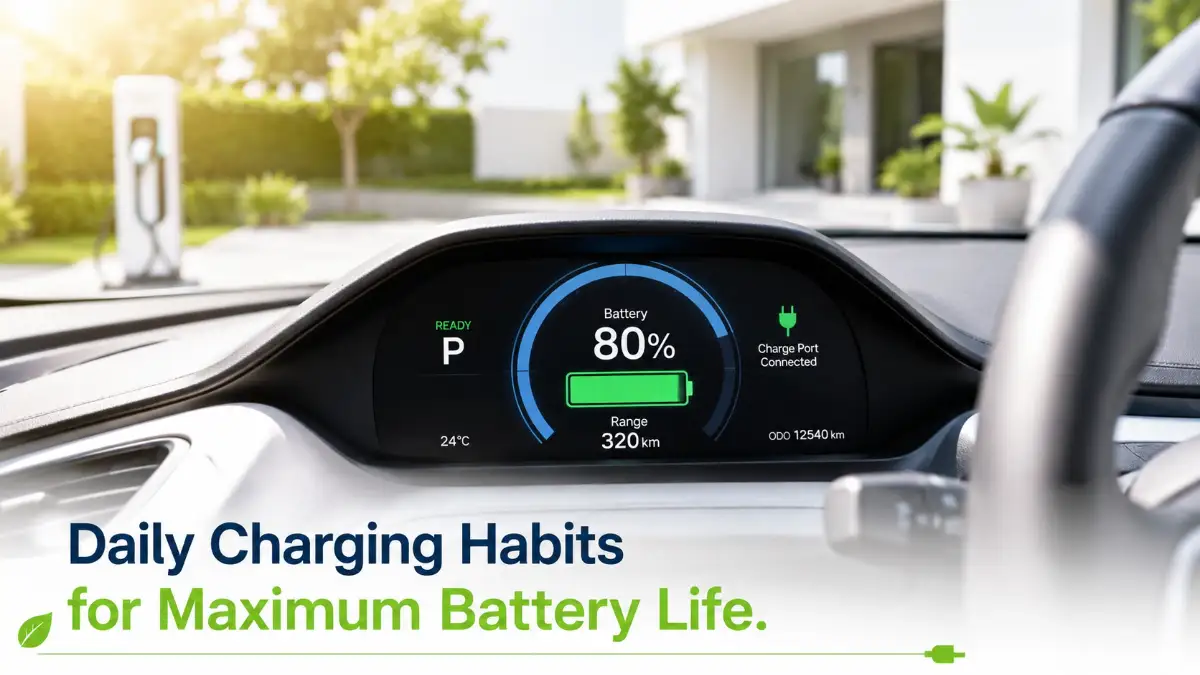
I highly recommend checking out our upcoming guide on Charging an Electric Car at Home: A Step-by-Step Setup Guide for First-Time Owners to see exactly how to set up these limits easily. For daily commuting, you should set your car's software to stop charging at 80%.
If you are just driving to work, picking up groceries, and coming home, you do not need a 100% charge anyway. You should only charge to 100% right before a long road trip when you actually need that maximum range. As soon as it hits 100%, you should get in the car and start driving to relieve that internal voltage pressure.
Here is a personal realization I had during my second month of ownership. I used to plug my car in every single time I parked in my garage, no matter what my battery level was. I quickly learned that constantly topping off from 75% back up to 80% multiple times a day is completely unnecessary. My pro tip is to just let the car drop down to around 40% or 30% over a few days before plugging it back in for a healthy, solid charging session.
Extreme Weather: Defending Against the Heat and Cold
Temperature is the silent enemy of battery health. You might notice that your cell phone shuts down if you leave it sitting in the hot sun at the beach. Your electric car reacts to temperature changes in a very similar way, just on a much larger scale.
When battery cells get too hot, the chemical reactions inside them speed up dramatically. This rapid chemical activity breaks down the internal structures much faster than normal. Parking your car on hot black asphalt under the blazing summer sun for days on end is a surefire way to reduce your maximum range over time.
Cold weather, on the other hand, does not permanently damage the battery in the same way, but it causes a temporary headache. Cold temperatures slow down the chemical reactions, making the battery sluggish. This is why your car might suddenly show 20% less range on a freezing winter morning.
To combat this, modern vehicles have built-in thermal management systems. These systems act like a heating and cooling blanket for the battery pack. They circulate liquid to warm the cells up in the winter and cool them down in the summer.
Watch this clear explanation of how extreme temperatures affect your daily driving range and what you can do about it.
Whenever possible, try to park your car in the shade or inside a garage during extremely hot days. If you know a freezing night is coming, leave the car plugged into your home charger. The car will pull electricity directly from the wall to keep the battery warm, rather than draining its own power to run the internal heaters.
The Truth About Fast Charging Stations
If you have taken a road trip, you have probably used a DC fast charger. These massive stations pump an incredible amount of electricity into your car in just 30 minutes. They are amazing for long journeys, but they should not be your everyday power source.
Pushing that much electricity into the battery creates a massive amount of heat very quickly. As we just discussed, heat is the main driver of battery degradation. While occasional fast charging is perfectly fine, doing it every single day will slowly chip away at your battery's total capacity.
You should rely on Level 2 AC charging at home or at work for your daily needs. This slower method pushes energy in gently, keeping the battery cool and relaxed. Save the fast chargers for when you are on the highway and need to get back on the road quickly.
Understanding Phantom Drain When Parked
Have you ever parked your car with 60% battery, gone away for the weekend, and come back to find it sitting at 55%? This unexpected loss of power is known as vampire drain or phantom drain. It happens because your car is never truly turned off.
An electric vehicle is basically a giant computer on wheels. Even when parked and locked, it is constantly running background tasks. It checks for software updates, monitors the security cameras, and runs the battery cooling pumps if the weather gets too hot.
All of these computer systems require a steady trickle of electricity to stay awake. If you open your mobile app repeatedly to check on the car while you are away, you are actually waking the car up from its deep sleep state. Every time it wakes up, it uses a little bit more power.
If you want to read more about separating the facts from fiction regarding range loss, check out Myth or Fact? The Ultimate Truth About EV Batteries Exposed. To minimize this phantom drain, turn off features like "sentry mode" or cabin overheat protection if your car is parked safely in your own garage. Try to avoid checking the app constantly when you leave the car at the airport for a week.
The Role of Regenerative Braking
One of the most unique features of driving on battery power is regenerative braking. When you take your foot off the accelerator pedal, the car feels like it is braking automatically. What is actually happening is that the electric motor runs in reverse, turning kinetic energy back into electricity.
This process feeds free energy back into your battery pack every time you slow down for a red light. It increases your daily range and heavily reduces wear on your physical brake pads. However, there is a small detail about battery health hidden within this feature.
When your battery is completely full at 100%, or when it is extremely cold outside, the car often disables or limits regenerative braking. The battery simply cannot accept that sudden rush of incoming energy when it is already stuffed full or freezing cold.
This is another great reason to follow the 80% daily charging limit. By leaving some empty space in the battery, you ensure that regenerative braking always has room to send that captured energy. You will enjoy a smoother driving experience and maximize your efficiency on city streets.
Smart Habits for Long-Term Storage
Sometimes life gets in the way, and you might need to leave your car sitting untouched for several weeks or months. How you prepare the car for this resting period makes a massive difference in its long-term health. You should never park an electric vehicle for a month with a nearly empty or completely full battery.
The ideal resting state for lithium-ion chemistry is right around 50%. If you know you are going away, try to drive the car until it hits the halfway mark. According to guidelines from Battery University regarding long-term storage, keeping cells at partial charge reduces voltage-related stress significantly.
Many modern vehicles have a specific storage mode you can activate in the settings menu. If yours does not, simply plug the car in and set the maximum charge limit to 50%. Leaving it plugged in allows the car to easily manage its own temperature and run computer updates without slowly draining itself to zero.
A battery that drains completely to 0% and sits empty for weeks can suffer permanent, irreversible damage. The internal cells can actually break down chemically, leading to a massive loss of capacity or a completely dead pack. By taking five minutes to adjust your charging limits before a long trip, you guarantee your car will be perfectly healthy when you return.
By understanding these basic physical realities, you take complete control of your vehicle. You stop worrying about every percentage point and start enjoying the smooth, quiet ride that made you buy the car in the first place. You do not need a degree in chemistry to keep your battery healthy; you just need to follow a few simple, logical habits every single day.
Taking Your Battery Care to the Next Level
Once you understand the basic rules of charging, you can start using a few advanced tricks to really protect your vehicle. These are the secrets that seasoned electric car owners use to keep their battery capacity nearly perfect for thousands of miles. It honestly feels like a fun little game once you get the hang of it.
The most powerful tool at your disposal is something called preconditioning. Think of your car battery like a human muscle before a heavy workout. If you jump out of bed and immediately start sprinting, you are probably going to pull a hamstring.
Your battery cells work the exact same way. If you force a freezing cold battery to suddenly push a heavy car down the highway, it causes a lot of internal chemical stress. To prevent this, you can tell your car's computer exactly when you plan to leave for work.
You simply open your phone app and set a scheduled departure time for 8:00 AM. The car will then pull electricity straight from your house to gently warm up the battery pack while it is still plugged in. By the time you sit in the driver's seat, the battery is at the perfect temperature and ready to perform effortlessly.
According to guidelines published by the Department of Energy on electric vehicle efficiency, using grid power to warm the cabin and battery is one of the smartest ways to preserve your daily range. You are not draining your actual battery to run the heater, which leaves more power for your commute.
The Hidden Connection Between Tires and Battery Health
Most people never think about their tires when they worry about battery degradation. However, your tire pressure has a massive, direct impact on how hard your battery has to work every single day. I learned this lesson the hard way during my first winter of driving an electric car.
When the weather gets cold, the air inside your tires compresses, and the pressure drops significantly. Driving on soft, underinflated tires creates a lot of extra rolling resistance on the road. The electric motors have to pull significantly more power from the battery just to maintain normal highway speeds.
This constant, heavy pull of electricity generates extra heat deep inside the battery cells. We already know that excess heat is the number one enemy of lithium-ion chemistry. By simply keeping your tires inflated to the manufacturer's recommended level, you dramatically reduce the daily strain on your battery pack.
Mastering the Art of Route Planning
If you want to understand Why Some Electric Cars Charge Faster Than Others and the Key Factors Behind It on long trips, it all comes down to software and route planning. Modern electric vehicles have incredibly smart navigation systems built right into the dashboard.
When you type a destination into the car's map, it does not just show you the fastest roads. It actually calculates the physical elevation, the outside weather, and the exact temperature of your battery pack. It uses all this data to figure out exactly where and when you should stop for power.
If it knows you are approaching a fast charging station in twenty miles, the car will automatically start cooling or warming the battery to accept the power perfectly. You should always use the built-in navigation for long trips, even if you already know the way. Giving your car's computer the ability to prepare itself reduces charging stress immensely.

The Heartbreaking Habits That Ruin Battery Life
It actually makes me sad when I see new owners treating their beautiful electric vehicles poorly simply because they do not know any better. I have a neighbor who treated his brand new electric truck exactly like his old gas guzzler. He would drive it around until the dashboard practically flashed zero percent, and then he would leave it sitting empty in his driveway overnight.
Doing this creates an incredible amount of stress on the delicate chemistry inside the floor of the car. When lithium-ion cells drop near zero, the voltage dips dangerously low. If you leave it sitting in that exhausted state for hours, you risk permanently damaging the capacity of the entire pack.
The financial cost of replacing a damaged battery is absolutely massive, often costing thousands of dollars. It is an entirely preventable tragedy. You just need to break the old habit of waiting for the warning light to come on before you plug in.
The Highway Fast Station Trap
Another incredibly common pitfall is treating fast charging stations as your daily power source. People often buy an electric car while living in an apartment without home charging, thinking they can just use the grocery store fast charger every single afternoon. This is a recipe for long-term battery anxiety.
I strongly suggest reading our upcoming post on Common EV Charging Mistakes That Can Slow Down Performance Over Time to fully grasp how damaging this can be. Shoving massive amounts of high-voltage electricity into the car every single day literally cooks the internal components.
The cooling pumps will run at maximum speed, sounding like a jet engine, but they can only do so much to fight the intense heat. Research from scientists studying battery longevity at the Argonne National Laboratory shows that continuous rapid charging accelerates the breakdown of the protective layers inside the cells.
If you constantly fast charge, you might notice your maximum range dropping noticeably after just a few tens of thousands of miles. Your car will start taking longer and longer to accept power because the battery management system is trying to protect the damaged cells. You end up stuck at charging stations longer, constantly worrying about your shrinking range.
Ignoring the Warning Signs of Overheating
Electric vehicles are very good at protecting themselves, and they will explicitly tell you when they are suffering. Sometimes, after a long drive on a blistering summer day, your dashboard might display a small warning about reduced power. Many drivers simply ignore this message and continue flooring the accelerator pedal.
When the car limits your power, it is desperately begging you to let it cool down. Pushing the vehicle hard when the battery is already extremely hot forces the cells past their safe temperature thresholds. It is like forcing a runner to sprint uphill in the desert when they are already exhausted and dehydrated.
If you see a temperature warning, just slow down and drive gently for a few miles. Give the internal liquid cooling system a chance to catch up and pull the heat away from the pack. Ignoring these simple warnings is a guaranteed way to shave years off your vehicle's lifespan.
Your Simple Roadmap for a Healthy Electric Vehicle
At the end of the day, managing your electric car should not feel like a stressful part-time job. The entire point of this amazing technology is to make your life easier, quieter, and more efficient. Once you build a few basic routines, taking care of the car becomes completely second nature.
You do not need to obsess over every single percentage point on your dashboard. Just remember to set your daily limit to a comfortable level and plug the car in when you park at home. Treat the battery with a little bit of respect, avoiding extreme heat and freezing cold starts whenever you easily can.
Let the car's incredibly smart software do the heavy lifting for you. Use your scheduled departure times to keep things warm, and trust the built-in navigation when you hit the open highway. If you follow these basic, logical steps, your battery will likely outlast the actual car itself.
It is time to completely let go of that heavy range anxiety. You are now equipped with the knowledge to drive confidently, knowing you are preserving the heart of your vehicle.
I know the switch to electric driving feels a bit overwhelming at first, but I promise it gets incredibly easy and incredibly fun. Just plug in when you get home, trust your car's computer, and enjoy the amazing, silent ride ahead!
Questions People Constantly Ask About EV Batteries
Does charging my car every single night cause damage?
No, it actually does the exact opposite! Plugging your car in every night is the healthiest thing you can do, as long as you have the charge limit set to around 80%. Small, frequent charging sessions are much better for the battery chemistry than deep, massive recharges.
Should I ever charge my electric vehicle all the way to 100%?
Yes, you absolutely can and should charge to 100% right before you leave for a long road trip. The trick is to just start driving shortly after it reaches full capacity. You just want to avoid letting the car sit parked in your garage for days with a completely stuffed battery.
How much range will I actually lose over the years?
Most modern electric vehicles lose only a very tiny fraction of their capacity, usually around a few percentage points over several tens of thousands of miles. If you follow the daily habits we discussed, the degradation happens so slowly that you will barely even notice it in your daily life.
Is it completely safe to leave my car unplugged for a week while on vacation?
It is safe, but it is definitely not ideal for long-term health. The car will slowly drain power to keep its computers running, which could push the battery dangerously low if you are gone for a long time. It is always better to leave it plugged in and set to a 50% limit while you travel.
Does driving fast on the highway ruin my battery pack?
Driving fast does not ruin the battery, but it does drain your energy incredibly quickly due to wind resistance. High speeds require a lot of sustained power, which can heat the battery slightly, but the car's cooling system easily handles this. Just be prepared to stop for a charge much sooner if you have a heavy foot on the highway.
Disclaimer: The information provided in this article is for educational and informational purposes only. I am not a certified automotive mechanic or a battery engineer. Every electric vehicle manufacturer has specific guidelines and software systems. Always consult your vehicle's official owner's manual or contact your dealership for specific advice regarding your exact car model's maintenance and charging requirements.
About the Author
Munira Parveen is a dedicated Digital Content Strategist and Lead Researcher with a passion for simplifying complex topics. From navigating personal finance and emerging tech trends to uncovering the best practical lifestyle solutions, she spends her time analyzing data to bring readers highly accurate, actionable, and easy-to-understand guides. Her ultimate goal is to empower everyday people to make smarter, more informed decisions in this fast-paced digital world.